
In Lesson 120, we looked at how operating income changes when revenue grows. But even when profit grows, the cash a company can actually use may be less than you expect.
That is because money is needed to buy equipment to make more products, to build up inventory before selling to customers and to wait for customers to pay.
When does the money for capital spending go out?
Spending on assets that a company will use for several years, such as equipment or factories, is called capital expenditure (capex), or capital spending. It can go toward replacing worn-out equipment or toward increasing production capacity.
The time when the company pays for equipment can differ from the time when the cost shows up in the income statement. When equipment is used for several years, its purchase cost and similar amounts are recorded as an expense spread over its useful life. This is called depreciation. The amount recorded each year depends on the calculation method, the useful life and the value the asset is expected to have left at the end.
Suppose a hypothetical company pays $100,000 in cash this year to buy equipment, and its depreciation for the year, including on equipment it already owns, is $50,000. The two amounts do not have to match in the same year. The $50,000 is the amount recorded as an expense this year, and the $100,000 is the cash paid this year to buy equipment.
Carry forward the equipment left on the books
Book value is the amount at which an asset is recorded in the company's accounts. For example, if equipment has a book value of $400,000 at the start of the year, the company acquires $100,000 of new equipment during the year and depreciation is $50,000, then with no other changes the book value at the end of the year is $400,000 + $100,000 − $50,000 = $450,000.
Suppose the same hypothetical company keeps investing in equipment in later years. This forecast assumes no other changes, such as sales of equipment or impairments (write-downs in value).
| Item | Year 1 | Year 2 | Year 3 |
|---|---|---|---|
| Equipment book value at start of year | $400,000 | $450,000 | $510,000 |
| New equipment acquired | $100,000 | $120,000 | $140,000 |
| Depreciation | $50,000 | $60,000 | $70,000 |
| Equipment book value at end of year | $450,000 | $510,000 | $580,000 |
For year 2, the end-of-year book value is $450,000 + $120,000 − $60,000 = $510,000. This table is an example that shows how the calculation is structured. In practice, depreciation has to be estimated separately, based on things such as when new equipment starts being used and how much of the existing equipment's life remains.
Growing revenue can also tie up money
Money the company is owed for products it has sold but not yet been paid for is accounts receivable. Products it has made in advance are inventory, and money it owes for materials and other purchases that it has not yet paid is accounts payable.
Let's keep it simple and combine just these three items: accounts receivable + inventory − accounts payable. When you calculate working capital in practice, you can include other operating items as well, depending on your purpose.
| Item | Start of year | End of year |
|---|---|---|
| Accounts receivable | $100,000 | $150,000 |
| Inventory | $120,000 | $140,000 |
| Accounts payable | $80,000 | $110,000 |
| Total of the three items | $140,000 | $180,000 |
At the start of the year, the total is $100,000 + $120,000 − $80,000 = $140,000, and at the end of the year it is $150,000 + $140,000 − $110,000 = $180,000. That is an increase of $40,000. All else being equal, the money not yet collected and the money put into inventory grew by more than the amount not yet paid, so more cash became tied up in the business.
You need to check separately whether these items grew because revenue grew, or because customers are paying later or inventory is not selling.
Start from profit and work out the cash left over
We assumed that the hypothetical company in Lesson 120 earns operating income of $170,000 in year 1. This time, assume that this profit already includes $50,000 of depreciation as an expense, and that a hypothetical tax rate of 25% applies to operating income. To keep things simple, assume there are no other non-cash expenses or changes in other operating assets and liabilities, and that taxes and payments for equipment are paid in cash in the same period.
Operating income after tax is $170,000 × (1 − 25%) = $127,500. Add back the $50,000 of depreciation already deducted as an expense, then subtract the $40,000 increase in the three items calculated above and the $100,000 paid for equipment, and you get $37,500.
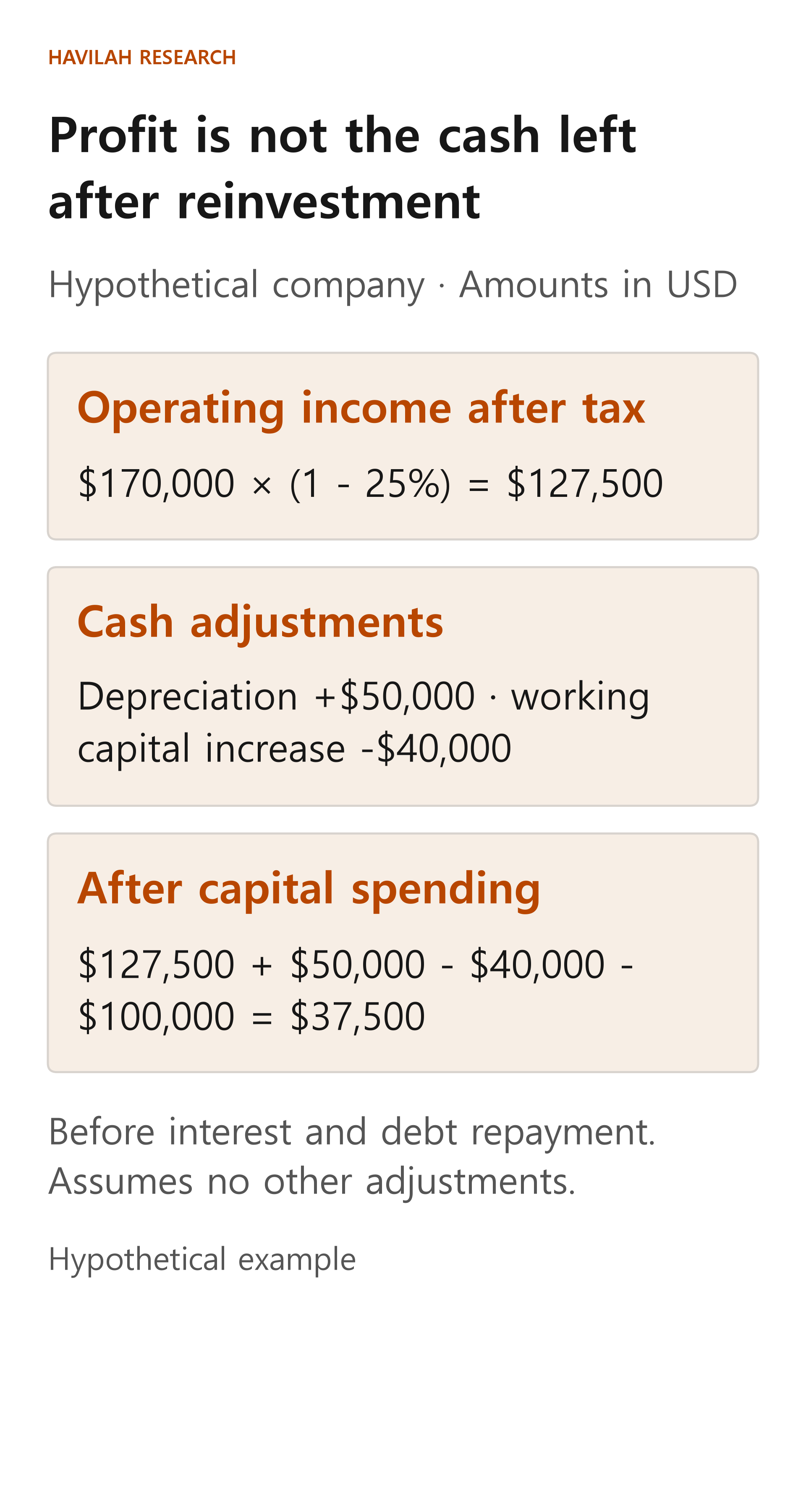
This amount is a simple estimate of the cash the business has left after taxes and reinvestment, before financing items such as interest payments and debt repayment. Do not treat it as money that can be paid out to shareholders right away. A real calculation also needs to consider other non-cash items and the timing of taxes, working capital and investment spending.
Some companies separately report the amount left after subtracting what they spent on equipment from the cash generated by operating activities. If interest payments and similar items are already reflected in that operating cash, the figure cannot be treated as the same as the cash before financing that we calculated above. Check which items the company has included.
What should you check before investing?
As the business grows, look at how much the company spends to maintain its existing equipment and how much it spends on new businesses. If the company does not disclose these two kinds of spending separately, it is hard for an outsider to split them accurately.
Depreciation alone does not tell you how much the company paid for equipment this year, and growth in revenue alone does not prove that cash has grown. If you put your revenue and profit forecasts side by side with capital spending and changes in inventory and receivables, you can think more realistically about the money growth requires.