
Two companies both grew their revenue by 20%. One company's profit rose sharply, but the other's actually fell. Why?
Because the cost of making their products and the cost of running the business changed differently while revenue was growing.
First, subtract the cost of sales from revenue
Revenue is the income a company records from selling its products. The cost of making or buying the products it sold, along with similar costs, is called the cost of sales (or cost of goods sold). Revenue minus the cost of sales is gross profit. The time when revenue and costs are recorded can differ from the time when cash is actually received or paid.
Suppose a hypothetical company records revenue of $1 million and a cost of sales of $600,000 in a year. Gross profit is $1 million − $600,000 = $400,000. Gross margin is gross profit as a percentage of revenue, so it is $400,000 ÷ $1 million × 100 = 40%.
That is not the end of it. You also need to consider the costs of selling the products and running the company. Selling, general and administrative expenses, or SG&A for short, can include items such as advertising and the cost of running offices. Check the company's filings to see how it actually classifies its costs.
If this hypothetical company's SG&A is $300,000 and it has no other operating expenses, operating income is $400,000 − $300,000 = $100,000. Operating income is not the same as net income, which also takes interest, taxes and other items into account.
Costs that grow with sales and costs that stay the same for now
Some costs rise as sales volume rises. For example, each additional product the company makes needs more materials. Other costs stay the same within a certain range: the company may pay the same office rent even as sales grow.
Costs that change with sales or production like this are called variable costs, and costs that do not change much within a certain range and period are called fixed costs. Fixed costs are not fixed forever. They can change if the company runs out of space and rents a new site, or when a contract is renewed. Some real costs also have a mix of both characteristics.
Calculate what happens when revenue grows
For the hypothetical company above, assume the cost of sales is 60% of revenue. SG&A consists of $250,000 that the company spends regardless of revenue, plus costs equal to 5% of revenue. There are no other operating expenses, and these assumptions hold only while revenue is between $800,000 and $1.4 million.
| Item | Base year | Forecast year 1 | Forecast year 2 |
|---|---|---|---|
| Revenue | $1 million | $1.2 million | $1.4 million |
| Cost of sales | $600,000 | $720,000 | $840,000 |
| Gross profit | $400,000 | $480,000 | $560,000 |
| SG&A | $300,000 | $310,000 | $320,000 |
| Operating income | $100,000 | $170,000 | $240,000 |
Gross profit in year 1 is $1.2 million − $720,000 = $480,000. SG&A is the fixed $250,000 plus $60,000, which is 5% of revenue, for a total of $310,000. So operating income is $480,000 − $310,000 = $170,000.
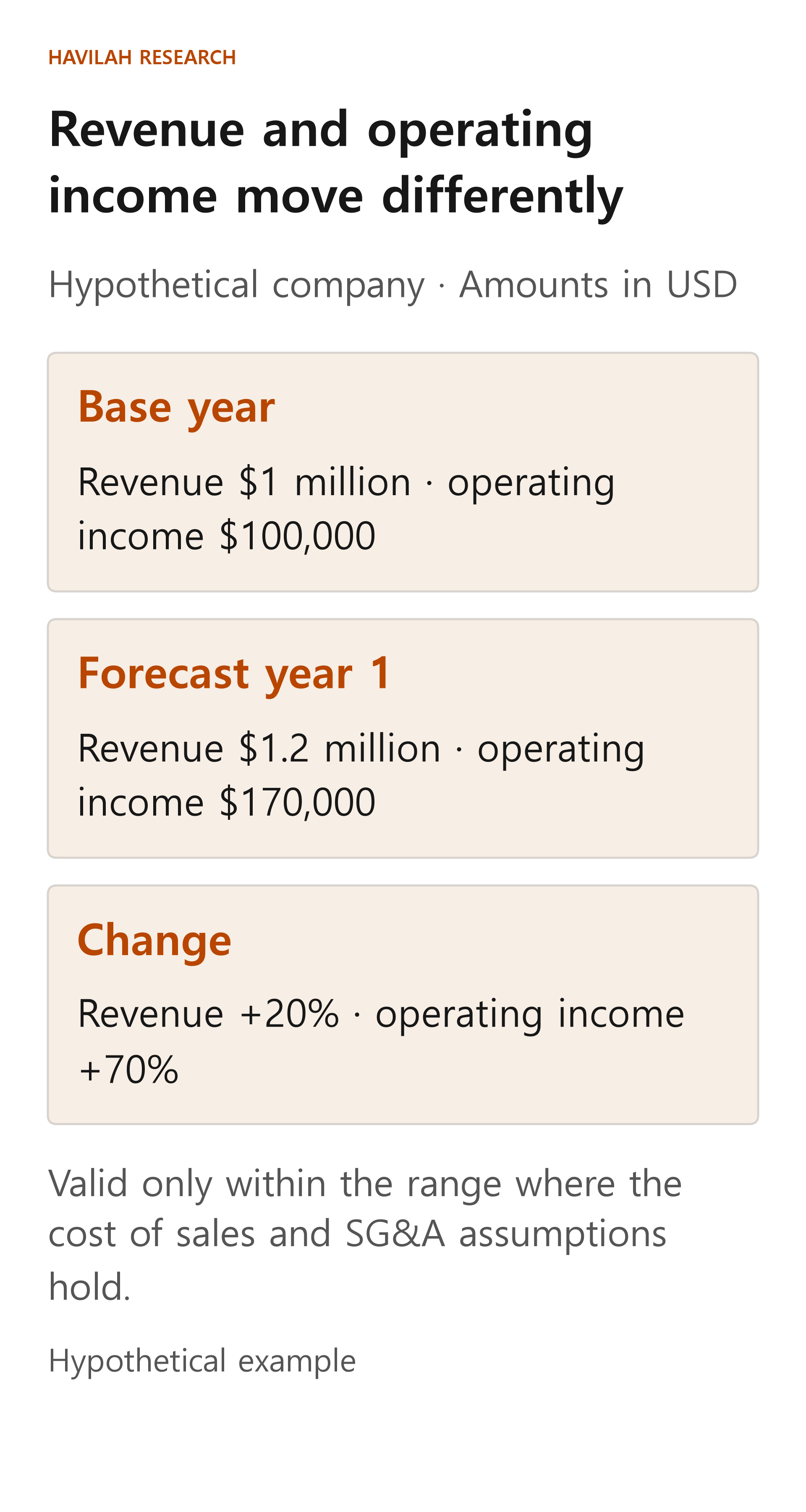
Revenue grew 20%, from $1 million to $1.2 million, but operating income grew 70%, from $100,000 to $170,000. In this hypothetical case, that is because the fixed costs stayed the same while the money left over from revenue after the cost of sales and variable SG&A increased.
What if revenue falls instead?
Under the same cost assumptions, if revenue falls to $800,000, the cost of sales is $480,000 and gross profit is $320,000. SG&A is $250,000 + $40,000 = $290,000, so operating income is $30,000.
Just as profit can grow quickly when revenue rises because fixed costs stay the same, profit can also fall more quickly when revenue drops because the fixed costs still have to be paid. The effect of this kind of cost structure on changes in profit is called operating leverage. In practice, though, how profit changes depends on many conditions, including prices, costs and production capacity.
If margins change, so does the answer
Suppose revenue is still $1.2 million, but costs rise so that the gross margin is 30% instead of 40%. Gross profit is $1.2 million × 30% = $360,000. If SG&A is $310,000 as assumed earlier, operating income is $50,000. Even though revenue has grown, that is less than the base year's operating income of $100,000.
As this shows, if you simply apply past margins to the future, you can miss price cuts or rising costs. Look at how the product mix, raw material prices, labor costs, advertising spending and the cost of adding production capacity are likely to change.
In many real income statements, fixed and variable costs are not clearly separated. Keep the numbers you confirmed in the filings apart from the assumptions you estimated yourself, and do not fill in costs you cannot know as if they were established facts.
Adding margin and cost assumptions to a revenue forecast lets you think through operating income. Next, we will look at the investment and cash a company needs to keep growing like this.