
When you hear that an industry is growing fast, it can feel as if every company in it will grow too. But even when a market expands, one company's revenue can shrink if its customers move to competitors.
This difference is easier to understand if you separate the growth of the market as a whole from the share the company takes within it.
The market can grow while your share shrinks
Market size is the total value of sales of a given range of products in a given region over a given period. Market share is the percentage of the market's sales that a particular company accounts for.
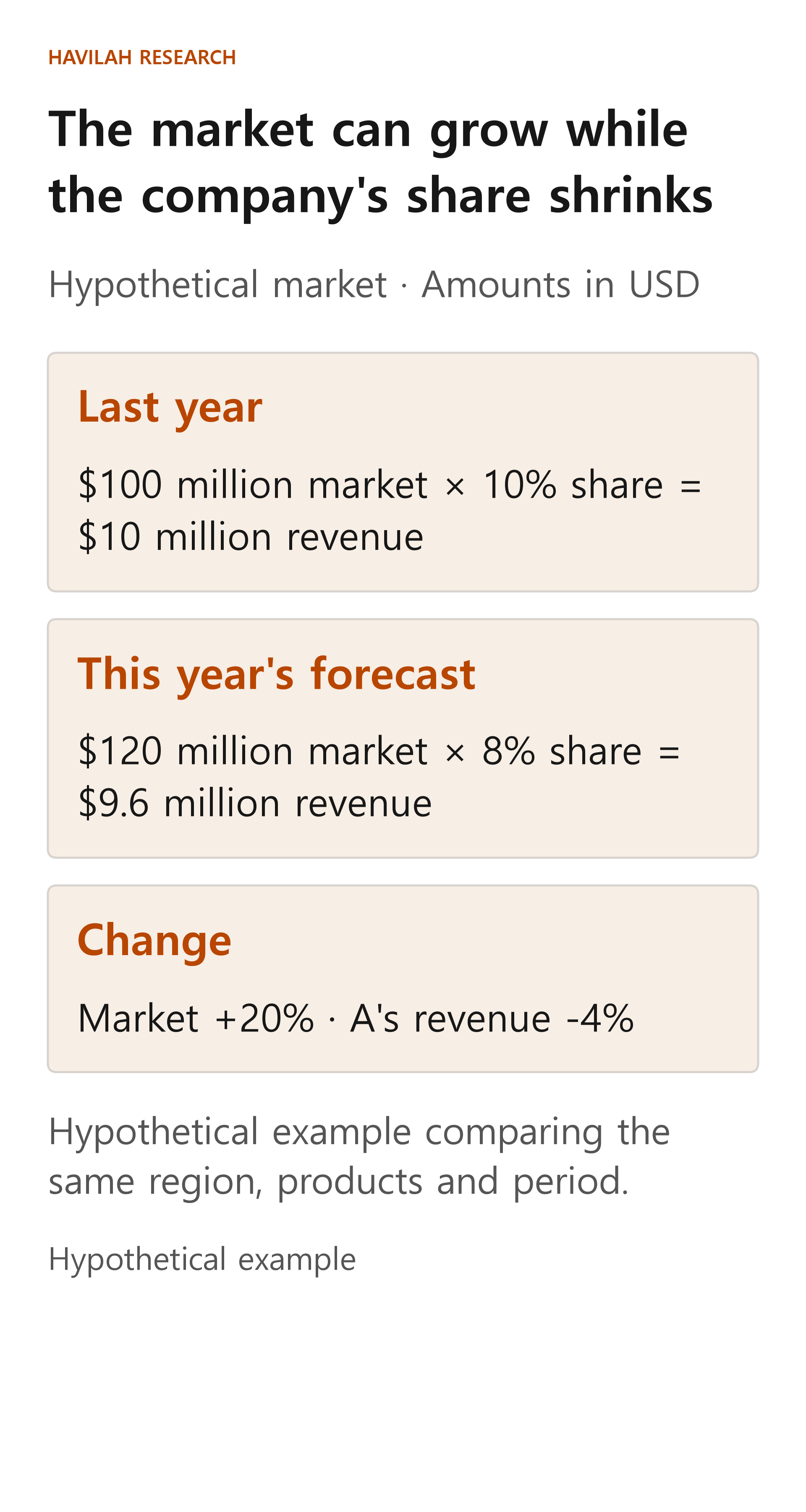
Suppose that in a hypothetical device market, total sales last year were $100 million and hypothetical Company A's revenue was $10 million. A's market share was $10 million ÷ $100 million × 100 = 10%.
Now assume the market grows 20% this year to $120 million, but A's share falls to 8%. A's forecast revenue is $120 million × 8% = $9.6 million. Even though the market has grown, A's revenue is $400,000, or 4%, lower than last year's $10 million.
A falling market share can have many causes, such as a competitor's new product or price cuts, or a change in customers' tastes. Rather than jumping to conclusions from the numbers alone, look at the businesses of both the company and its competitors.
Start by defining the market you compare against
What happens if you calculate the market share of a company that sells a particular device in the United States, but use worldwide sales of all electronics as the denominator? You end up dividing by a number far larger than the market the company actually competes in.
First fix the same products, the same region and the same period, then compare the company's revenue with total market sales within that scope. If the company has several businesses, use only the revenue of the business you are interested in. When you compare amounts, also try as far as possible to use the same currency and the same treatment of discounts, returns and similar items.
Different market studies include different products and use different methods, so their numbers can differ. If you mix a market size and a company's revenue measured on different bases, the market share will be distorted. If you cannot confirm the exact scope, note that the figure is an estimate with that limitation.
Check whether the company can supply that much
In the hypothetical case above, assume Company A's average selling price is $10 per unit, so to reach $9.6 million in revenue it must sell 960,000 units in the same year.
But if it can make at most 800,000 units that year and has no inventory from earlier, then even if it sells them all and meets the conditions for recognizing revenue that year, its revenue is 800,000 units × $10 = $8 million. That is $1.6 million less than the $9.6 million calculated earlier.
In this case, if you keep assuming a $120 million market, A's market share by revenue is $8 million ÷ $120 million × 100, or about 6.7%. So if you build in the supply limit and at the same time assume A keeps an 8% share, the two numbers do not fit together.
The size of the whole market can also change depending on whether other companies can make up the shortfall. To keep the comparison simple, we assumed here that other sellers fill the gap and the market size stays the same. Check not only production capacity but also inventory, the supply of components and when products are actually delivered to customers.
Look at what it costs to win market share
If a company cuts prices to defend its market share, its sales volume may rise, but the money it keeps on each product can shrink. On the other hand, if it holds its prices, it may be able to keep its profitability, but it could lose some customers.
Rather than treating a higher market share as a good result in itself, look at it together with revenue and operating margin. When market size is measured in money, price changes are included in it. Where possible, check separately how much came from selling more units and how much from higher prices.
Compare your forecast with actual results
When you begin your analysis, record where your market size and market share figures come from, and the period and scope they cover. Also note whether the market outlook is optimistic, whether the company has reasons to expect to hold its share and whether it can actually supply the volume.
When results are released, check whether the gap came from your market forecast or your forecast for the company. Your next judgment will differ depending on whether the market itself grew less than expected, the company lost share to competitors or production or deliveries were delayed.
Hearing that an industry is growing is only the start of the analysis. To forecast a company's revenue, you also need to consider the share of that market it can win and how much it can actually sell.