
"I think this company will grow 20% a year from now on."
It sounds plausible, but before you can use it in an investment decision, you need to ask one more question: what has to increase for revenue to grow 20%?
Is the company gaining customers, can it raise its prices, or is a new business adding revenue? The answer changes which information you need to check and the reasons your forecast could turn out wrong. Before trying to predict the future, let's look at how the numbers are produced.
Start by reviewing past results on the same basis
Write the company's revenue and operating income for the last few years in a table. Look at the years when revenue grew quickly, and check whether operating income grew along with it. If a year included one-time income or the sale of a business, mark it separately.
Keeping periods and units consistent also matters. If you compare a full year of results directly with 3 months of results, or mix dollars with millions of dollars, the changes will look wrong. Take care, too, when comparing companies whose fiscal years end on different dates.
A past growth rate is a starting point, not a promise that it will repeat in the future. If customer growth has slowed or competition has become tougher, your forecast needs to reflect those reasons.
Break revenue into the numbers that produce it
Consider a hypothetical company that sells a subscription service. Assume every customer pays the same annual fee and that there are no discounts, add-on products or refunds. The fee is recorded as revenue in proportion to the period in which the service is provided. For example, the revenue from a customer who used the service for only half a year is half the annual fee. In the base year, the company has an average of 1,000 customers over the year, and the annual fee per customer is $120.
Annual revenue is 1,000 customers × $120 = $120,000.
Now suppose that next year the average number of customers is 1,100 and the annual fee becomes $130. Revenue is then 1,100 customers × $130 = $143,000. Revenue grows by (143,000 − 120,000) ÷ 120,000 × 100, or about 19.2%.
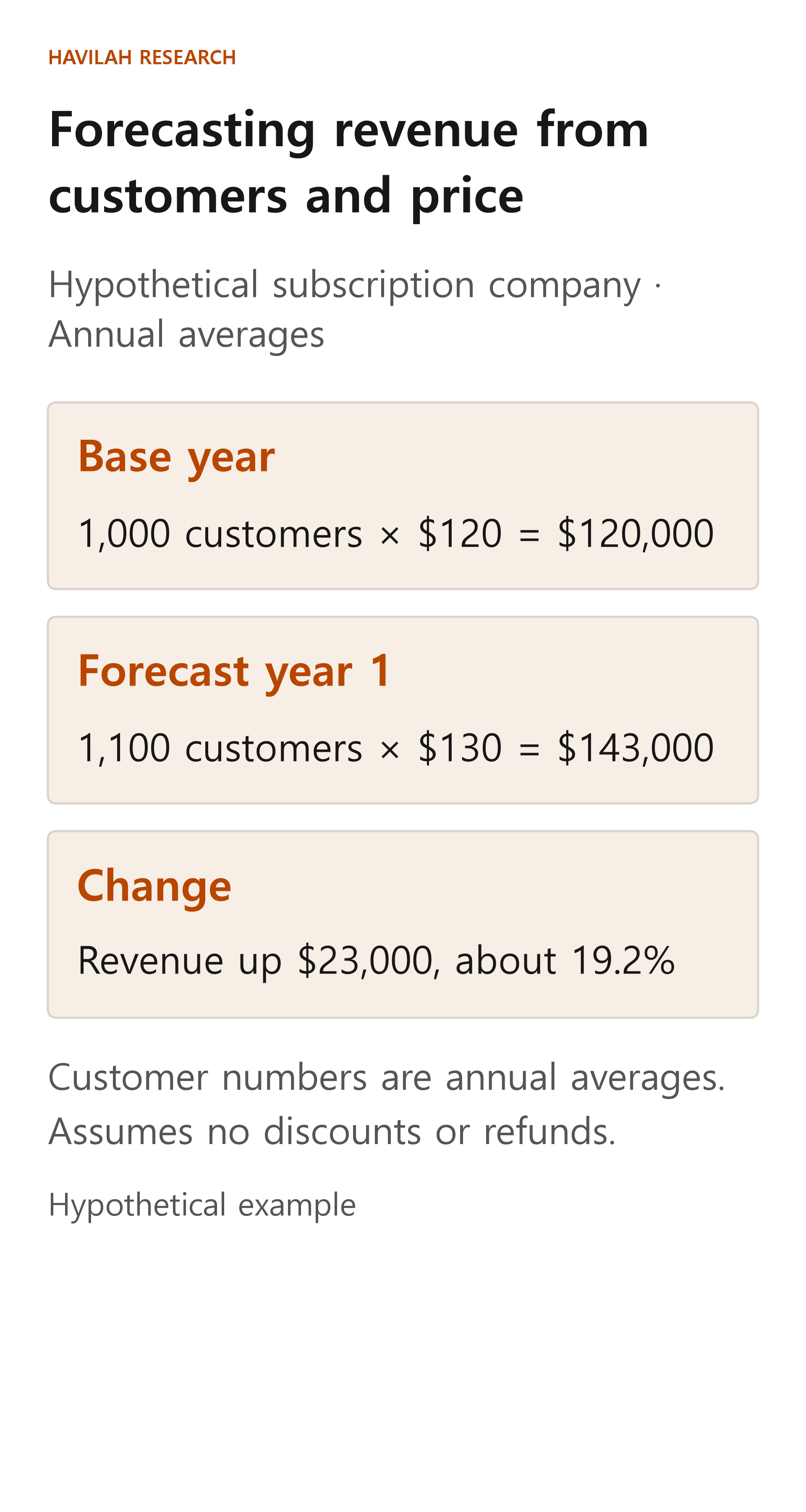
The important number here is not just 19.2%. You also need to see the assumptions behind it: the company has to gain 100 customers and raise the annual fee by $10. The number of customers at the end of the year can differ from the average number during the year. Real companies also have free users, customers who cancel partway through, discounts and several pricing plans, so this simple calculation may not hold exactly.
Carry the calculation forward three years
For the same hypothetical company, assume the average number of customers grows 10% each year over the previous year, and the annual fee is $130 in the first year, $135 in the second year and $140 in the third. The numbers below are not a forecast for any real company.
| Item | Base year | Forecast year 1 | Forecast year 2 | Forecast year 3 |
|---|---|---|---|---|
| Average customers for the year | 1,000 | 1,100 | 1,210 | 1,331 |
| Annual fee per customer | $120 | $130 | $135 | $140 |
| Annual revenue | $120,000 | $143,000 | $163,350 | $186,340 |
For example, revenue in year 2 is 1,210 customers × $135 = $163,350. When you move the table into a spreadsheet, enter the number of customers and the fee in separate cells and multiply them in the revenue cell. Then check that the result changes when you change an assumption.
A revenue forecast alone does not tell you the profit. If the hypothetical operating margin in year 1 is 20%, operating income is $143,000 × 20% = $28,600. This is not net income, which also reflects interest, taxes and other items. If the advertising spending needed to win customers or the cost of running the service rises, the margin can change.
Put the company's outlook next to your own assumptions
Companies sometimes publish an outlook for their future revenue or profit. You can use it to understand the company's goals and how management sees the business. But an outlook is an estimate based on the information available now, so actual results can differ from it.
If the company plans to raise prices, ask whether its customers will accept the higher price. If it expects the number of customers to grow, look at how many new customers it may gain and how many existing customers may leave. Anything the company does not explain should remain an unconfirmed assumption.
What changes if the forecast misses?
If you settle on a single number, it is hard to know how much changes when you are wrong. Let's calculate another possibility for the first year. If the average number of customers is 950 and the annual fee stays at $120, revenue is 950 customers × $120 = $114,000. That is $29,000 less than the $143,000 forecast earlier.
This, too, is only a hypothetical calculation for exploring possibilities. It does not tell you how likely it is to happen. When customer numbers fall, prices and costs can change as well, so check that your assumptions fit together.
After the earnings release, put your forecast and the actual results side by side and see where the gap came from. Checking whether there were fewer customers than expected, whether prices were different or whether costs rose helps you improve your next judgment.
A good forecast does not begin with promising an exact number. It begins with laying out the assumptions that drive revenue and profit, and deciding in advance what information would make you change your view.