
One company's stock trades at 30 times its current earnings, while similar companies trade at 10 times. Is the company with the higher price automatically expensive?
It may be, but it may also be that investors expect it to grow faster and to earn high profits for longer. What matters is checking whether growth large enough to explain the high price is actually possible, and how much the company has to invest to achieve that growth.
A high price carries expectations about the future
Valuation means estimating what a company is worth, or comparing its current price with figures such as earnings or revenue. Even two companies with the same earnings can command different prices from investors if the money they will earn in the future and their risks are different.
For example, a company whose customer base keeps growing and that can keep high margins for a long time may be given a high multiple. But a high multiple is not, in itself, evidence of growth. If competition gets tougher or customers leave, expectations can change.
To judge whether a high multiple is reasonable, you need concrete numbers rather than the single phrase "it will grow." Think step by step about how much the company needs to grow and for how many years, what margin will be left at that point, and how much money the process will take.
Revenue can grow while profits shrink
Suppose a hypothetical company had revenue of $1 million last year and an operating margin of 20%. Its operating income was $1 million × 20% = $200,000.
This year, revenue grew to $1.2 million, but if the operating margin fell to 10%, operating income is $1.2 million × 10% = $120,000. Revenue rose by ($1.2 million − $1 million) ÷ $1 million × 100 = 20%, but operating income fell: ($120,000 − $200,000) ÷ $200,000 × 100 = −40%.
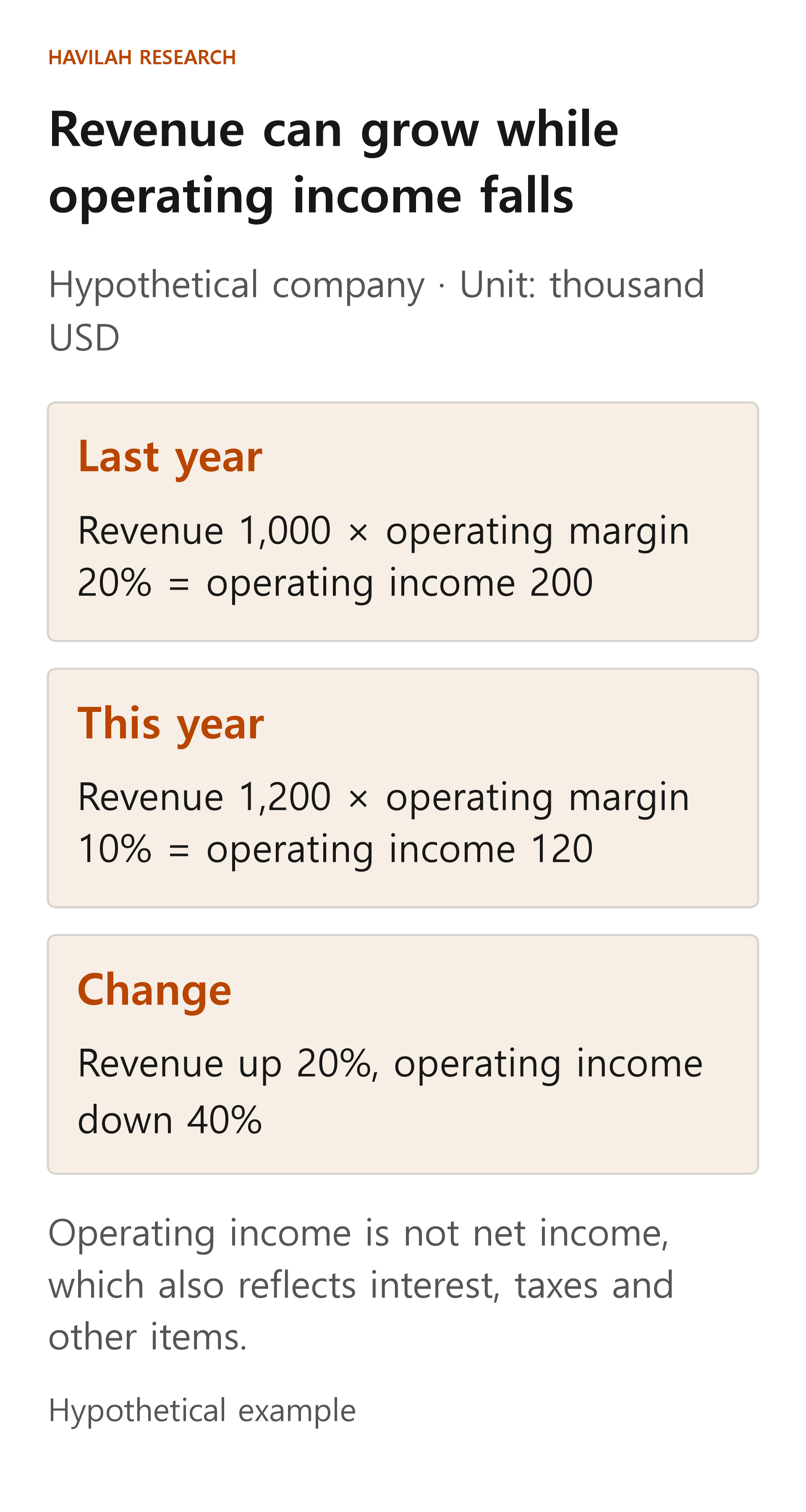
This example alone does not tell you why the margin fell. There are many possibilities, such as selling at a discount, rising costs or the expense of a new business. You need to check the company's explanation and its actual costs. Operating income is also different from net income, which reflects interest, taxes and other items.
How much has to be put back into the business to grow?
Winning new customers may require advertising, and producing more may mean building factories or buying equipment. You can think of the money a company earns and then puts back into the business in this way as reinvestment.
Suppose two hypothetical companies each generated $1.2 million in cash from operating activities over the same period. Company A spent $900,000 on equipment and Company B spent $400,000. If you simply subtract this equipment spending from the operating cash flow, A has $300,000 left and B has $800,000. This calculation does not take into account later cash flows, such as other investments, financing, dividends and debt repayment.
EBITDA, which we looked at in Lesson 114, is a measure that adjusts accounting profit, so it is different from the cash that actually came in and went out through operating activities. Cash flow can also vary with money not yet collected from customers, changes in inventory and similar items.
A company that spent heavily on equipment in a particular year is not necessarily a bad company. The new equipment may be needed to produce higher profits in the future. On the other hand, a company that invests little may have plenty of cash left for now, but if it has neglected aging equipment, a large expense may come later. Look at the purpose of the spending together with the results over several years.
Return on invested capital, or ROIC, is a measure of how much after-tax operating profit a business produces from the capital put into it. The scope of the calculation and the way average capital is used vary from source to source, so make sure the definitions match before you compare. Ask not only whether revenue is growing quickly, but also whether the additional money invested is earning an adequate return.
How long can the growth last?
A company that grows quickly for just a single year and one that can keep growing for many years have different futures. Check whether the market leaves room for the customer base to keep growing, whether competitors make similar products and whether the company can hold its prices. How long the company can keep up its growth rate matters as much as how high that rate is.
When interest rates or the return investors require change, the value placed today on money to be earned far in the future can change as well. But you cannot predict that a particular share price will definitely move in a particular direction just because interest rates have risen.
Also check what each share gets
If a company issues new shares as it grows, the percentage of the company that existing shareholders own can fall. Even if the company's total earnings rise, if the number of shares rises faster, the growth in earnings per share can become smaller or turn into a decline.
So check not only the total size of revenue and earnings but also how the number of shares changes. Also look at whether stock-based compensation or convertible securities could affect the number of shares in the future.
When you examine a high valuation, it helps to set four things side by side: how large the growth is and how long it lasts, the margin that remains, the reinvestment required, and what each share gets. If any one of them turns out weaker than expected, you may need to rethink the current price. Even if all of your assumptions are right, a return is not guaranteed.