
Suppose you are comparing two companies that rely heavily on factories and machinery. Their enterprise values and operating results look similar, but one of them may need far more money in the future to replace aging equipment.
In a case like this, rather than looking at a single profit figure, it helps to set the numbers before and after depreciation side by side. That makes the difference easier to find.
Why compare EV with earnings?
You learned about enterprise value (EV) in Lesson 110. It is a measure of the price of the business: you take the market value of the shares, add financial borrowings and similar items, and subtract cash and similar items. A real calculation also needs rules for preferred shares, non-controlling interests, leases, restricted cash and so on.
EV/EBIT is EV divided by EBIT. EBIT means earnings before interest and taxes. It is sometimes used much like operating income, but the two may not be exactly the same, depending on items such as the company's non-operating gains and losses, so check what actually went into the calculation.
EV/EBITDA is EV divided by EBITDA. You can think of EBITDA as EBIT with depreciation and the amortization of intangible assets added back. Depreciation is the accounting treatment that spreads the purchase cost of an asset used for several years, such as a machine or a building, over the period it is used, taking into account things like the value it is expected to have left at the end.
The two ratios have one thing in common: both compare EV, the value of the business, with earnings before interest is paid. But you cannot conclude that a stock is necessarily cheap just because one of these multiples is low, because businesses can differ in growth, risk and the investment they need.
Same EBITDA, different EBIT
Hypothetical Company A and Company B each have an EV of $10 million in the same year and annual EBITDA of $2 million. Assume that neither company has differences such as non-operating gains or losses, so that EBIT equals operating income in the calculation below.
| Item | Company A | Company B |
|---|---|---|
| EV | $10 million | $10 million |
| Annual EBITDA | $2 million | $2 million |
| Annual depreciation and amortization (D&A) | $400,000 | $1.2 million |
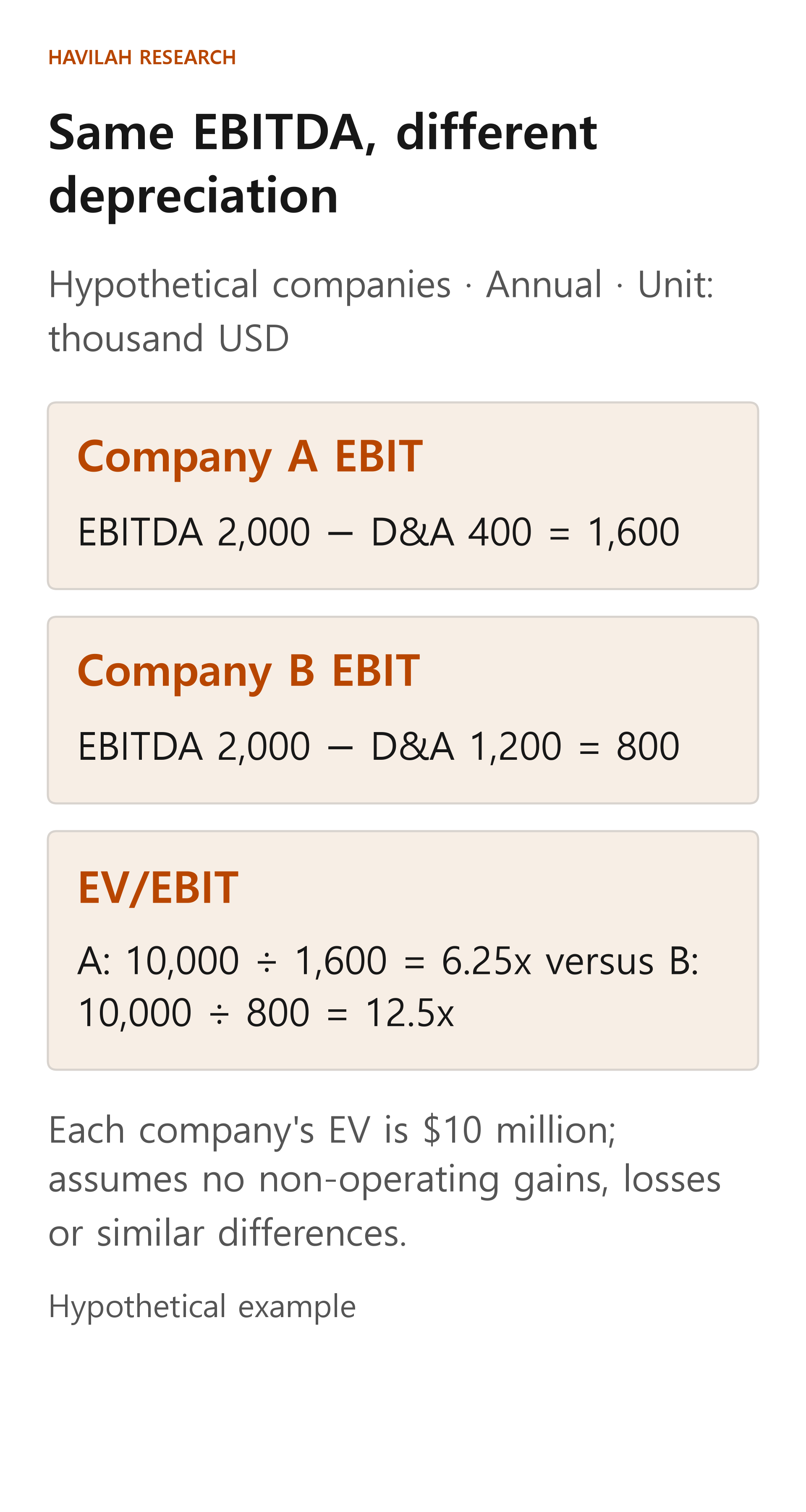
EV/EBITDA is $10 million ÷ $2 million = 5x for both companies. But Company A's EBIT is $2 million − $400,000 = $1.6 million, while Company B's is $2 million − $1.2 million = $800,000.
If you calculate EV/EBIT, A comes to $10 million ÷ $1.6 million = 6.25x and B to $10 million ÷ $800,000 = 12.5x. A difference that stayed hidden when you looked only at the identical EV/EBITDA now shows up.
Why does depreciation matter?
For example, when a company spends cash to buy a machine, that cost can show up in the accounts as depreciation spread over several years. The depreciation recorded this year and the cash actually spent on buying machines this year are different numbers.
That does not mean you can ignore depreciation. Machines that have been used for a long time have to be replaced or repaired. EBITDA does not directly show how much money will actually be needed to replace that equipment in the future. Also check the age of the assets, the cost of replacing them and the company's investment plans.
Even when depreciation is large, you cannot assume that future investment spending will be exactly the same amount. The amount needed also changes depending on whether the company has already invested in new equipment, whether prices have changed and whether it is expanding the business.
EBITDA is not cash in the bank
A company may have recorded revenue without having collected the money from its customers yet. The timing of building up inventory or paying suppliers also affects cash flow. EBITDA does not include these changes, and it leaves out the cash spent on equipment, interest and taxes.
So EBITDA of $2 million does not mean the company has received $2 million in cash that it could hand out to shareholders. Look at the cash flow statement, investment spending and the debt repayment schedule as well.
The "adjusted EBITDA" that companies report sometimes adds further items to, or subtracts them from, basic EBITDA. Because the adjustments can differ from company to company, check the list of adjustments in the company's materials together with its earnings under the accounting standards.
What to check when comparing
First, check whether the debt and cash included in EV are measured on the same basis, and whether the earnings are actual figures or forecasts for the same period. Then look at the differences in depreciation and amortization, capital spending and cash flow. If EBIT or EBITDA is 0, you cannot divide by it, and when it is negative, it is hard to compare it in the same way as a positive multiple.
EV/EBITDA and EV/EBIT ask questions that complement each other. EV/EBITDA compares EV with earnings after depreciation and amortization have been added back, while EV/EBIT compares it with earnings after those costs have been deducted. If the two numbers are very different, start by looking more closely at the assets and the investment the company will need in the future.