
A company's market cap is smaller than the net assets recorded on its books. It looks as if you could buy $1 million worth of assets for $800,000. Does that make it a cheap stock, no questions asked?
First you need to look at what those assets are and how much they can earn in the future. The amount recorded on the books may not be the same as what you could actually get by selling the assets right now.
Book value and P/B
Subtract a company's liabilities from its assets, and what remains is its shareholders' equity in accounting terms. Book value per share is the book value of the equity that belongs to common shareholders divided by the number of shares. Book value is the amount recorded in the financial statements, so it can differ from current market prices or from what would be recovered if the company were liquidated.
P/B, the price-to-book ratio, is the share price divided by book value per share. In a simple case with no claims other than common shares, no non-controlling interests and no other adjustments, you can get the same ratio by dividing market cap by the equity that belongs to common shareholders.
If a hypothetical company has assets of $2.5 million and liabilities of $1.5 million, its equity is $2.5 million − $1.5 million = $1 million. If the market cap of its common shares is $800,000, its P/B is $800,000 ÷ $1 million = 0.8x. This means the market value of the shares is 80% of the common shareholders' equity on the books.
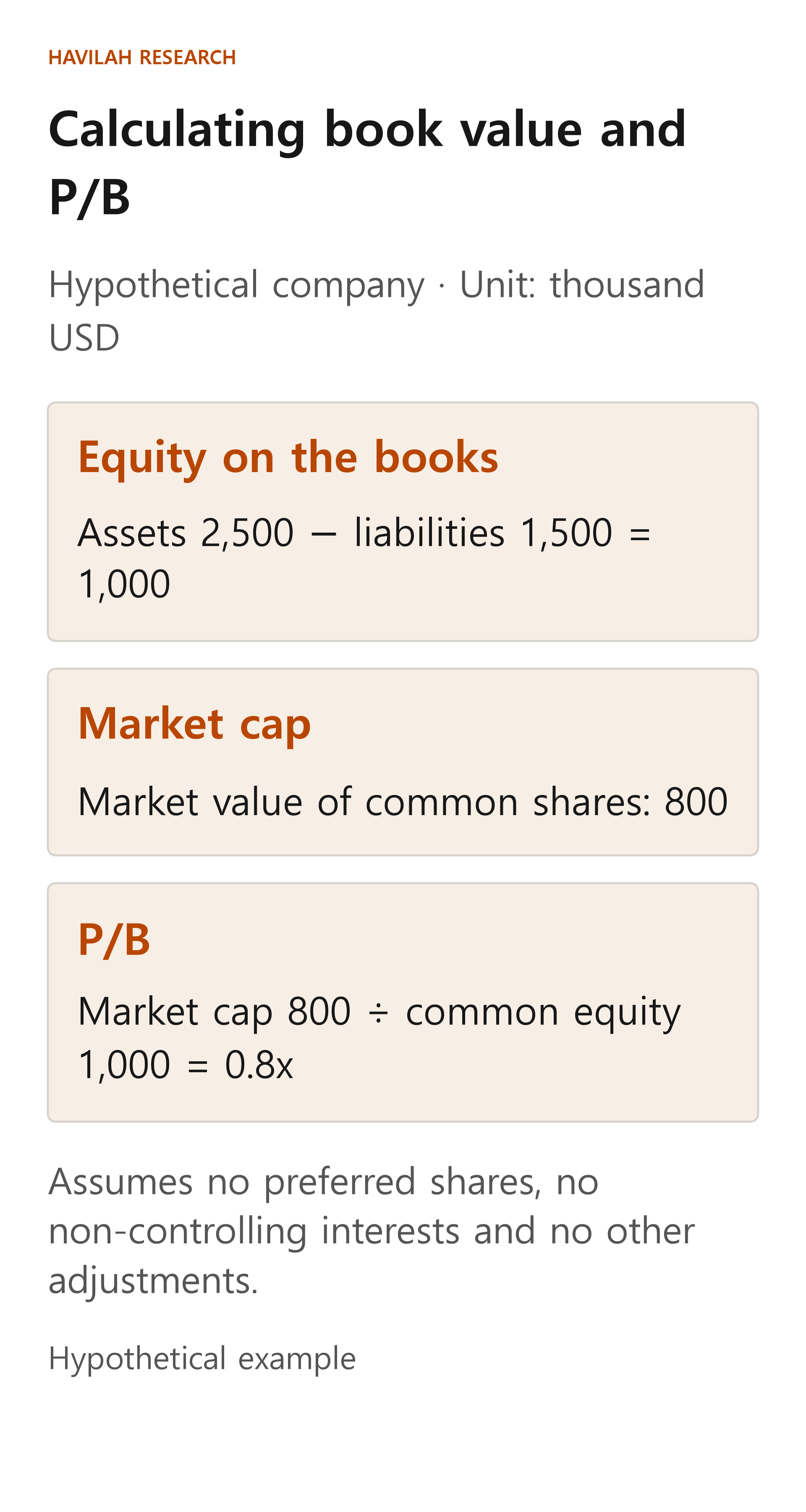
If this company has no preferred shares and no subsidiary stakes owned by other shareholders, you can use the simple calculation above. For a real company, you need to check separately how much of the equity belongs to common shareholders.
What if the numbers on the books change?
Suppose the hypothetical company writes down $200,000 of asset value as a loss, with no tax effect and no other changes. If assets fall from $2.5 million to $2.3 million while liabilities stay at $1.5 million, equity becomes $2.3 million − $1.5 million = $800,000.
If the market cap also happens to stay at $800,000, the P/B becomes $800,000 ÷ $800,000 = 1x. The earlier 0.8x changed because book value fell. In real situations, losses, taxes, the share price and other assets and liabilities can all change at the same time, so this example is not a prediction of what will happen.
The amount at which machinery, real estate and inventory are recorded in the accounts can differ from what they could actually be sold for. Some assets also depend on judgment about their value, such as the goodwill a company records when it acquires another company. Look at the condition of the assets as carefully as at their size.
How much is the company earning on its equity?
A measure often looked at alongside P/B is return on equity, or ROE. It compares the net income that belongs to common shareholders over a period with the average common equity over the same period, to see how efficiently the company has used its equity. Average equity is worked out from figures such as the equity at the start and at the end of the period, so check which method was used.
A low P/B may mean that investors expect low profitability in the future or see a high risk of losses. But it is also possible that those worries have gone too far. To judge which is the case, look at sustainable earnings excluding one-off gains and losses, debt, future investment and the competitive situation.
If equity is 0, P/B cannot be calculated, and if equity is negative, it is hard to compare the ratio in the same way as a positive P/B. Also check why equity has become small, for example because of share buybacks or accumulated losses.
When you look at banks, also check the quality of their loans
A bank's main assets are the loans it has made to customers. If customers fail to repay principal and interest as agreed, the bank's losses can grow. So look at the types of loans, how many are overdue, and the allowances (provisions) the bank has set aside in its accounts for expected losses.
Allowances are estimates of losses that have not happened yet, so they can differ from what actually happens. Banks also differ in their borrowers, how they raise their funding, the regulations they face and the accounting standards they apply. A low P/B alone does not mean the risk is small.
At the other end, for companies whose technology or brands matter most, much of the value they have built themselves may not show up in the assets on their books. That is why book value tells you different things in different industries.
Applying this to real investing
First, check the dates the market cap and the common shareholders' equity refer to. Then look at what the assets are made of and whether their value can be recovered, the liabilities, and whether the ROE can be sustained. When you compare with other companies in the same industry, also check their accounting standards and business structures.
A low P/B is where the questions begin. Only after you have checked whether the book value can be trusted and how much that equity can earn in the future can you judge whether the price is attractive.