
Two companies each have a share price of $30. Since the prices are the same, are the two stocks also priced about the same relative to their earnings?
Not if one company earns $3 per share and the other earns $1. The P/E is a way of setting the same share price side by side with earnings.
Divide the share price by earnings per share
P/E stands for price-to-earnings ratio. You divide the current share price by earnings per share. Earnings per share (EPS) is the part of the company's net income that belongs to its common shares, expressed per share. In a real calculation, you also need to account for changes in the number of shares during the period and for adjustments related to different classes of shares.
Hypothetical Company A and Company B both have a share price of $30. Suppose that over the most recent year, Company A's earnings per share were $3 and Company B's were $1.
| Item | Company A | Company B |
|---|---|---|
| Share price | $30 | $30 |
| EPS, most recent year | $3 | $1 |
| P/E | 10x | 30x |
Company A's P/E is 30 ÷ 3 = 10x. Company B's is 30 ÷ 1 = 30x. Even though the share price is the same, Company B's stock trades at a higher price relative to its earnings per share for the most recent year.
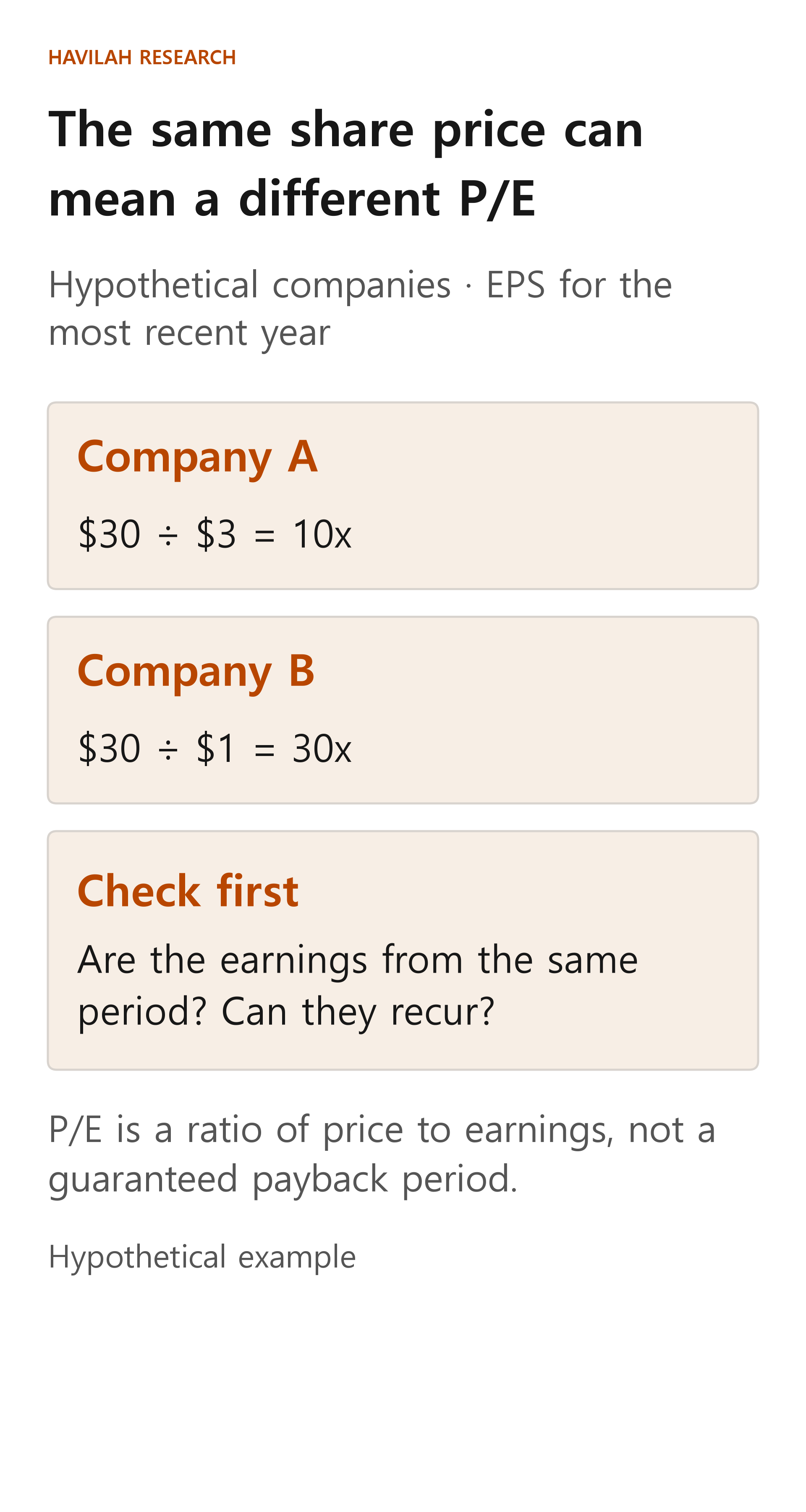
Do not read this as "a P/E of 10x means you get your money back within 10 years." A company does not necessarily pay out all of its earnings to shareholders in cash, and next year's earnings and share price can change. P/E is a ratio of price to earnings, not a guaranteed payback period.
Past earnings and expected earnings are different
What we just calculated is a P/E based on the most recent year's earnings, which have already been reported. P/E is also calculated using the earnings a company is expected to make in the future. Even with the same share price, the number changes depending on which earnings you put in the denominator.
Suppose hypothetical Company B is expected to earn $2 per share over the next year, and its share price is still $30. Its P/E based on expected earnings is 30 ÷ 2 = 15x. The P/E of 30x on past earnings becomes 15x on expected earnings simply because different earnings are used.
The $2 has not been earned yet. Actual earnings could stay at $1, turn into a loss, or come in above $2. Check who made the forecast and when, and whether the figure comes from the company itself or from analysts' estimates.
Does low mean cheap and high mean expensive?
A company with a low P/E may indeed face relatively low expectations. But the reason matters. A P/E can also be low when a large one-off profit in the past has inflated the denominator, or when earnings are expected to fall.
On the other hand, a high P/E can reflect expectations of future growth. In Lesson 109 we saw that if those expectations are not met, the share price can fall even while earnings grow. Even within the same industry, companies differ in growth rate, debt and profitability, so do not draw a conclusion from a single multiple.
When you compare with other companies, use earnings from the same period and of the same kind. If one side uses past earnings and the other uses next year's expected earnings, simply putting the two numbers side by side does not give you a fair comparison.
When there are no earnings or earnings are temporarily small
If earnings per share are 0, you cannot divide the share price by 0, so the P/E cannot be calculated. If earnings per share are negative, the math produces a negative number, but comparing it in the same way as a positive P/E of 10x or 30x is of limited use.
In that case, look into why the company is losing money. Check whether it is a one-off cost or whether the business keeps draining cash, and whether there is evidence that earnings will recover. You can also use other measures that compare the price with revenue or cash flow, but no single measure reveals all of the risks at once.
The questions behind the number
When you look at a P/E, first check which period the earnings cover and what they are made of. Next, think about whether those earnings can recur and what growth expectations the current share price might reflect. Finally, consider how your investment decision would change if the earnings forecast changed.
P/E is a starting point for comparing price with earnings. It is not an answer that judges the company's future for you.