
Two companies each have a market capitalization of $1 million. Does that mean the market is putting the same price on the whole business of each company?
Not if one company carries a lot of debt and the other has almost none. Market capitalization, which looks only at the market price of the shares, and enterprise value, which also takes debt, cash and other items into account, are different numbers.
Market cap is the price tag on the shares
Market capitalization (market cap) is the price of one share multiplied by the number of shares currently issued and held by investors. It uses the number of shares that have actually been issued and are still outstanding, not the maximum number of shares the company is authorized to issue.
If a hypothetical company's share price is $10 and it has 100,000 shares of the same class outstanding, its market cap is $10 × 100,000 shares = $1 million. If the share price moves or the number of shares changes, the market cap changes too.
This amount is the market's valuation, at the current price, of all the shares that belong to shareholders. It does not mean the company has $1 million in the bank, and there is no guarantee that buying every share would cost exactly this amount. The price can move while you buy in large quantities, and the terms of a takeover can be different.
Bringing debt and cash into the picture
Enterprise value is usually shortened to EV. It is a measure for valuing a business: you start with the market value of the shares, add the company's financial borrowings and similar items, and subtract cash and similar items.
Why add debt? Because buying the shares does not make the money the company has borrowed disappear. Cash, on the other hand, is subtracted on the idea that cash left in a company you take over could be used to pay off part of its debt. You still need to check whether the cash is really available to use and whether any contracts restrict it.
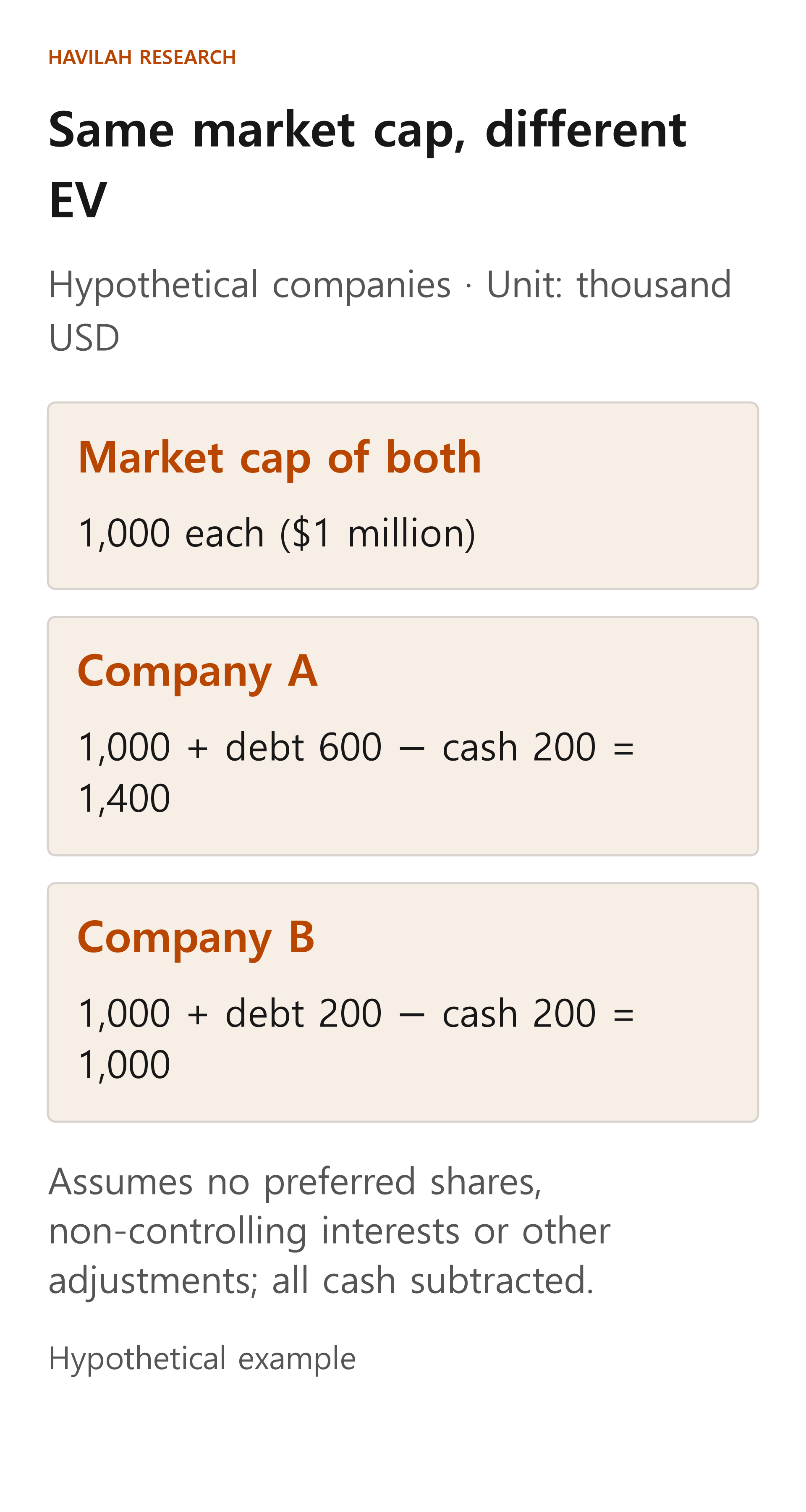
Suppose hypothetical Company A and Company B both have a market cap of $1 million. Assume that neither company has extra adjustment items such as preferred shares or non-controlling interests, that the book value of the debt below equals its market value, and that all of the cash is subtracted.
| Item | Company A | Company B |
|---|---|---|
| Market cap | $1 million | $1 million |
| Debt | $600,000 | $200,000 |
| Cash | $200,000 | $200,000 |
Company A's simple EV is $1 million + $600,000 − $200,000 = $1.4 million. Company B's is $1 million + $200,000 − $200,000 = $1 million. Even when the market cap is the same, EV differs if debt and cash differ.
Debt here means interest-bearing financial debt, such as bank loans and corporate bonds. Not every liability is automatically counted as debt; money the company still owes its suppliers for goods, for example, is not necessarily included. Which items count as debt depends on the purpose of the analysis and the calculation method, so check them.
Why cash and debt work in opposite directions
Company A above has $600,000 of debt and $200,000 of cash, so its net debt (debt minus cash) is $400,000. Adding $400,000 of net debt to the $1 million market cap gives the same EV of $1.4 million. Be careful not to add total debt and then subtract cash twice.
If a company has more cash than debt, its net debt can even be negative. That does not automatically make the company cheap. Some of the cash may be needed for day-to-day operations or restricted in how it can be used, and the profitability of the business may get worse in the future.
Real companies have extra items
Preferred shares are shares that can carry different rights from common shares, for example to dividends or to being redeemed. Non-controlling interests are the part of the subsidiaries included in a company's consolidated reports that belongs to other shareholders. When comparing the results of a whole business, some calculations also add the value of these claims to EV.
The result also changes depending on whether lease liabilities are included, whether short-term investments are subtracted like cash, and whether the book value of debt is used instead of its market value. Even when different websites show a figure under the same name, EV, the items in it may not be exactly the same. Financial companies in particular are hard to compare with other industries using the simple formula, because borrowing is part of their business.
In addition, the share price is today's, while the cash and debt figures may come from a report several months old. Write down the dates you used in your calculation, and check whether there has been a large acquisition, new borrowing or share issuance in between.
How can you use it when investing?
EV is a starting point for comparing the size of businesses that carry different levels of debt and cash. For example, dividing EV by annual revenue shows how many times revenue the whole business is priced at. But do not conclude that a stock is a good investment just because that ratio is low, because profit margins, growth and the risk of repaying debt can differ from company to company.
Think of market cap as the price tag on the shares, and EV as the price tag on the business that also takes the capital structure into account. Both measures are based on market prices, and neither one settles the true value of a company precisely.