
You have found a company whose business is doing well and looks set to keep growing. Does that make its stock a good investment at any price?
The business and the price you pay for it are two separate questions. Even when the business is good, if high expectations are already built into the price, the share price can fall while the business keeps growing.
Look at the company and its share price separately
Suppose a shop makes good money every year. For someone buying that shop, how much they have to pay matters just as much as how much it can earn. Using the Korean won (KRW) as an example currency, buying the same shop for KRW 100 million is a very different deal from buying it for KRW 1 billion.
Shares of a listed company work in a similar way, with one difference: buying shares is not a deal in which one person buys the whole shop. The price changes as many investors buy and sell, each with their own views. Use the analogy only to see why price matters.
The share price is the price at which the stock trades in the market right now. A company's value is an amount you estimate from the money the company will earn in the future, its risks and other factors. Because no one can know the future exactly, any estimate of value comes with a range and a margin of error. And the value you calculate does not become the market price just because you calculated it.
Earnings can rise while the share price falls
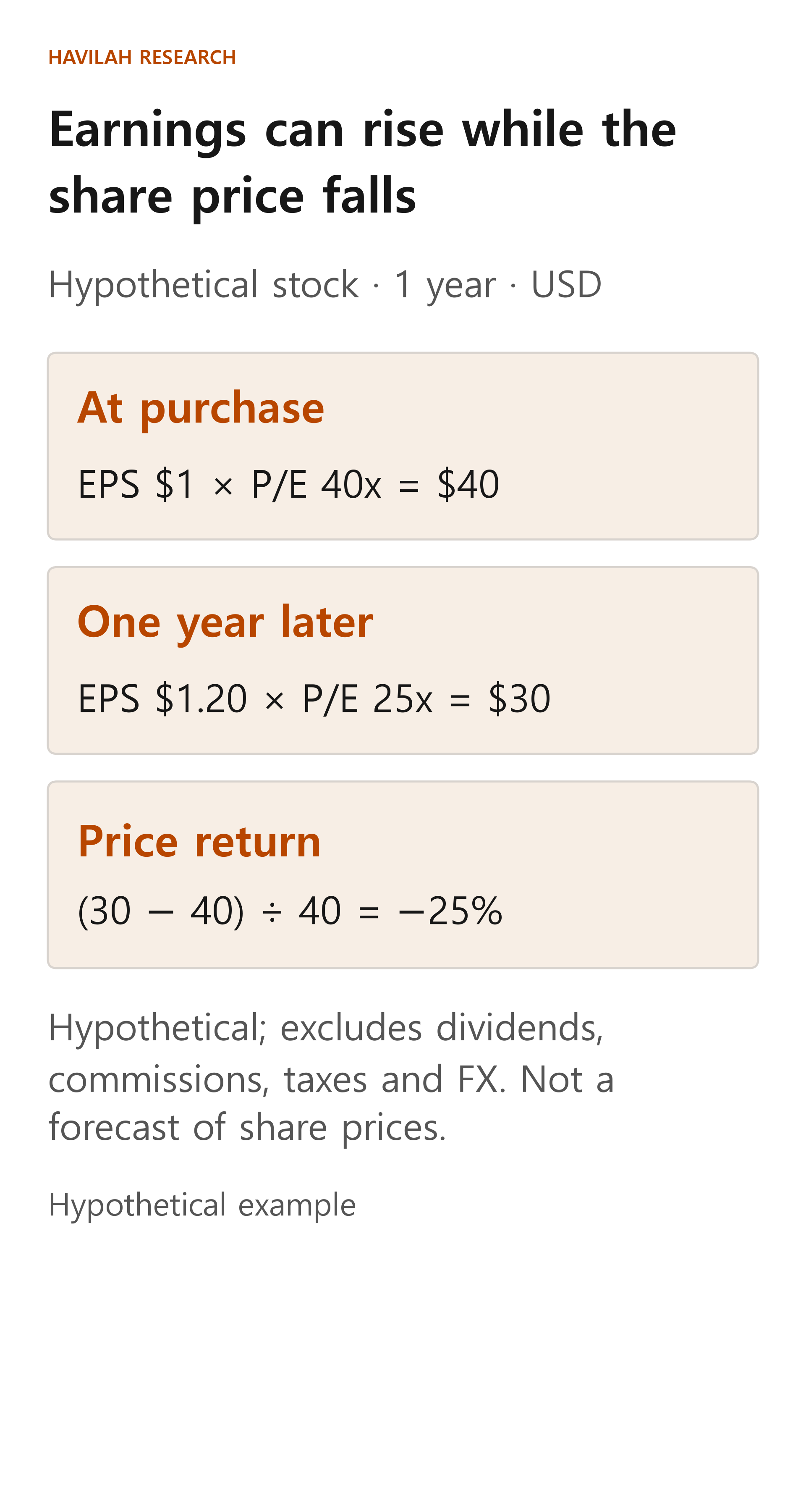
Take a hypothetical company. Suppose the profit for the past year that belongs to each share, its earnings per share, is $1, and the share price is $40. The price-to-earnings ratio, or P/E, is the share price divided by earnings per share: 40 ÷ 1 = 40x. P/E is one number that shows how high the share price is relative to earnings.
Now assume that one year later earnings per share have grown to $1.20. Earnings have increased by (1.20 − 1) ÷ 1 × 100 = 20%. But if the stock is then trading at 25 times earnings per share, the price is 1.20 × 25 = $30.
If you bought at $40 and sold at $30, you lost $10 on the change in price. Measured against your purchase price, your return is (30 − 40) ÷ 40 × 100 = −25%. This example is the price return on a single share, leaving out dividends, commissions, taxes and exchange rates.
The 25x in this example is only an assumption made for illustration. It does not predict how real share prices will move. You also need to look at why earnings per share grew and whether those earnings can continue.
Is a high P/E always bad?
No. A high price can reflect many views, such as the expectation that earnings will grow quickly or confidence in the stability of the business. On the other hand, a low P/E may reflect worries about falling earnings or risks in the business.
P/E alone cannot tell you the right price. Start by checking whether the earnings in the ratio are the earnings already reported for the past year or the earnings expected in the future. Expected earnings can turn out to be wrong, and when earnings are zero or negative (a loss), the usual way of reading a positive P/E is hard to apply.
The companies you compare can also differ in growth, debt, accounting choices and one-off profits. A multiple that is the same or lower does not, on its own, mean that two stocks carry the same risk.
The return you want and today's price
Assume you could sell the hypothetical stock for $30 in one year and that it pays no dividends in the meantime. Leaving out commissions, taxes and exchange rates, what would today's price need to be for you to earn a 10% price return?
Today's price × 1.10 has to equal $30, so the price is 30 ÷ 1.10, or about $27.27. In other words, if the assumption of $30 in one year comes true exactly, buying at about $27.27 gives you a price return of roughly 10%. Because the price is rounded, the actual percentage comes out very slightly different.
But $30 is not a guaranteed future price. The price you actually sell at could be lower, and dividends, costs and the exchange rate between the dollar and your home currency can all change your final return. If you assume a different future price, the current price you calculate changes as well.
Applying this to real investing
First, look at how the company makes money and how it will grow its earnings. Then ask how much growth is already built into the current share price. Also think through several scenarios for how the price could change if forecasts miss or if the return investors demand changes.
Another approach is to try conservative, base and optimistic assumptions for both expected earnings and the P/E. Each of these numbers is an assumption, not a prophecy. Because you can lose money at any price, also decide how much to put into a single company and what you will recheck if your thinking turns out to be wrong.
Once you have found a good company, the next question is this: at today's price, how much are you paying for what makes it good?