
Even after you find a good company, you often have to wait, because you need to see at the next earnings release whether orders have grown and whether a new product is actually selling.
In investing, an event like this, one that gives you a reason to reassess your view of a company, is called a catalyst. A catalyst does not mean the share price will necessarily move. It is easier to think of it as the moment when something investors have been wondering about is newly confirmed.
Which events should you watch?
Different companies have different important events. For a company with steady revenue, quarterly results and the outlook for the next period may be what matters. For a company with high hopes for a new product, you need to check customer response and actual sales after the launch. For a company waiting on a large contract, look not only at the signing but also at the delivery terms and the chance of cancellation.
Some events happen outside the company, such as changes in regulation and interest rates. For example, the U.S. central bank publishes the schedule of its monetary policy meetings. You can know the meeting dates in advance, but not what will be decided or how the market will react afterward.
For a drug company waiting for clinical trial results, keep the trial results and approval to sell separate. A clinical trial is a study in people that examines things such as how well a treatment works and how safe it is. Even positive interim results do not automatically mean approval to sell.
Write down questions along with the dates
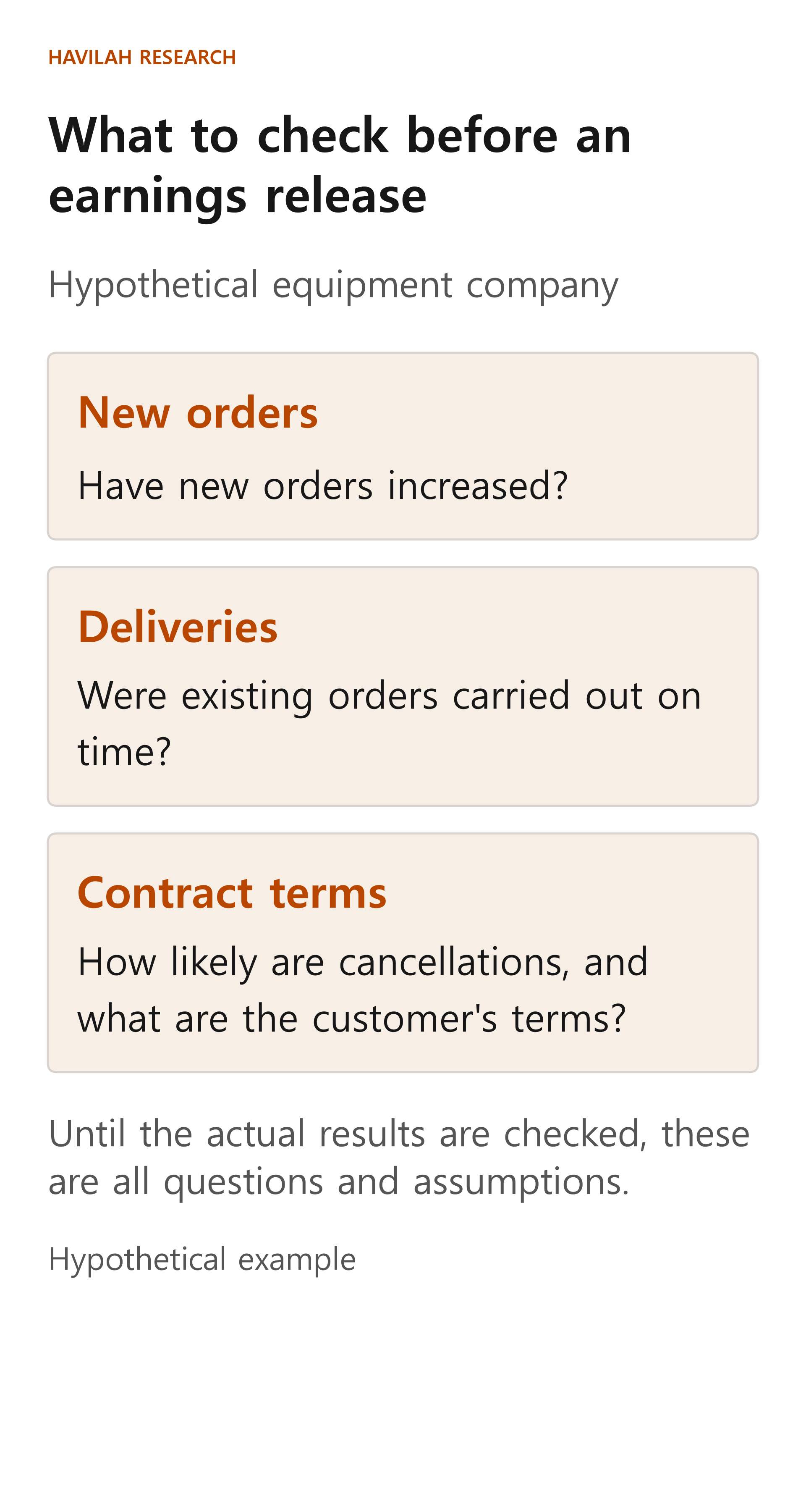
Suppose a hypothetical equipment company will report its results next month. Rather than just writing "earnings release" on your calendar, also write down the questions you want answered, such as "Have new orders increased?" and "Have deliveries of existing orders been delayed?"
Next to them, write how your view would change depending on the answer. If orders grew and deliveries went ahead, the evidence for demand may become stronger. If orders grew but are likely to be canceled, or deliveries keep slipping, that may be a reason to lower your estimates or to wait longer. Either way, these are assumptions until you have checked the actual figures.
If the release date has not been set, write down only the expected timing and check again in the company's investor relations materials. Dates can be brought forward or pushed back. It also helps to check whether the release comes after the market closes, so that you understand the gap between trading hours and the release time.
A share issue is also an important event
A company may issue new shares to build a factory or to pay off debt. New money may then come into the company, but the portion of the company that existing shareholders own can shrink. This is called dilution.
Suppose a hypothetical company has 100 shares in total, all with the same rights, and you hold 10 of them. Your stake is 10 ÷ 100 × 100, or 10%. If the company issues 25 new shares of the same kind and you do not buy any more, the total becomes 125 shares. Your stake is then 10 ÷ 125 × 100, or 8%.
Your ownership fell from 10% to 8%, a drop of 2 percentage points. Measured against your stake before the issue, that is a 20% decrease. You still hold 10 shares, but the total number of shares has grown.
This calculation shows only your ownership percentage. How the issue affects the value of each share and the share price depends on what the company does with the new money and at what price it issued the shares. You cannot work out how much the share price will change from the drop in your ownership percentage alone.
Good news can still come with a falling share price
Investors look not only at the event itself but also at the gap between what people expected beforehand and the actual result. If many people already expected a large order, the actual orders may fall short of expectations even though they grew. Conversely, a result that looks bad may still be better than people feared.
However, it can be hard to pin down exactly, as a single number, what the market as a whole expected. If there is an average forecast from analysts at brokers, you can use it as a reference, but it does not represent what every investor thinks. It is also hard to say for sure that a share price moved after the results because of one particular event.
After the release, check the results again
For the results, look at the company's release materials and quarterly report (10-Q). For important contracts or share issues, check the terms in the relevant filing. Major corporate events at U.S. companies are sometimes disclosed in current reports (Form 8-K). Companies based outside the United States may use different filing forms depending on how they are registered, so check that company's own materials.
Next to the questions you wrote down at the start, record the actual results and how your judgment changed. If the result differs from what you expected, look again not only at the numbers but also at the evidence you relied on and at what you still do not know. What matters is not guessing events correctly but revising your view with better evidence after each event.