
News that a company's revenue grew does not tell you on its own whether the company will keep growing. You start to wonder whether it raised prices or gained customers, and whether it expects the same trend next quarter.
This is where the earnings conference call comes in. It is a session in which management explains the results and answers questions. It helps you look at the reasons behind the numbers.
Read the numbers first, then listen to the explanation
Companies usually publish revenue, profit, results by business and other figures in their earnings release materials. On the conference call, management explains those numbers and shares its thinking about the business ahead. Some companies then take and answer questions from analysts at brokers and other firms.
You can find the release materials and the call schedule in the investor relations section of the company's website. Some companies also make a recording or the presentation available afterward. How they provide these materials and how long they keep them available differ from company to company.
Before you listen, jot down this quarter's results and earlier results from the release materials. If you listen without knowing the numbers, it is easy to remember only the upbeat phrases. For U.S. companies, you can also check the financial statements and notes in the quarterly report (10-Q) and the annual report (10-K).
Write results and the outlook in separate columns
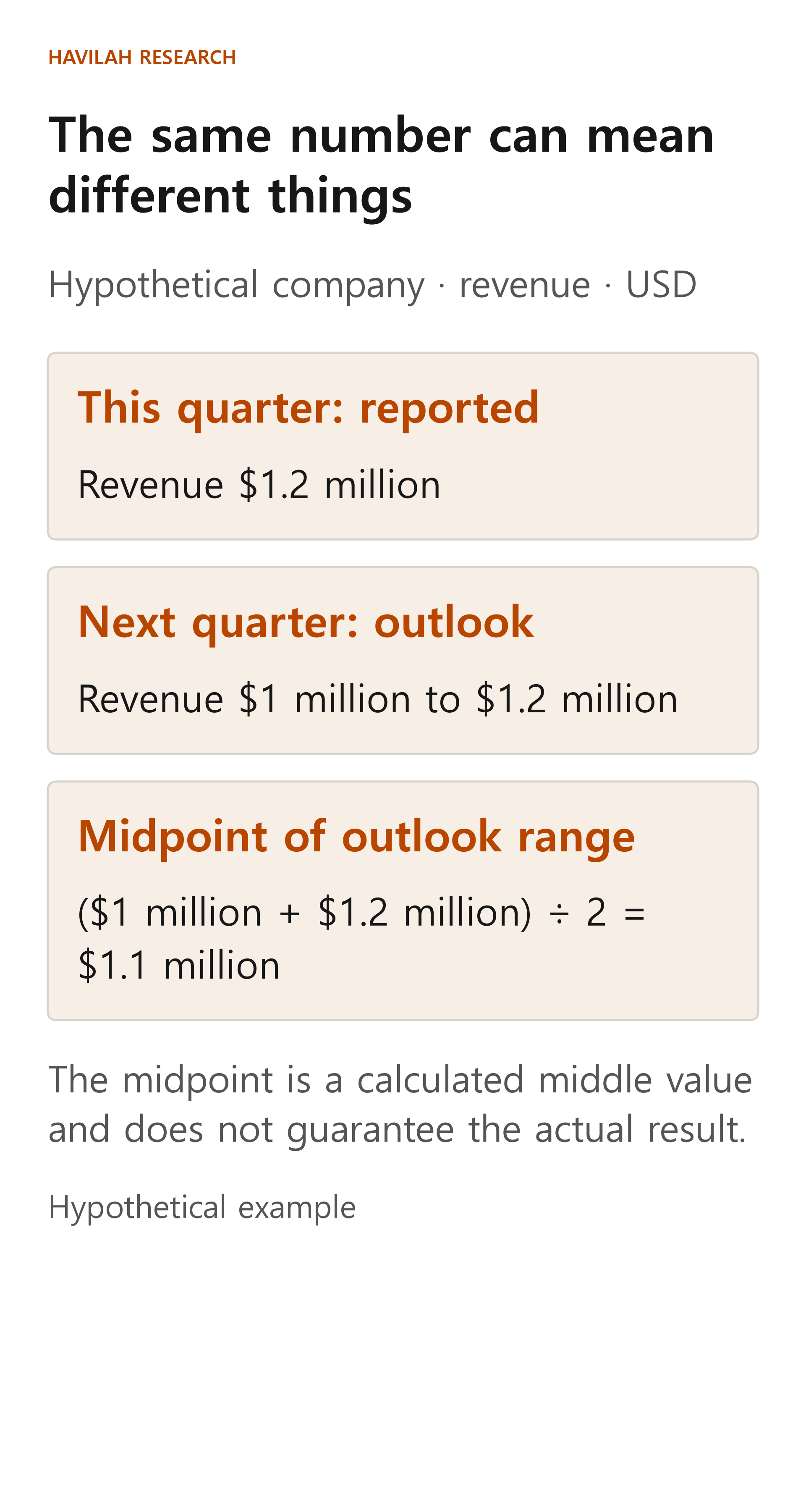
Suppose a hypothetical company reports revenue of $1.2 million for this quarter and expects revenue of $1 million to $1.2 million next quarter. This quarter's $1.2 million is a reported result, while next quarter's range is management's outlook.
The midpoint of the outlook range is ($1 million + $1.2 million) ÷ 2, or $1.1 million. Compared with this quarter's revenue of $1.2 million, that is $100,000 lower, and $100,000 ÷ $1.2 million × 100 is about 8.3%. Also note that the two amounts cover different quarters.
The midpoint is just one number used for the calculation. It does not mean the actual result is most likely to land near it. The company's outlook can change, and the actual result can fall outside the range. You also need to consider seasonal differences between quarters.
Ask what changed
When management explains revenue growth, listen for which of these changed: the number of customers, the volume sold or the selling price. Revenue may have risen because of a price increase even though volume fell. And even if revenue rose, profit can fall if costs rose faster.
Changes are easier to see if you put the plans management described last time next to what it says this time. For example, suppose hypothetical managers said last quarter, "We expect to ship by the end of the year," and this time said, "We can set the schedule only after the customer completes its acceptance checks." Then you need to check whether the uncertainty around the schedule has grown. Those words alone, however, do not prove that the contract was canceled.
Write down the date of each remark and which business it referred to, and compare it with actual order and delivery data. A remark taken out of context can take on a different meaning, so it is better to read the question and the answer together.
What not to miss in the question-and-answer session
During the questions, analysts may ask about uncertain areas such as rising costs, customer orders and investment plans. Listen carefully for whether the company answered with specific numbers, attached conditions, or said it does not know yet.
A vague answer means you now have something to check. It does not necessarily mean bad news. The company may not be allowed to disclose contract details, or the matter may genuinely not be decided yet. You can then watch whether later filings explain more about that question.
Companies sometimes present measures such as adjusted earnings, in which certain items are added to or subtracted from the figures prepared under standard accounting rules. Do not pick only the numbers that look good. Look at the figures under the accounting rules and at what was adjusted. A cost described as one-time is still a cost that was actually incurred.
Three things to write down after the call
First, write down the confirmed results for this quarter and the outlook for the next period separately. Second, write down what has changed since the last explanation and why. Third, note the questions that have not been answered yet and the materials you will check next.
A conference call is a chance to hear management's explanation, not a place that tells you where the share price will go. What was announced may already be reflected in expectations, and forecasts can turn out wrong. Use the call to revise your own judgment by comparing, one after another, what was said, the numbers and what actually happened afterward.