
A large technology company has announced that it will spend a great deal of money on data centers. Will the revenue of companies that make the equipment artificial intelligence (AI) needs also rise by the amount announced?
The first question an investor needs to answer is where the money will go. A data center needs more than computers. Money also goes into putting up buildings, supplying electricity and connecting the equipment together.
What kind of money is CAPEX?
CAPEX stands for capital expenditure: money a company spends to acquire assets that it will use in its business for a long time. Building a factory, buying a building and installing servers are examples. What each company includes in the number it announces, and how the amount is counted for accounting purposes, can differ.
It helps to picture equipment that is not used up in a day but used for several years. Not all money spent on buying things is capital expenditure, however. Everyday operating costs and the materials used to make products, for example, need to be looked at separately.
A capital spending plan is an expectation of what the company will spend. Keep it separate from actual spending, where the money has already been paid out. The amount and timing of an investment plan can change with the company's circumstances.
Break a large amount down by use
Suppose a hypothetical company plans to spend a total of $100 million on a data center. Assume that it plans to spend it all in one period and that the four items below do not overlap.
| Use | Planned amount |
|---|---|
| Servers | $40 million |
| Buildings and construction | $30 million |
| Power equipment | $20 million |
| Networking equipment | $10 million |
Adding the four amounts gives $40 million + $30 million + $20 million + $10 million, or $100 million. Even if the company spends the whole budget as planned, the money set aside for servers is $40 million under this assumption. You cannot treat the entire announced budget as revenue for a single server company.
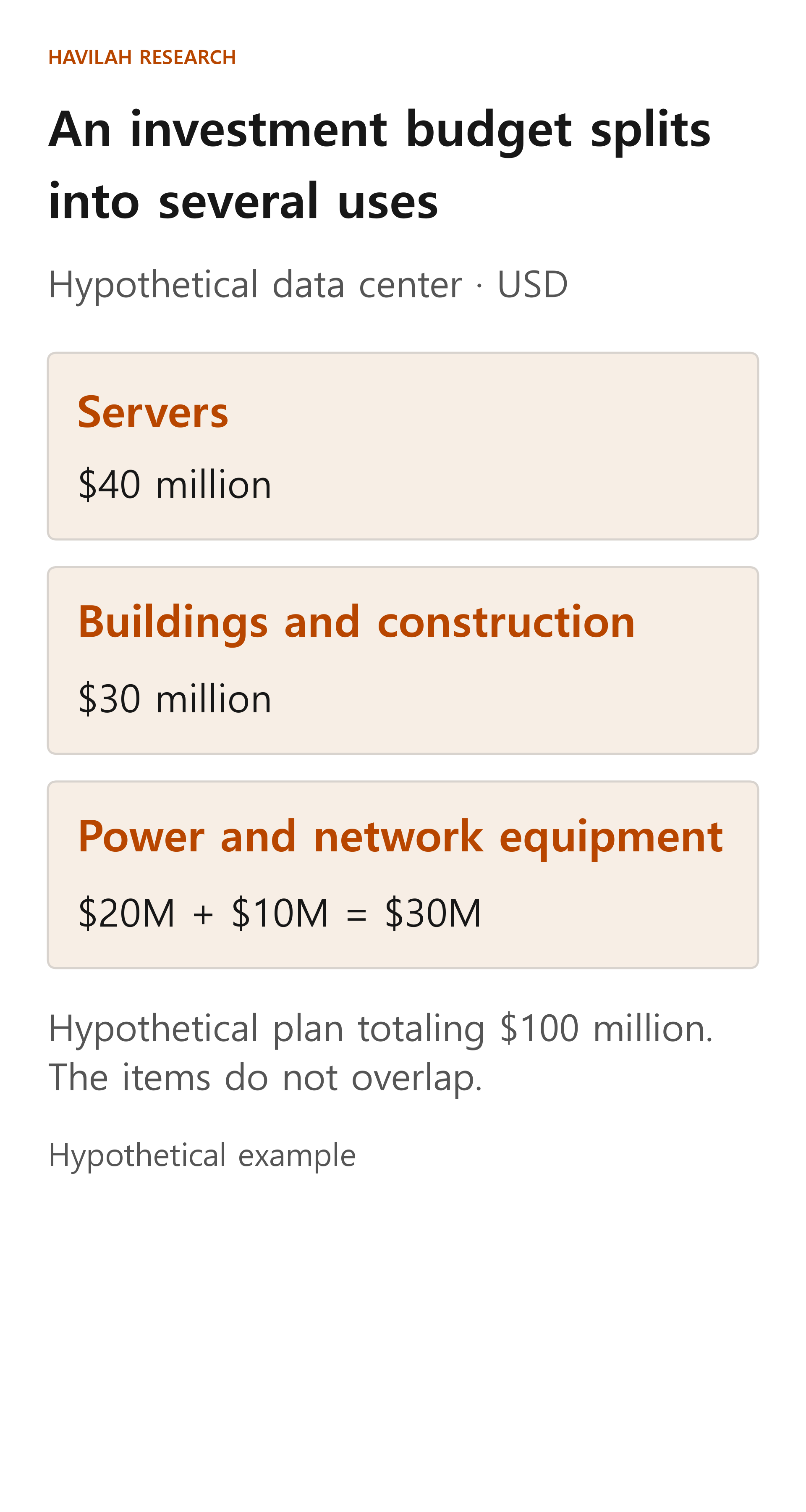
In a real announcement, the company may not disclose amounts by item. In that case, do not make up a breakdown like the one in the table above. Mark the amounts as not disclosed.
The share one supplier gets can be smaller still
Suppose hypothetical Supplier A wins a direct contract for 1/4 of the $40 million server budget. The contract is worth $40 million ÷ 4, or $10 million. Under this assumption, the rest of the server budget is $30 million.
That does not mean A's revenue becomes $10 million the moment it wins the contract. It may not have supplied the equipment yet, or the conditions for recognizing revenue under the contract may not have been met. If the work is carried out over several periods, the revenue may also be spread over several periods according to those conditions.
The announced budget, the actual order, the delivery and the recognition of revenue are each separate stages. The more you check the evidence for each stage in order, the easier it becomes to tell expectations apart from confirmed results.
Also look at whether the company making the plan will pay for it with cash it has or will need to borrow. If its funding is delayed, the ordering schedule can change. Even after an order is placed, in some deals the equipment has to be delivered and the customer has to complete the acceptance checks required by the contract before the deal moves to the next stage. What acceptance means and when revenue is recognized differ from contract to contract, so do not apply one rule to all of them.
If the supplier is paid later, even after it has recognized the revenue, that money is not cash yet. Look at the payment terms in the contract, the company's accounts receivable (money customers still owe it) and how much cash is actually collected.
Things to watch when you follow the supply chain
The same money can appear in the revenue of more than one company. For example, if an equipment maker buys a component for $7 million and sells equipment containing it to a customer for $10 million, the component maker and the equipment maker can each record revenue. You should not add these two together and say the customer spent $17 million, because the transactions overlap within the same supply process.
Nor can you assume that the component maker's revenue equals the equipment sale. You need to know the component's price and volume, and whether the component maker has a direct contract. Even when revenue grows, profit depends on how much the cost of goods and any additional investment add up to.
Even when a contract has been signed, delivery of the equipment or the construction work may not be finished yet. Do not mix the plan, the actual contract, delivery and accounting revenue, and the cash payment as if they were numbers from the same point in time. Also check each source's definition to see whether the investment figure the company uses includes leased assets or costs not yet paid.
Applying this to real investing
First, check the period the investment announcement covers and what the company plans to buy. Next, see whether the supplier you are interested in actually provides those items, and whether a contract or order with that customer has been disclosed. A relationship with the customer does not mean the supplier automatically receives a fixed share of a new investment budget.
Finally, check in the supplier's results when the revenue was recorded and at what margin. Growth in spending across an industry and growth in one company's profits are different questions. If the information is not enough, leave it as a possibility and wait for the next filing that backs up the orders or deliveries.