
You hear that a company has agreed to supply large equipment for $100 million. Does that mean this quarter's revenue will also rise by $100 million?
No. The company may have agreed to deliver the equipment over several years, and the customer may change the order. Start from the contract news, but look separately at when, and how much of it, will show up in the actual results.
Orders received, work still to do
Winning an order means the company has secured a job to supply products or services to a customer. Backlog, put simply, is the part of the orders won that has not been carried out yet and may turn into revenue in the future.
When diners in a restaurant have ordered their meals but the food has not been served yet, the kitchen still has orders to work through. A company's backlog is similar in that it shows the work still ahead. Real business contracts, however, are more complex than restaurant orders. Deliveries can stretch over several years, contracts can be changed partway through, and each company defines differently what it includes in its backlog.
Backlog is a clue to the work ahead. It is not profit already earned or money already in the bank. Even the timing and amount of the revenue it brings depend on the contracts and on how the work progresses.
Follow how the number changes
Consider a hypothetical equipment company. All the amounts below are in dollars, and we assume that work already carried out and recognized as revenue drops out of the backlog.
| Item | Amount |
|---|---|
| Backlog remaining at the start of the period | $1 million |
| New orders received | $500,000 |
| Work carried out and recognized as revenue | $300,000 |
| Orders canceled before the work was done | $100,000 |
With no other changes, the backlog at the end of the period is $1 million + $500,000 − $300,000 − $100,000, or $1.1 million. That is $100,000 more than at the start, but the revenue recognized from these orders during the period is $300,000. If you added the $1.1 million backlog to this period's revenue, you would wrongly count orders that have not been carried out yet as this period's revenue.
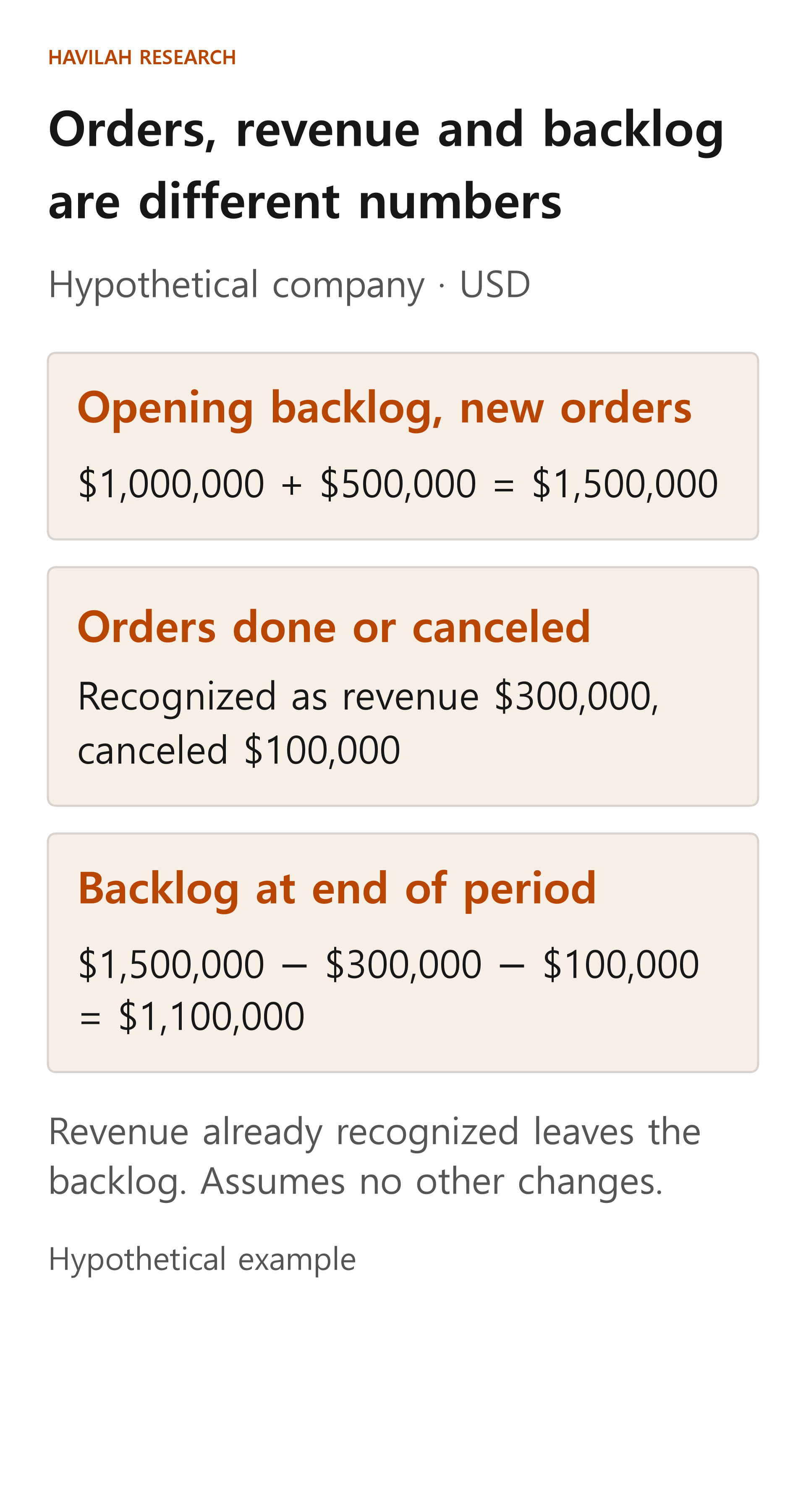
A company's actual backlog can also change for other reasons, such as exchange rates, changes in contract values and orders that come with an acquired business. The calculation above is an illustrative example that assumes only these four changes.
Check when it becomes revenue
Suppose the hypothetical company expects to carry out $600,000 of the remaining $1.1 million next year and $500,000 the year after. If the work goes as planned and is recognized as revenue in those periods, next year's share is $600,000. The full $1.1 million does not become next year's revenue.
This schedule is not fixed either. If the customer postpones its plans or the company's deliveries run late, work can slip into the following year. Some contracts allow the customer to end them early or change their terms. Whether there is a cancellation fee, and how much the company can be paid for work already done, differs from contract to contract.
You also need to look at how revenue is recorded. For some products, revenue is recognized when control passes to the customer. For some contracts, it is recognized over the period in which the work is done. The fact that a deposit arrived first does not, on its own, make that amount revenue straight away.
A large backlog can still bring small profits
Suppose the company carries out $600,000 of work and records it as revenue, and the cost of doing that work is $540,000. The revenue from that work minus this cost is $60,000. If there are selling, general and administrative expenses, interest, taxes and other items not counted here, the company's final profit will differ even more.
If material costs rise, or extra costs arise to finish the work by the agreed delivery date, less money is left over. On the other hand, if the contract lets the company pass higher costs on to the customer, the effect can be different. A large order may be a good sign, but you cannot judge profitability from the order amount alone.
What should you look at in a real company?
First, read how the company defines its backlog. Some companies leave out options that customers have not exercised yet, while others include long-term agreements that meet certain conditions. Even under the same name, the numbers can cover different things. Remaining performance obligations, shown in the notes to the financial statements, are the promises the company still has to deliver to its customers, but they are not always the same number as the backlog the company announces.
Next, check three things. First, when the company expects to do the work and recognize it as revenue. Second, whether customers can cancel or change their contracts. Third, what risks there are to costs and margins. If the filings do not give the contract details, it is better to leave that point marked as not verified.
Finally, separate the earlier orders that were actually carried out from the new orders. You cannot conclude that demand has weakened just because backlog fell. It may have fallen because the company steadily carried out existing orders and turned them into revenue. Conversely, even if backlog rises, the results you expected may not arrive if cancellations and delays grow.
The key question when you look at backlog is simple. Beyond how large the orders are, ask when and on what terms the work will be done, and how much the company can keep from it.