
A company grew its revenue sharply this year. Will it grow at the same pace next year? Last year's and this year's numbers alone will not tell you. Start by looking at what the company sells, how much of it, and what price its customers pay.
Estimating revenue is not a game of predicting the future exactly. It is a process: you write down which conditions must be met for the revenue you expect to appear, and then you compare that with the actual results.
Start with the number of customers and the price
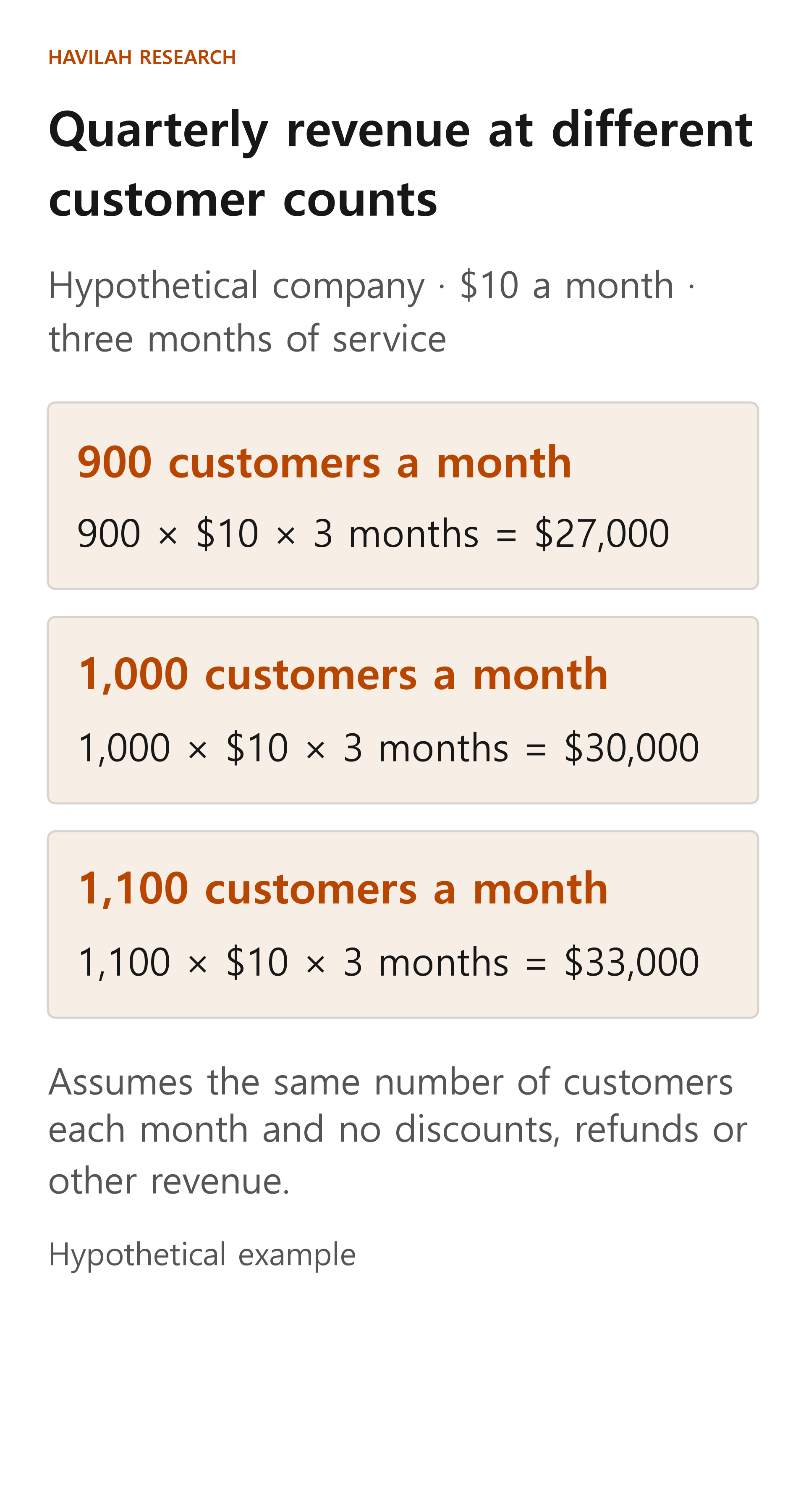
Suppose a hypothetical company provides a service for $10 a month. Assume that it serves 1,000 customers in each of the three months of next quarter, and that there are no discounts, refunds or other revenue.
Revenue for one month is 1,000 customers × $10, or $10,000. Revenue for the three months is 10,000 × 3, or $30,000. This is a simplified example that assumes the company serves the same number of customers every month and recognizes the revenue in that period.
With 900 customers a month, revenue would be 900 × 10 × 3, or $27,000. With 1,100 customers, it would be 1,100 × 10 × 3, or $33,000. Both cases assume the same price and the same period.
The number of customers and the price can both change. Even if the company gains customers, revenue may grow less than expected if discounts push down the average price per customer. For a company that sells products, you can split revenue into the number of units sold and the average selling price of each product.
Contract value and revenue can differ
When a company receives the fee for 1 year of service in advance, it may not record all of that money as revenue in the first month. Under some contracts, revenue is recognized bit by bit over the period in which the service is provided. When revenue is recorded depends on the service promised, the terms of the contract and the accounting standards.
So you should not treat the number of subscribers or the value of new contracts as accounting revenue straight away. In the company's filings, check the period over which the service is provided, how revenue is recognized and the terms for refunds and discounts. The time the money is received and the time the revenue is recorded can also differ.
Linking quarterly estimates to an annual number
If you expect next quarter's revenue to be $30,000, you cannot always just multiply by 4. Sales may be concentrated in a particular season, or contract renewals and new product launches may cluster in other quarters.
Suppose you estimate next year's four quarters at $30,000, $33,000, $27,000 and $36,000. Annual revenue is then the sum of these four numbers, $126,000. Write down what you assumed would change in each quarter as well.
If you do not have enough information for each quarter, you can start by simply using the same amount for every quarter. But note the limitation that this does not reflect seasonality or changes in contracts. Also be careful not to count twice by adding the annual total to the quarterly numbers it already includes.
The company's outlook and the market's estimate are different
When a company itself gives a range for its future revenue, this is called company guidance. The consensus estimate, which combines the estimates of several analysts, is a separate number. The two can differ, and some companies do not give an outlook at all.
Whether it is the company's outlook or analysts' estimates, check when it was published and which period it covers. If the company gave its revenue outlook as a range, look at what the top and bottom of the range assume, and whether exchange rate effects or acquisitions and divestitures are included. The company's outlook is neither confirmed orders nor confirmed results.
Build your own estimate and keep revising it
Before you copy the company's materials or analysts' estimates as they are, write down the factors that drive revenue, such as the number of customers, the price and the contract length. If you work out one case where customer growth is slower than expected and another where it is faster, you can see which assumptions matter most.
When the actual results come out, compare them with your estimate and find out why they differ. Look at whether sales volume was different, whether prices or exchange rates changed, and whether revenue was recognized at a different time than you expected. Do not write guesses about numbers you cannot verify as if they were facts. Leave them as questions to check in the next filing.