
When the economy weakens, people may put off replacing their cars. But they may not cut back by the same amount on the groceries they need right away. In the same way, a change in the economy as a whole does not reach every company equally.
Rather than trying to put the right name on the current phase of the economy, it is more useful for investors to think about how a change could affect the customers and costs of the companies they are interested in.
What it means to say the economy is recovering
A period when economic activity is growing is called an expansion, and a period when it is shrinking is called a contraction. When economic activity passes its low point and starts to grow again, people often call it a recovery. A slowdown, when growth becomes slower, is different from a contraction, when output actually falls.
The start of a recovery does not mean economic activity immediately gets back to its earlier high. For example, if hypothetical output falls from 100 to 80 and then rises to 88, it has recovered 10% from the bottom but is still 12% below its earlier level of 100. Here, 80 × 1.10 = 88, and (100 − 88) ÷ 100 × 100 = 12%.
When the timing of U.S. recessions is determined, it is judged not from gross domestic product alone but from a range of indicators of economic activity, such as employment and consumer spending. The business cycle is not a clock that repeats with exactly the same length and order every time.
Can customers put off their spending?
With long-lasting goods such as cars or furniture, people can postpone a purchase even when the time to replace them comes, or keep using what they have for longer. Demand for everyday necessities, by contrast, may fall relatively less. Even so, a company that sells necessities can see its results worsen if customers switch to cheaper products or its costs rise.
The same goes for companies whose customers are other businesses. If customers postpone plans to build new factories or replace equipment, orders at equipment suppliers can fall. On the other hand, maintenance of equipment that is already installed can be hard to stop right away. Even within one company, product sales and maintenance can respond differently.
The same fall in revenue can cut profits by different amounts
Hypothetical companies A and B each have revenue of $1,000. At A, the costs that change with revenue are 60% of revenue, and the costs that stay the same for a while even when revenue changes are $300. At B, the costs that change with revenue are 80%, and the costs that stay the same for a while are $100. Assume there are no other costs or taxes.
At first, A's profit is $1,000 − $600 − $300 = $100. B's profit is also $1,000 − $800 − $100 = $100.
What happens if revenue at both companies falls to $800 while the cost percentages and the costs that stay the same do not change? A is left with $800 − $480 − $300 = $20. B is left with $800 − $640 − $100 = $60. Revenue at both companies fell 20%, but under these assumptions A's profit fell 80% and B's fell 40%.
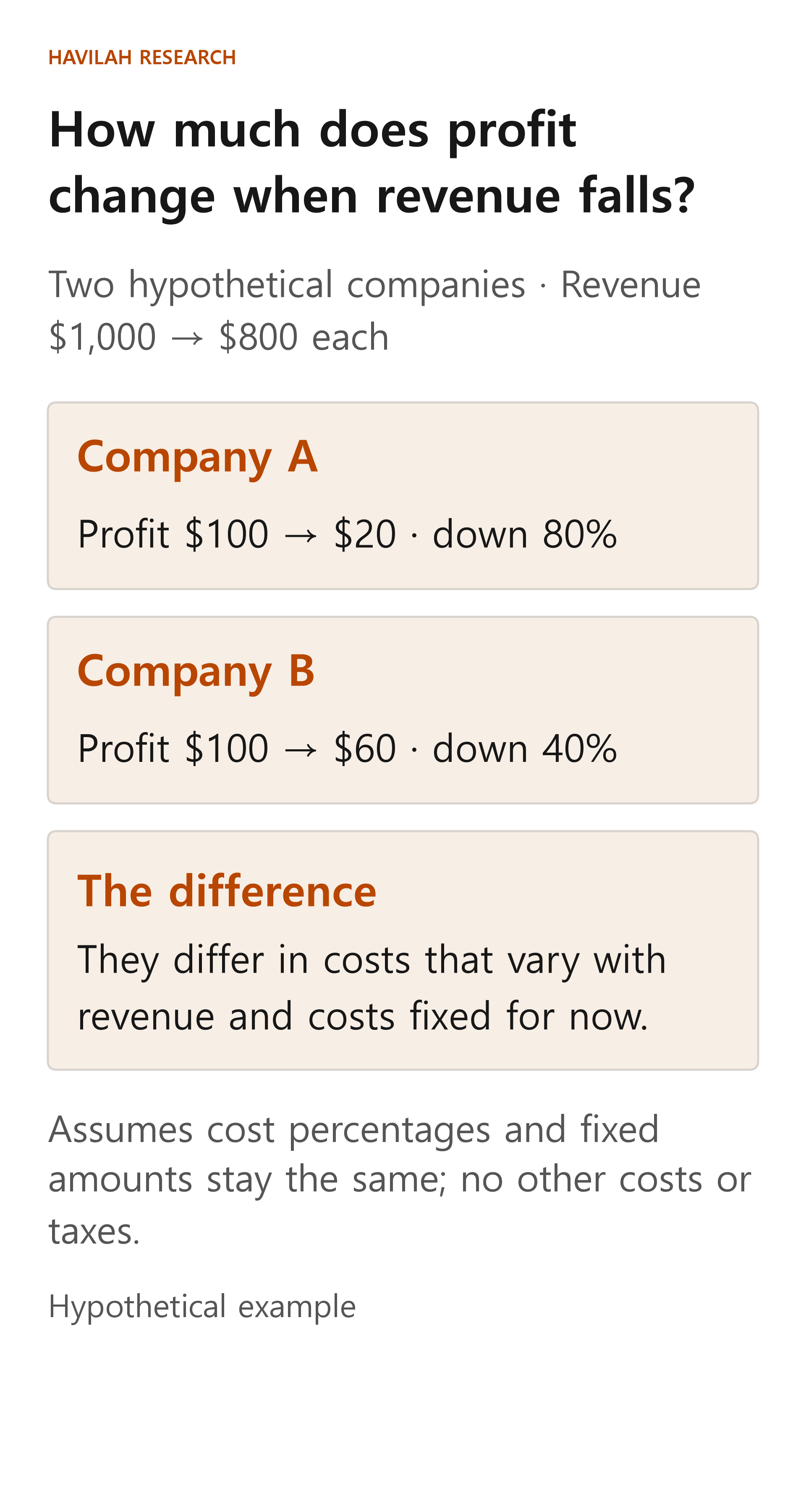
This does not mean A is the riskier stock. Real companies can adjust their costs or change their prices, and their debt, cash and business prospects also differ. But the example shows that when a company has many costs that are hard to cut quickly when revenue falls, its profit can change sharply.
Can you predict share prices from the phase of the cycle alone?
Not every stock rises when the economy recovers. Share prices can also react to the gap between how much of a recovery investors had already expected and what actually happened, as well as to interest rates, companies' financial condition and other factors.
Conversely, even when people are worried about a slowdown, profits do not fall by the same percentage in every industry. Customers' spending habits, existing contracts, inventories, cost structures and financial strength all differ. Even companies in the same industry can end up with different results.
Compare three scenarios as an investor
Start by writing down who the company's customers are. Then look at how much orders could fall if customers delay purchases, which costs remain even when orders fall, and whether the company's cash and debt position would let it get through that period.
Next, split the outlook into three cases: demand rises, stays about where it is now, or falls. If you write down your assumptions about how revenue and costs would change in each case, it becomes easier to see which risks remain if a single economic forecast turns out to be wrong. If you cannot put numbers on it yet, it is fine to start by listing the filings you need to read and the questions you need to answer.