
You see news that a U.S. company's revenue fell. Yet its stores abroad sold the same quantity at the same prices as last year. How can that happen?
The exchange rate used to convert the money earned abroad into dollars for reporting may have changed. Exchange rates can affect not only the revenue figure that is reported but also actual costs and what customers buy.
What it means when the dollar gets stronger
Here, let's compare the euro and the U.S. dollar. If 1 euro goes from $1.10 to $1.00, you receive fewer dollars when you convert the same 1 euro into dollars. Conversely, 1 dollar now buys more euros. This is described as the dollar strengthening against the euro.
An exchange rate can look like a different number depending on which currency is used as the base. The hypothetical examples below all show how many dollars 1 euro is worth. They are not actual market exchange rates.
Converting overseas revenue into dollars
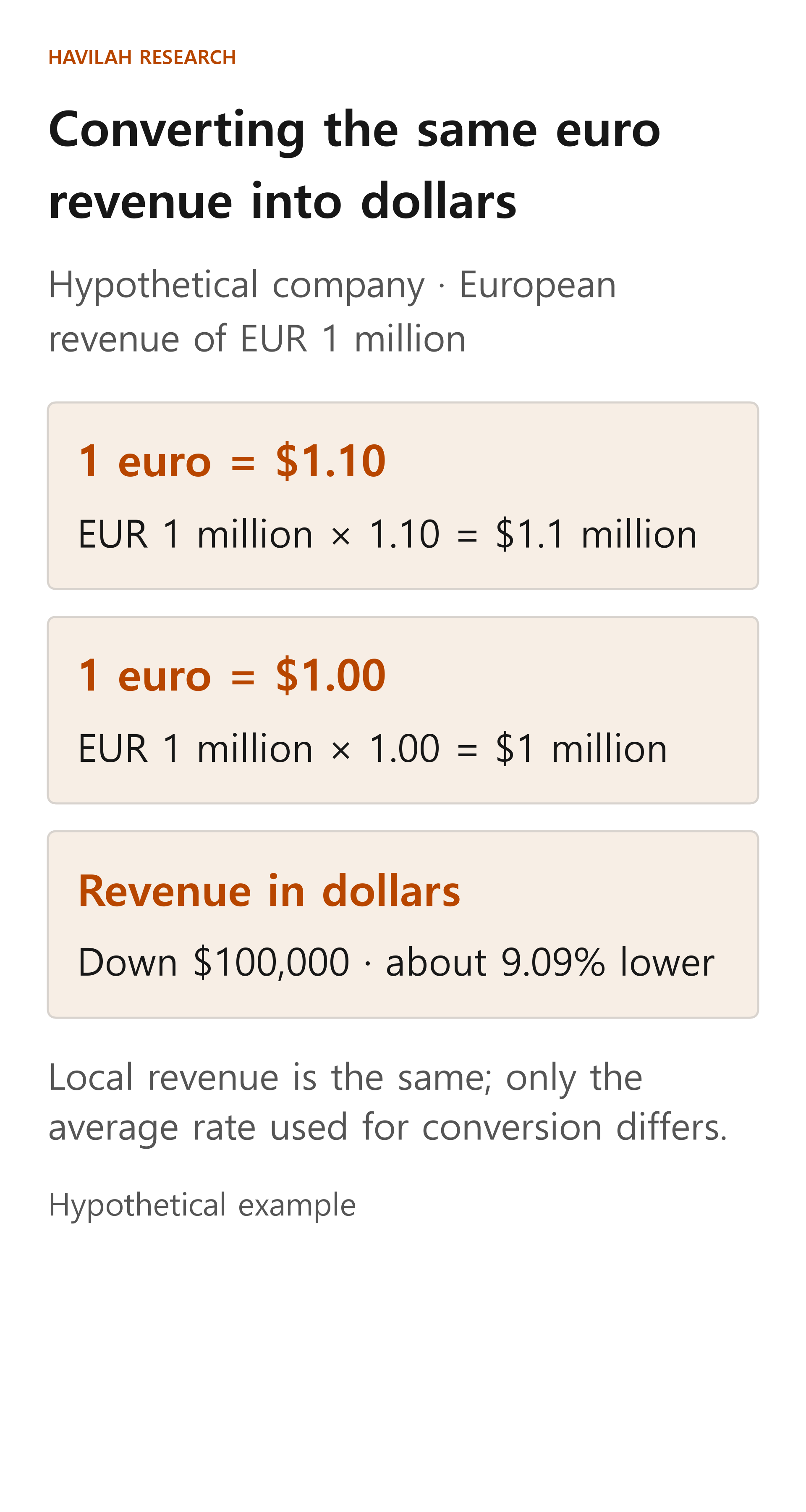
Suppose a hypothetical U.S. company earned EUR 1 million in Europe in a year. To keep things simple, assume the average exchange rate used to convert that period's revenue is $1.10 per euro. Revenue in dollars is then 1 million × 1.10 = $1.1 million.
The next year, European revenue is again exactly EUR 1 million, but the average rate has changed to $1.00 per euro. Revenue in dollars is now 1 million × 1.00 = $1 million. Revenue in euros is unchanged, yet revenue in dollars has fallen by $100,000. The decline is $100,000 ÷ $1.1 million × 100, or about 9.09%.
This calculation is meant to isolate the effect of the currency conversion. In actual reports, check when the business took place and which exchange rate basis was used. Amounts that build up over a period, such as revenue, and asset balances at a particular date are not always converted at the same exchange rate.
When revenue and costs are in the same currency
Suppose the same company spent EUR 800,000 on costs, paid in euros, while earning EUR 1 million of revenue in Europe. With no other costs or taxes, the amount left locally is EUR 1 million − EUR 800,000 = EUR 200,000.
Converted at $1.10, that EUR 200,000 is $220,000; converted at $1.00, it is $200,000. Revenue and costs in dollars both shrink, so the whole drop in revenue does not turn into a drop in profit.
However, not all of a company's costs arise in the same currency as its revenue. If it sells in euros in Europe but buys its products in dollars, revenue and the cost of goods can move in different directions. That is why you need to look at the currency of revenue and the currency of costs separately.
Does it affect actual sales too?
A strong dollar does not only affect converted figures. When customers abroad pay in their own currency for products priced in dollars, those products can become more expensive for them. Customers may buy less, or the company may adjust its local prices. On the other hand, a U.S. company that buys materials from abroad with dollars may see its costs fall, if prices in the other currency stay the same.
Companies sometimes use contracts such as currency forwards to reduce part of their exchange rate risk. A currency forward is a contract that fixes in advance the exchange rate and other terms that will apply on a set future date. But not every transaction and period is protected, so check the company's filings to see what it actually protected and by how much.
Questions for investors to ask
Look at which countries and currencies the company's revenue comes from, and which currencies its raw materials, wages and debt are in. Then, within the change in revenue, separate real changes in sales volume or prices from the effect of currency conversion.
If the company presents comparison figures that strip out currency effects, read how they are calculated as well. You cannot conclude that every U.S. company's profit will fall or rise just because exchange rates moved. The same exchange rate move can lead to different results depending on the currencies of revenue and costs, the company's contracts and how its customers react.