
Picture two companies that run their businesses partly on borrowed money. One has a long time before its debt is due and plenty of cash. The other must soon repay a large debt but is not sure it will be able to borrow again.
Even if the two companies owe the same amount, their situations are different. What matters is whether a company can raise money when it needs to, and how long it has until its debt matures.
When the road to borrowing again narrows
Companies borrow money by taking out bank loans or by issuing corporate bonds. A corporate bond is a security under which a company borrows money from investors and agrees to pay interest and repay the principal on agreed terms.
When the date a debt is due, called its maturity, draws near, taking out new borrowing to repay the existing debt is called refinancing. There is no guarantee that a company will be able to refinance. If investors and banks see a lot of risk, they may demand a higher interest rate or refuse to lend at all. When raising money becomes difficult like this, people say the credit market has seized up.
The gap between corporate and government bond yields
Investors often compare a corporate bond's yield with the yield on a government bond of similar maturity. The difference between the two yields is called the credit spread. Not only worries that the company may fail to repay, but also factors such as how hard the bond is to trade can affect this gap.
Hypothetically, if a government bond in the same currency and with a similar maturity yields 4% a year and a corporate bond yields 6% a year, the gap is 6% − 4% = 2 percentage points. This is also called 200 basis points; 1 percentage point equals 100 basis points.
If the government bond yield stays the same and the corporate bond yield rises to 9% a year, the gap is 5 percentage points, or 500 basis points. This example is an assumption to explain the yield gaps you can observe in the market. A wider spread does not mean the company will immediately fail to repay its debt.
How will the company find the money for debt coming due?
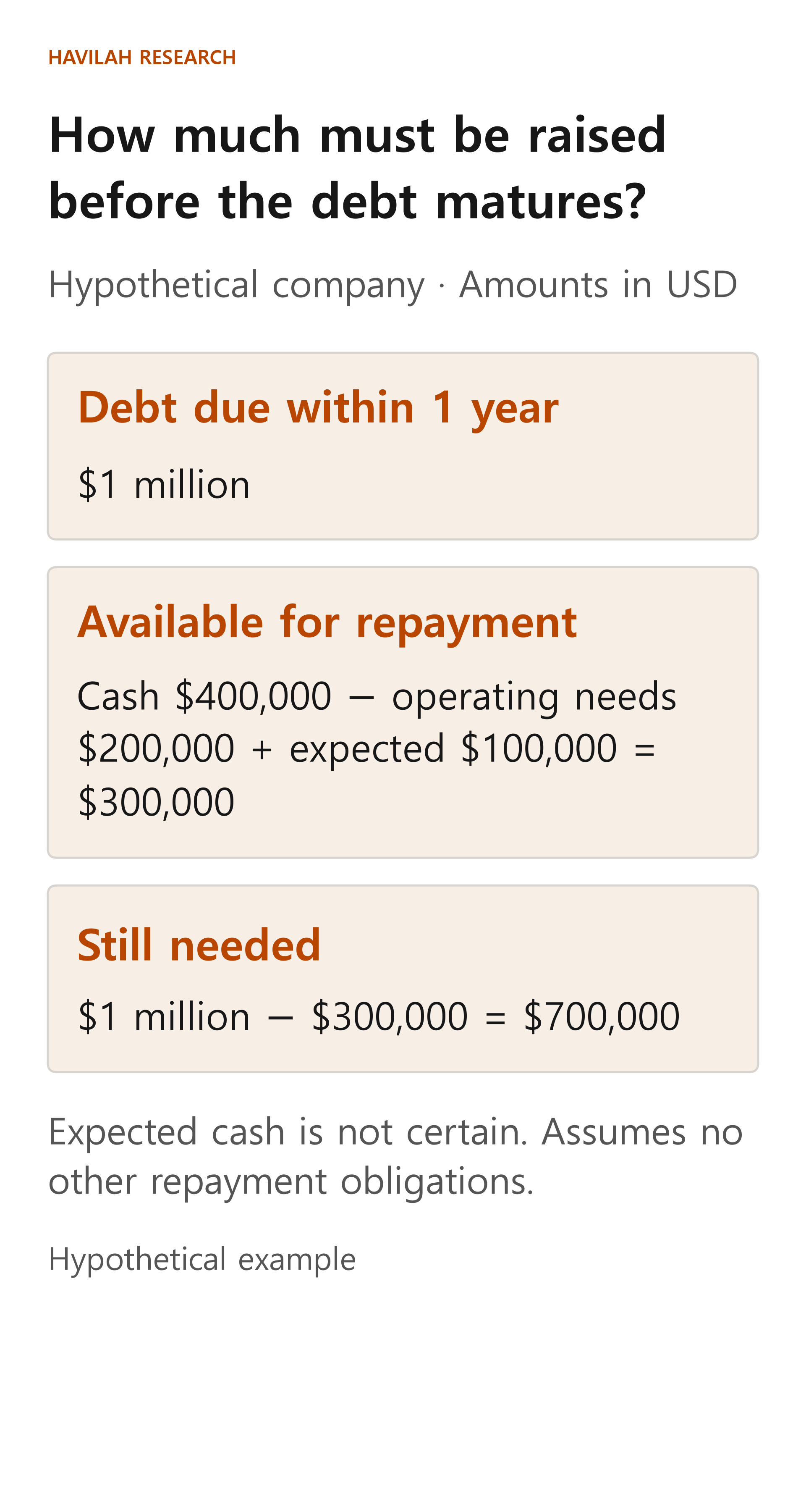
A hypothetical company has to repay $1 million of debt within 1 year. Of the $400,000 in cash it holds now, it must keep $200,000 to run the business, and it expects another $100,000 in cash to come in before the debt matures.
Under these assumptions, the money available for repayment is $400,000 − $200,000 + $100,000 = $300,000. That leaves $1 million − $300,000 = $700,000 still to be raised. But the $100,000 is only expected cash, so if it does not actually come in, the shortfall will be bigger. This is a simple assumption with no other repayment obligations or costs.
Suppose the company can borrow the missing $700,000 as a 1-year loan with simple interest. At 6% a year, the interest is $700,000 × 0.06 = $42,000. At 9% a year, it is $700,000 × 0.09 = $63,000. The difference in interest is $21,000. Fees and taxes are excluded.
This calculation assumes the company can borrow under either condition. In reality, besides charging a higher interest rate, lenders may require collateral or other terms, or the company may not be able to borrow the full amount it needs.
Which companies deserve a closer look?
First, check whether a lot of debt matures in the near term. If cash from operations does not come in steadily, or if a company is short of cash it can use right away and relies heavily on new borrowing, the strain can grow when markets are difficult.
Even if a company seems to have a lot of cash, not all of it can be used freely. Also look at the money needed to keep the business running, cash whose use is restricted and other repayment obligations. On the other hand, if its maturities are far off and it has enough cash and money coming in from operations, a company may have less need to raise new money in a hurry. That is not a guarantee that there is no risk either.
When the market yield on an existing fixed-rate bond rises, the interest agreed in that bond does not change right away. But when the company borrows again at maturity, new terms may apply. With floating-rate debt, the interest burden can change sooner, depending on the reference rate and the reset dates in the contract.
What should investors check in filings?
Do not look only at the cash and borrowings in the financial statements; also read the debt maturity schedule, the split between fixed and floating rates, and any collateral and contract terms. Debt contracts may limit the amount of debt or set conditions on financial ratios, and what happens if the company breaks those conditions differs from contract to contract.
Finally, think through a case where cash from operations comes in lower than expected. Whether the company can cover the shortfall with cash, how much it depends on refinancing, and whether it can keep the business going even if loan terms get worse will all help you make your investment decision.