
Even if a bakery sells the same number of loaves every day, it keeps less money when flour and electricity get more expensive. It could raise its prices, but then it has to worry about losing customers.
A sustained rise in prices is called inflation. How inflation affects a company's results depends on which costs are rising, how much of those costs the company passes on in its selling prices and how its customers react.
Less can be left over even when the selling price stays the same
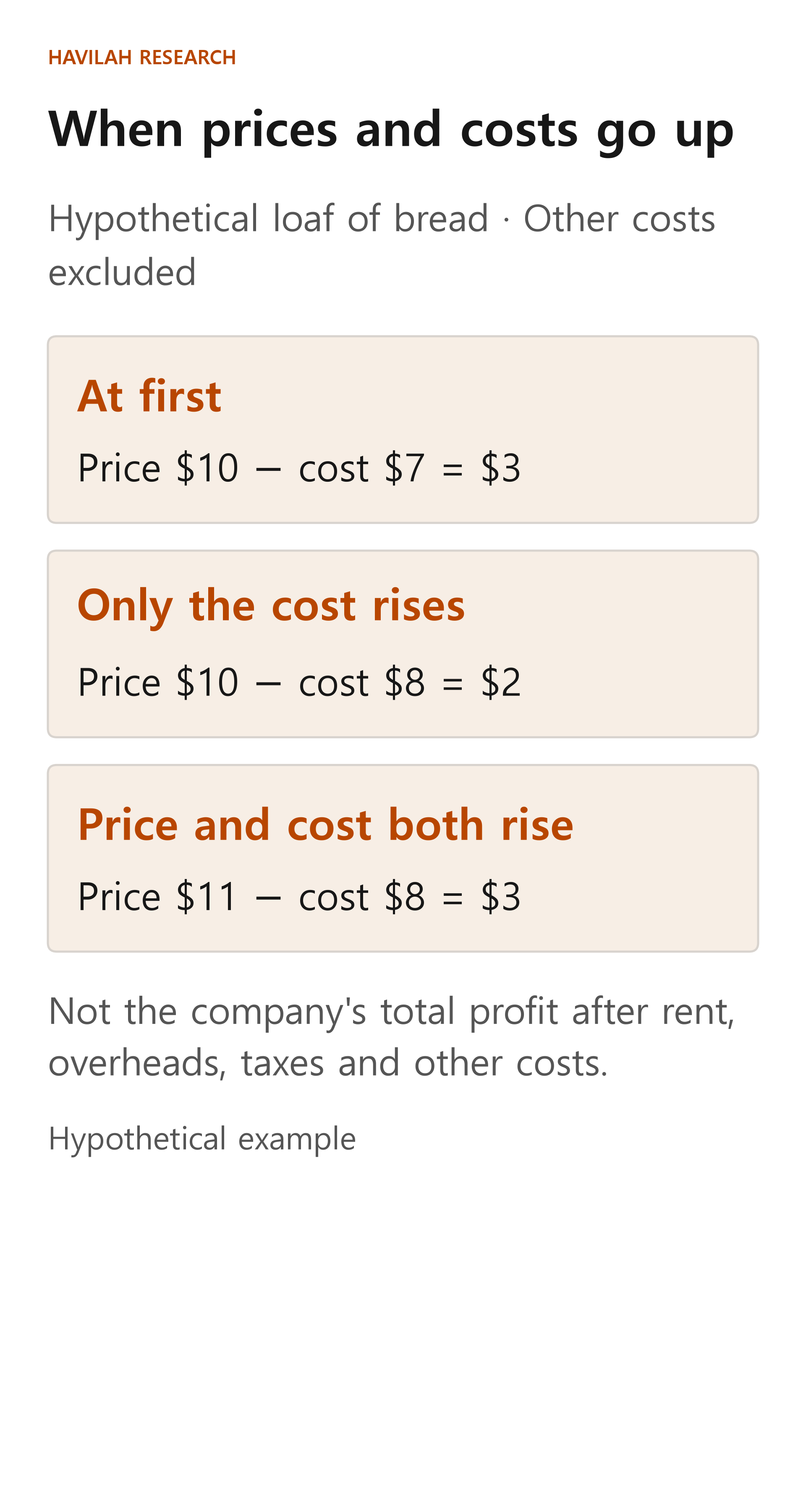
Suppose a hypothetical bakery sells a loaf of bread for $10, and the ingredients, packaging and other costs of selling one more loaf come to $7. The bakery keeps $10 − $7 = $3 per loaf.
If ingredient and other costs rise so that each loaf now costs $8 but the price stays at $10, the bakery keeps $10 − $8 = $2. The amount left per loaf has fallen from $3 to $2.
Here, the amount left over is simply the selling price of one loaf minus the cost of that loaf. It is not the final net income after the shop's rent, managers' salaries, taxes and so on. To see a real company's profit, you also have to account for those other costs.
Does raising the price solve everything?
Suppose the bakery raises its price from $10 to $11 a loaf, and each loaf still costs $8. The amount left from selling one loaf is $11 − $8, which is $3 again. But the share of the selling price that is left is 3 ÷ 11 × 100, or about 27.27%. That is lower than the earlier 3 ÷ 10 × 100 = 30%.
Even when the amount left per loaf is back where it was, the share left relative to the price is not necessarily back too. The percentages in this example reflect only the cost of each loaf, so they are not the same as the company's overall operating margin.
You also cannot know whether customers will keep buying the same quantity after a price increase. Hypothetically, if the bakery used to sell 100 loaves and sells 90 after the increase, its total falls from $300 to $270, even though it keeps $3 per loaf in both cases. This comparison assumes there are no other costs, and it does not mean a price increase always causes sales volume to fall.
Where does the power to raise prices come from?
A company's ability to pass rising costs on in its selling prices, at least in part, is called pricing power. It can depend on whether customers really need the product, whether many competitors sell similar products and when contracts come up for renewal.
Even a popular product cannot have its price raised without limit, because customers may look for cheaper alternatives or buy less. In fact, the U.S. restaurant company Cracker Barrel explained in its filings that trying to pass all of its costs on through prices could reduce customer demand. This is a risk that the company itself disclosed; it does not mean every restaurant company will see the same result.
Different companies face different rising costs
Food companies can be sensitive to the cost of grain, packaging materials and transportation. For companies that need a lot of staff, wages and employee benefits can be important. A company that has secured raw materials under long-term contracts may take some time before price changes show up in its actual costs.
So do not judge how fast a particular company's costs are rising from the headline consumer inflation rate in the news alone. An indicator that tracks the prices of goods and services that consumers buy and an indicator that tracks the prices producers receive measure different things. Look separately at the materials, wages and contract terms the company actually deals with.
What should investors look for in filings?
Start by looking at why revenue grew. Whether revenue rose because the company raised prices or because it sold more makes a difference to how you understand its situation. Next, check how much its cost of goods and labor costs changed, and whether the company explained any price adjustments or cost cuts.
If margins improved, also ask whether the change can last. A temporary drop in material costs or a move in exchange rates may have played a part. On the other hand, it is best not to conclude from a single quarter of rising costs that the same situation will continue. You need to look at prices, sales volume and costs together to see how a company is changing.