
Sometimes growth stocks move sharply on news that U.S. Treasury yields, the yields on U.S. government bonds, have gone up, even though nothing about the companies has changed. What does the money a company will earn in the future have to do with Treasury yields?
The key is how much you think money you will receive in the future is worth today. Interest rates are one of several factors that affect this valuation.
Treasury yields and the discount rate for stocks
A government bond is a security that a government issues when it borrows money. When people talk about a government bond yield, they usually mean the return you can expect from holding a bond that trades in the market. The yield differs depending on the bond's maturity and its price.
When investors think about what a stock is worth, they also convert the cash they expect to receive in the future into a value today, called the present value. The rate used to do this is the discount rate. In setting a discount rate, you can take into account both the return expected from relatively safe assets and the reward for taking on the risk of owning stocks.
That is why a change in government bond yields can be one of the factors that changes the discount rate assumed for stocks. But a bond yield and the discount rate for a stock are not the same number. How investors judge the risk of stocks can also change, and there is no guarantee that the discount rate will move by exactly as much as bond yields do.
The same money, received at different times
Imagine a hypothetical investment that pays you $100 just once. In one case you receive it 1 year from now; in the other, 10 years from now. Assume there is no other cash and no value left over, and that the amount and timing of the cash stay the same even when the discount rate changes.
If you set the discount rate at 10% a year, the present value of $100 received in 1 year is 100 ÷ 1.10, or about $90.91. If you receive the same $100 in 10 years, it is 100 divided by 1.10 to the 10th power, or about $38.55.
If you raise the discount rate to 12% a year, the present value of $100 received in 1 year is about $89.29, and the present value of $100 received in 10 years is about $32.20. All values are rounded to two decimal places.
| When the hypothetical cash is received | Discount rate 10% a year | Discount rate 12% a year |
|---|---|---|
| $100 in 1 year | About $90.91 | About $89.29 |
| $100 in 10 years | About $38.55 | About $32.20 |
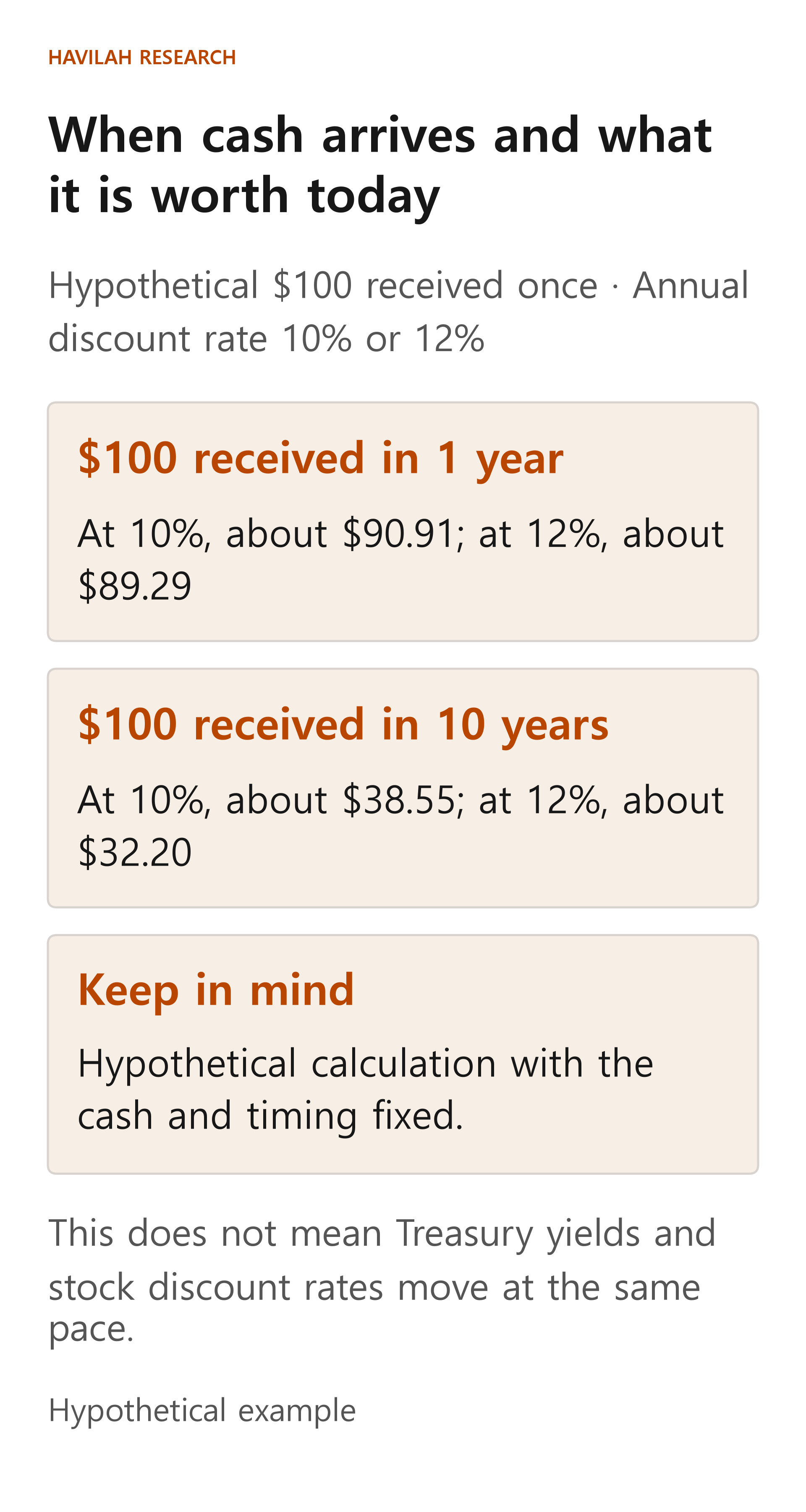
Under these assumptions, a higher discount rate cuts the present value of money received far in the future by a larger proportion. That does not mean actual share prices fall by as much as the table shows. Real companies generate cash at many different points in time, and their expected cash and their risk change as well.
Why growth stocks can be sensitive
Growth stocks are stocks that carry high expectations that revenue and profits will grow strongly in the future. If a stock's valuation depends heavily on cash that is far in the future rather than close to the present, its calculated value can change sharply when the discount rate assumption changes.
But you cannot pin down how sensitive a stock is to interest rates just because it is called a growth stock. Some of these companies already generate a lot of cash, while for others it is uncertain whether the growth will happen as expected. Look at when and how much cash is expected to come in, and at what expectations are already built into the share price.
Why Treasury yields are rising also matters
Growth stocks do not always fall when Treasury yields rise. For example, if yields rise together with expectations that the economy will improve, the outlook for some companies' future revenue and profits may improve too. On the other hand, raising money may become more expensive, or worries about future profits may grow.
Also look at the maturity of the Treasury yield you are watching. Short-term and long-term rates can move by different amounts and even in different directions. Long-term rates reflect not only current policy but also expectations about future interest rates and the economy.
Questions to ask when you invest
Look at how much the value of the company you are interested in relies on cash in the near term and how much it depends on growth in the distant future. It also matters whether the company needs more funding to achieve that growth and whether it can afford its interest costs.
Rather than plugging in a single discount rate and treating the result as the right answer, change the expected cash and the discount rate one at a time and compare how much the result changes. Share price moves are the combined result not only of interest rates but also of earnings, how risk is perceived and what the market expects.