
When the Federal Reserve System, the central bank of the United States, usually called the Fed, raises or lowers interest rates, the stock market can move sharply. Why would an interest rate between banks affect the companies you invest in?
An interest rate is the cost of borrowing money and the reward for lending it. When rates change, people's and companies' spending plans can change, and that change can feed through to companies' revenue and costs.
The two goals the Fed watches
The Fed aims for maximum employment and stable prices in the U.S. economy. In other words, it tries to help as many people as possible stay in work over time, while keeping prices from becoming too unstable.
The two goals do not always point in the same direction. When prices are rising fast, spending that is too strong may need to be cooled. On the other hand, when the economy is weakening and jobs are being lost, spending may need support. The Fed does not decide mechanically from a single number; it looks at employment, prices and a range of other information together.
Which interest rate does the Fed move?
The federal funds rate is the interest rate that applies when U.S. financial institutions borrow and lend money overnight in the federal funds market. The Federal Open Market Committee, the Fed's monetary policy decision-making body, sets a target range for this rate.
The Fed does not set every interest rate that companies pay on their loans. The target range and the Fed's policy tools influence short-term market rates, and these can in turn affect other interest rates and financial conditions. Actual lending rates also reflect the length of the loan, the borrower's creditworthiness and how the contract is set up.
How interest rates reach companies
When lending rates rise, companies that take out new loans or have loans whose rates change can face higher interest costs. Companies may also put off investing in equipment, and consumers may delay buying expensive goods. Conversely, when borrowing costs fall, there is more room for spending and investment to grow.
Suppose a hypothetical company borrows $1 million for 1 year, and the interest is calculated simply on the principal and paid at maturity. At 6% a year, the interest for 1 year is $1 million × 0.06 = $60,000. If everything else stays the same but the lending rate is 7% a year, the interest is $1 million × 0.07 = $70,000. The difference is $10,000.
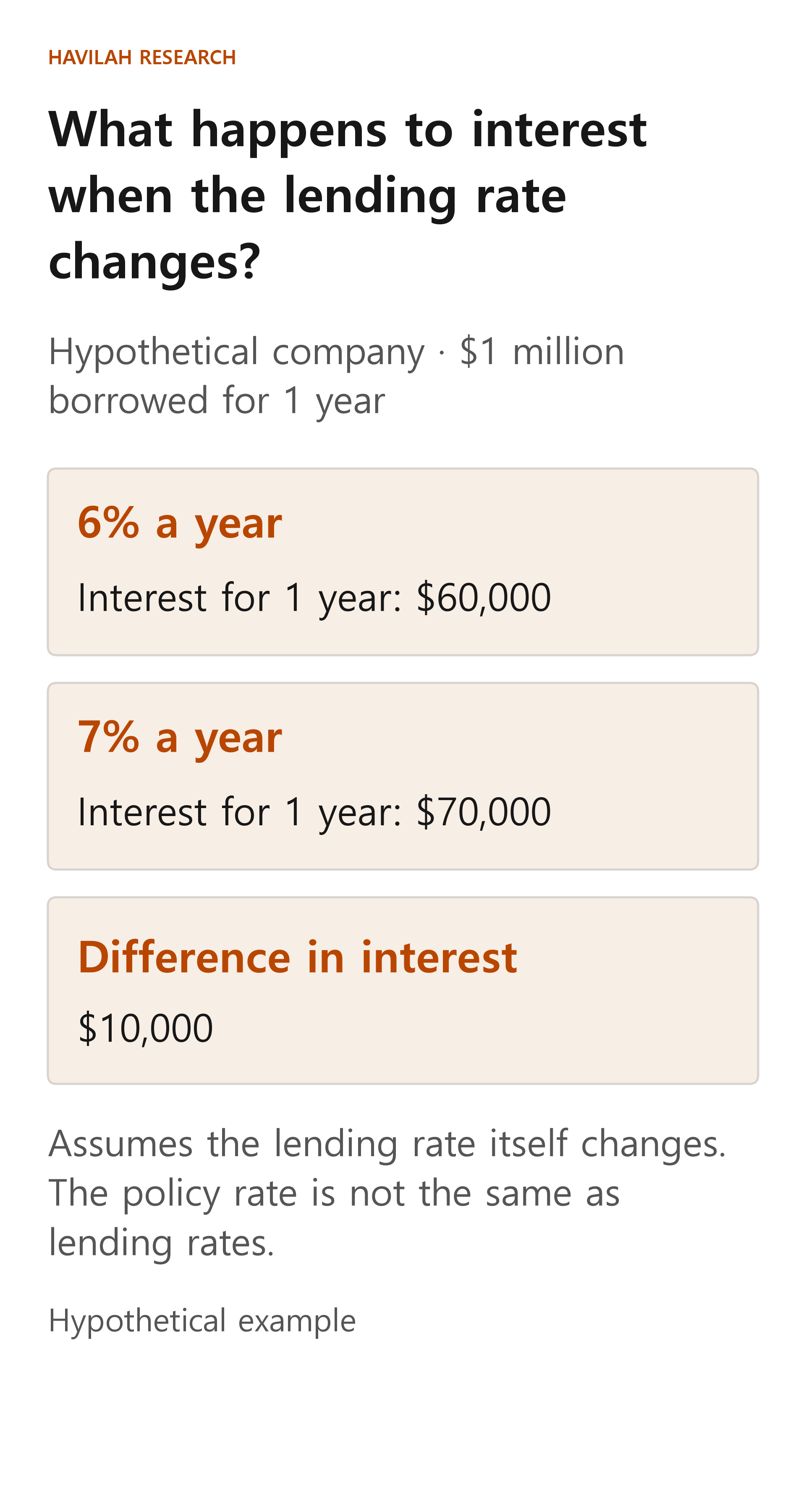
This example assumes that the lending rate itself changes from 6% to 7%. It does not mean that when the Fed raises rates by 1 percentage point, every company's lending rate also rises by exactly 1 percentage point. The example also leaves out fees, taxes, early repayment and the way interest is paid.
Money already borrowed at a fixed rate may keep the same rate for the agreed term. A floating-rate loan can change with the reference rate and the reset schedule written in the contract. That is why you should check both the maturities and the interest terms of a company's debt in its filings.
Do prices fall as soon as rates go up?
No. It can take time for interest rates to affect spending and investment, and for those changes to show up in employment and prices. Prices are also affected by factors other than interest rates, such as the supply of raw materials, the weather and logistics.
When rates are cut, the reason matters too. A cut because inflation pressure has eased and a cut because the economy has deteriorated sharply can leave companies facing different situations. You cannot conclude that every company's results will improve just because rates were cut.
What should investors check?
First, look at how much the company you are interested in has borrowed, how its debt is split between fixed and floating rates, and when it has to be repaid. If the company sells products that many customers buy with loans, how affordable those purchases are for customers can also matter.
Also separate the rate decision the market already expected from the actual announcement, and note how they differed. Long-term interest rates are affected not only by the current policy rate but also by expectations about future policy and the economy. You cannot know in advance that share prices will move in one direction after an announcement.
Interest rate news is not an automatic signal to buy or sell. It is a starting point for asking which interest rate, through which contracts, could affect the costs and revenue of the company you are interested in.