
Two shops earned the same amount of money this year. But one is expected to keep attracting customers steadily in the years ahead, and the other will soon have to close. Would you want to pay the same price for both?
When you think about what a business is worth, you look not only at the money it earned this year but also at how much cash it can produce in the future, how long you have to wait to receive that money and what risks you have to accept along the way.
Turning future money into today's value
$100 you have now and $100 you will receive in 1 year are the same amount, but you receive them at different times. If you have the money now, you have the chance to use it elsewhere in the meantime, and there is also a chance that the future money will not arrive as expected.
Converting money you expect to receive in the future into an amount in today's terms is called discounting. The rate you use to do this is called the discount rate. The discount rate is an assumption you set by considering how long you have to wait, how risky that cash flow is and other factors.
Let's value money you will receive in 1 year
Here is a very simple hypothetical example. In 1 year, after covering all of its costs, taxes, payments owed to creditors and so on, a company pays $110 in cash to its shareholders as a whole and then closes its business. Assume there is no money to receive after that and no value left in any remaining assets. This $110 is not an amount that is certain to be paid; it is an estimate used for explanation.
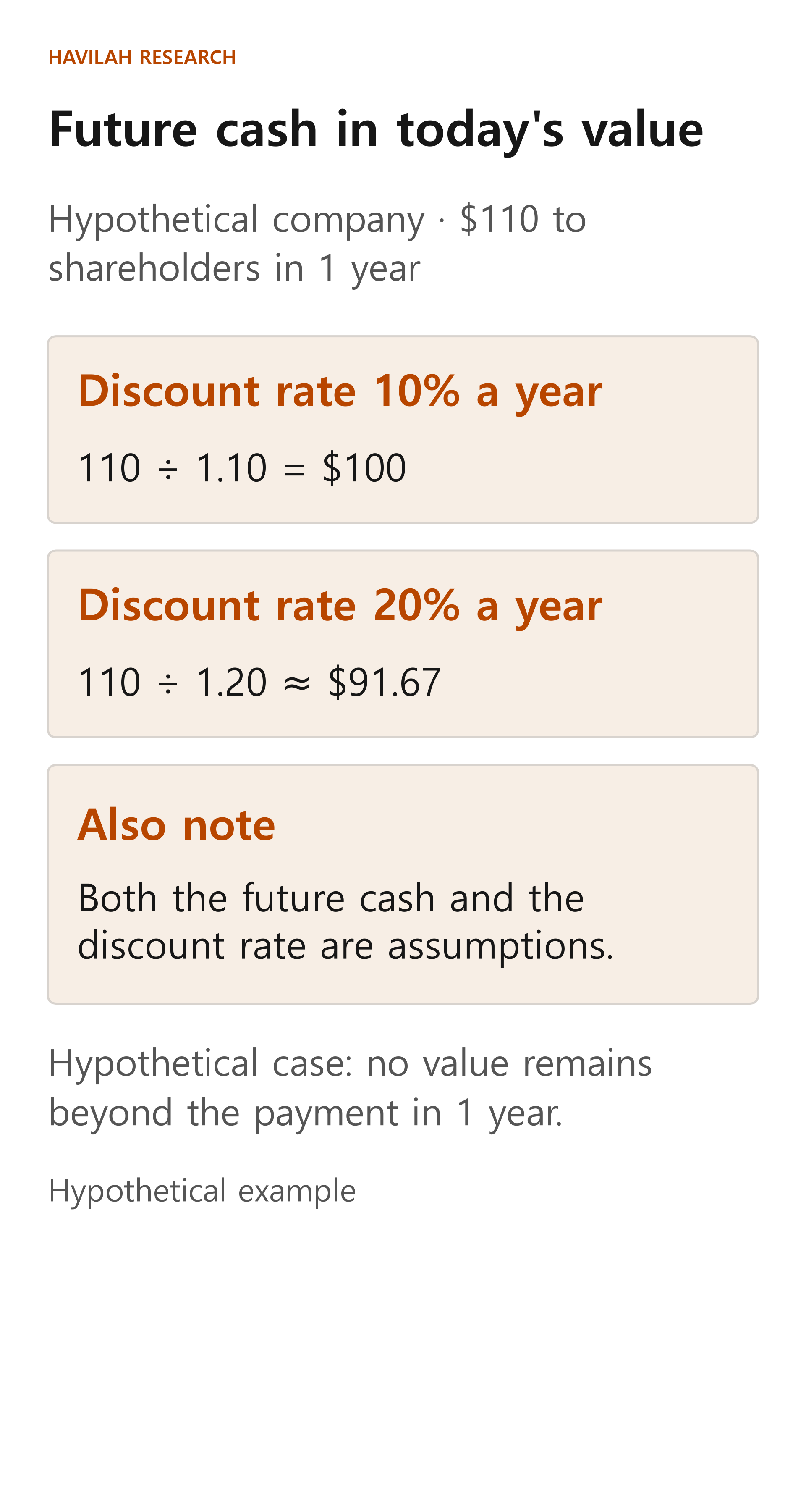
If shareholders require a return of 10% a year on this cash flow, the present value of $110 received in 1 year is 110 ÷ 1.10 = $100. Put the other way around, $100 today that grows by 10% over 1 year becomes $110.
If you instead apply a discount rate of 20% a year to the same future cash of $110, the present value is 110 ÷ 1.20, or about $91.67. This is rounded to two decimal places. Even for the same future amount, the present value is lower when the required return is higher.
| Hypothetical cash to shareholders in 1 year | Discount rate assumed | Present value |
|---|---|---|
| $110 | 10% a year | $100 |
| $110 | 20% a year | About $91.67 |
Linking this to the value of one share
Under the first assumption, suppose the present value of the cash going to shareholders as a whole is $100, the company has 100 common shares, and every share carries the same rights. If there are also no new shares to be issued and no claims by other shareholders, the value per share is 100 ÷ 100 = $1.
This number is a calculation that assumes the future cash and the discount rate set earlier are correct. It does not mean the actual market price will be $1 or that investors will earn 10% a year. If the cash turns out different from the forecast, or if the shares trade at a different price, the actual result will differ too.
The example above already took account of payments to creditors, such as debt repayment, and valued the cash going to shareholders directly. If you subtract the same debt again from a shareholder value calculated this way, you may end up counting that burden twice.
A real company's future does not end after one year
A real company can keep operating for many years. So you need to forecast its cash year by year, convert each year's cash into present value, and also take proper account of the value beyond the period you forecast in detail. Keep the two parts separate so that you do not count the same future cash twice, once in the forecast and again in the value after it.
When you estimate cash, keep in mind that even when revenue grows, the company needs money to build up inventory and replace equipment. A high profit figure alone does not tell you exactly how much cash shareholders can receive.
Cash available to the business as a whole and cash available to shareholders cover different scopes. Use a discount rate that matches the kind of cash you forecast, and when you convert the value of the whole business into shareholder value, treat debt and other claims consistently.
How can you check the assumptions as an investor?
Check where the expected cash comes from. See whether the forecast includes the costs and equipment spending that revenue growth requires, debt repayment and so on. The cash a company will produce in the future is not a settled fact, so it also helps to look separately at a good case and a bad case.
The discount rate is not a number with a single right answer either. For example, as in the calculation above, the same hypothetical cash of $110 has a different present value at 10% a year than at 20% a year. That is why it is important to change the various assumptions and check how much the result changes.
A valuation is a tool for asking why the current share price might be reasonable, or what expectations are built into it. A single calculated result cannot guarantee real returns or settle what the future holds.