
If all you know is that a company has $600 of debt, it is hard to tell whether that is risky. You also need to see how much the business earns, how much it has to repay soon and how much cash it actually has available.
Debt can help a business grow, but it also creates an obligation to pay interest and repay principal. What matters is looking at the size of the debt together with the company's ability to carry it.
First look at debt and cash together
Net debt is a measure calculated as borrowed money minus cash and similar items. Not every liability on the financial statements is a bank loan or a bond, so you need to be clear about which debts are included. Companies may also treat cash, lease liabilities and other items differently.
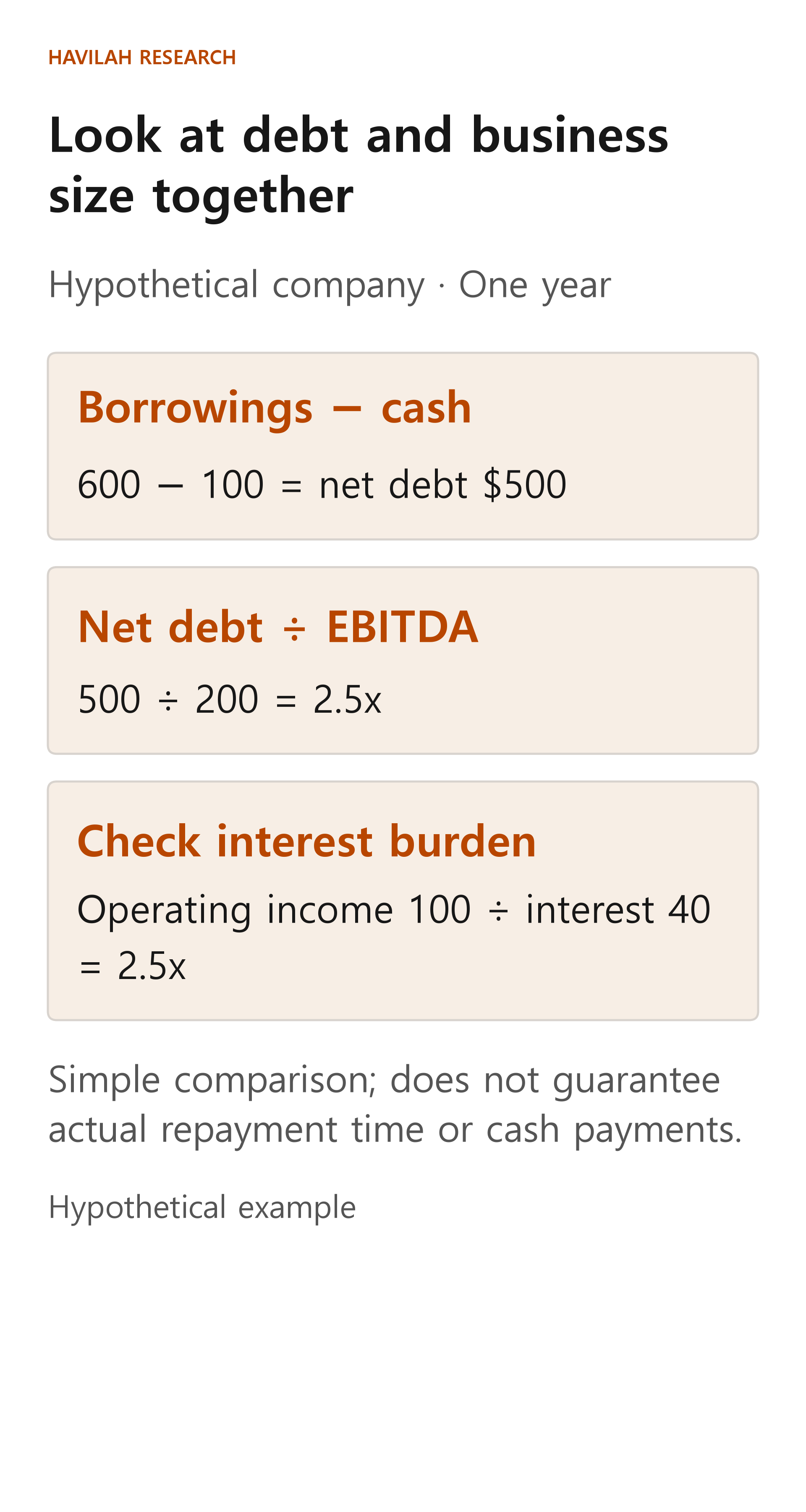
Suppose a hypothetical company has $600 of borrowings and $100 of cash. In this example, net debt is 600 − 100 = $500. This calculation makes the simple assumption that all of the cash can be used freely.
In reality, some of the cash may be restricted or needed to run the business. A net debt figure of $500 does not prove that the company could use all $100 to repay debt right away.
How large is the debt compared with the business?
Suppose this company's EBITDA for 1 year is $200. EBITDA is a measure of profit before interest, taxes, depreciation and amortization are taken into account. The adjustments can differ from company to company, so check what was added and what was subtracted.
Dividing net debt of $500 by EBITDA of $200 gives 2.5x. This ratio is one yardstick for comparing debt with the size of the company's profit. It is a simple comparison that leaves out interest, taxes, spending on equipment and other cash needs, so it does not mean the company could actually pay off its debt in 2.5 years.
| Hypothetical company | Amount or ratio |
|---|---|
| Borrowings | $600 |
| Cash | $100 |
| Net debt | $500 |
| EBITDA for 1 year | $200 |
| Net debt ÷ EBITDA | 2.5x |
If EBITDA is 0, you cannot divide by it, so the multiple cannot be calculated. If EBITDA is negative, a simple comparison of multiples is hard to make. Check not only what the multiple is but also whether the business actually brings in cash.
Can the company afford its interest?
The interest coverage ratio is one way to look at the interest burden by comparing profit with interest expense. If a hypothetical company's operating income for 1 year is $100 and its interest expense for the same period is $40, the ratio is 100 ÷ 40 = 2.5x.
This calculation only shows how many times its interest expense the company earned in operating income. It does not guarantee that the company can pay its interest in cash. The top and bottom of the interest coverage ratio can be defined differently by different companies or loan agreements, so check how it is calculated.
If operating income falls or the interest on a variable-rate loan rises, this ratio can get worse. If interest expense is 0, you cannot calculate a multiple this way, and when operating income is negative, a simple comparison of multiples is hard to make.
Do not overlook maturities and cash flow
Two companies can have similar net debt and interest coverage ratios, yet be in different situations if one company's debt comes due soon and the other repays its debt in installments over several years. Look in the notes to the financial statements for how much principal falls due at each maturity and whether the interest rates are fixed or variable.
Even if a company plans to refinance, that is, borrow new money to repay existing debt, it cannot always raise the money, and it may not get the same interest rate as before. Also check the terms of its loan agreements and how much cash it has available.
Check whether operating cash flow, after the equipment spending the company needs, still leaves enough room to cover interest and principal payments. But look at how the cash flow statement classifies items, so that you do not subtract a second time any interest that is already reflected in operating cash flow.
When you invest, do not reach a conclusion from one number
Even within the same industry, companies differ in how fast they grow, how much they invest in equipment and how stable their cash flow is. Rather than applying one multiple to every company to sort them into safe and risky, it is more useful to compare a company with others in similar businesses and to look at the trend over several periods.
As an investor, you can check four things. How much has the company borrowed, and how much cash can it actually use? Is its profit large enough compared with its interest burden? When does its debt come due? Can the cash the business generates cover the spending and repayments it needs?
Indicators are a starting point for finding companies worth a closer look. No single number guarantees a safe investment or future returns.