
Two shops made the same profit. One works with modest equipment, and the other uses far more expensive machines and premises. Even when the profit is the same, you see a different picture once you also look at the money put into running each business.
ROIC stands for return on invested capital. It is a measure of how much profit a company produced from the capital it put into its business. The calculation method can differ from one company to another.
How is it different from ROE?
ROE, which you saw in the previous lesson, compares net income with shareholders' equity, the capital that belongs to shareholders. ROIC takes a broader view of the capital used in the business and compares it with the business profit that capital produced. A business can be funded with both shareholders' money and borrowed money.
One way to calculate it is to take operating income before interest expense, adjust it for the effect of taxes, and divide the result by average invested capital. Using profit before interest is meant to show how the business itself performed before that profit is shared out between shareholders and the people who lent the company money.
You can think of invested capital as the money put into the business. Some companies add debt and shareholders' equity and then subtract cash and similar items, and some adjust other items. Even when the name is the same, the calculations can differ.
Let's calculate it for a hypothetical company
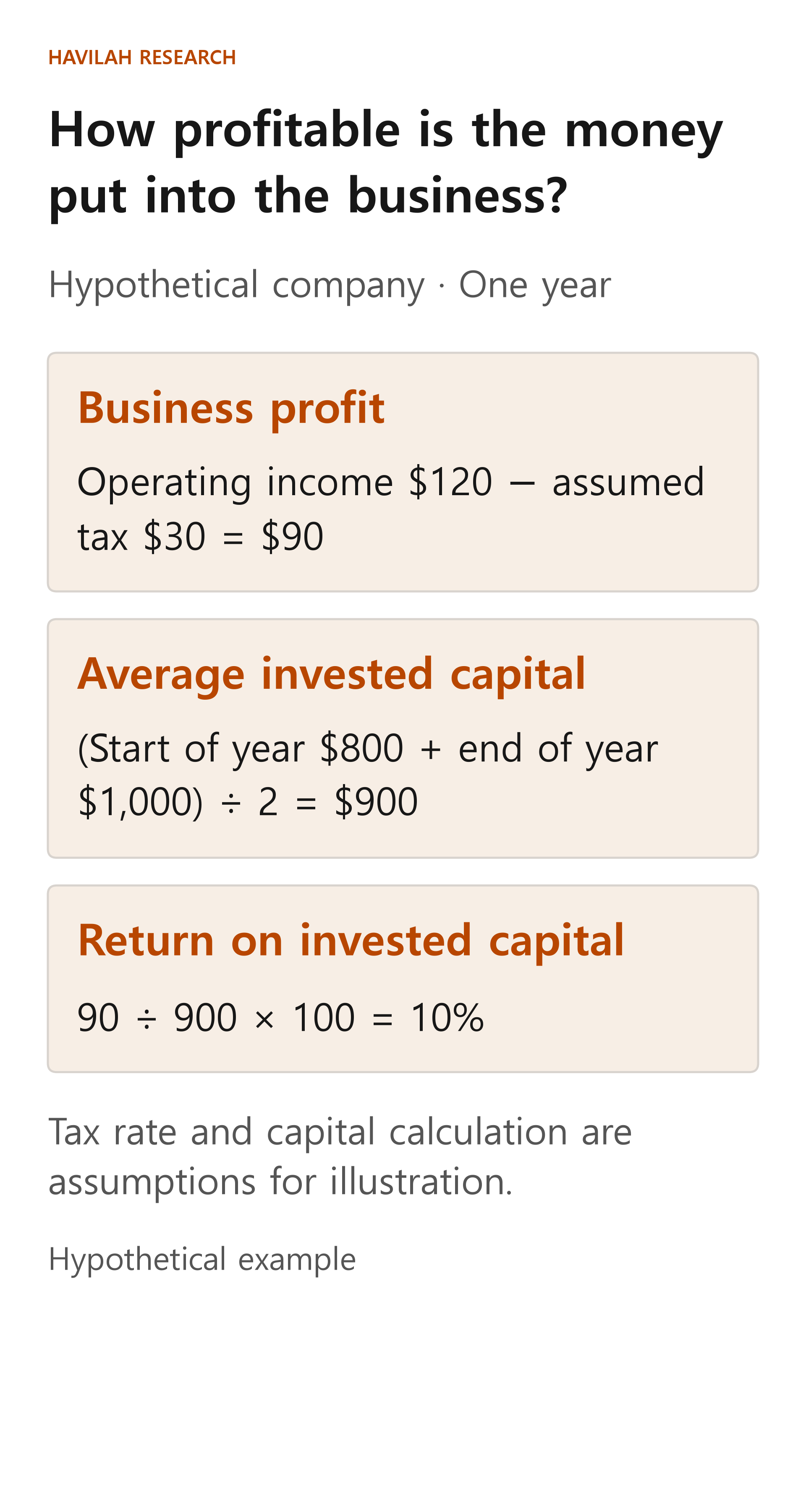
Suppose a hypothetical company recorded operating income of $120 before interest expense in one year. If we simply assume a hypothetical tax rate of 25% on its business profit, we subtract $30, which is 25% of $120, and $90 is left. This is not a calculation of the tax actually paid; it is an assumption made for the comparison.
Say the company's invested capital was $800 at the start of the year and $1,000 at the end. This example uses the average of those two points, so average invested capital is $900.
| A hypothetical year | Calculation |
|---|---|
| Operating income before interest expense | $120 |
| Assumed tax effect: 25% | −$30 |
| Business profit after the tax effect | $90 |
| Average invested capital: (800 + 1,000) ÷ 2 | $900 |
| ROIC: 90 ÷ 900 × 100 | 10% |
So in this calculation, ROIC is 10%. If the way you average, the tax rate or the items included in invested capital change, the result can change too.
Compare it with the cost of raising capital
Borrowing money creates an interest burden, and shareholders who put money in also expect a return. So you can estimate what it costs to raise the capital a business needs. An estimate that takes into account the mix of debt and shareholders' equity and the cost of each is called the weighted average cost of capital, or WACC for short. When you compare it with an ROIC calculated from business profit after the tax effect, you need to account for things such as the tax effect on the cost of debt, and make sure the business, the period and the scope of invested capital match.
For the hypothetical company above, assume a WACC of 8% a year. If ROIC calculated on the same basis is 10%, the difference is 2 percentage points. Multiplying the average invested capital of $900 by 2% gives $18. This is a rough estimate, from a simple comparison, of the business profit earned above the assumed cost of capital.
This $18 is not cash that actually landed in a bank account, nor is it money that could be paid to shareholders right away. In particular, WACC is an estimate, so if assumptions such as the interest rate, the return shareholders expect or the capital mix change, the result of the comparison changes too.
Why a high ROIC alone is not enough
Companies differ in what they include in invested capital and in business profit. For example, the result can change depending on how cash and lease obligations are treated and whether assets that arose from acquisitions are included. If a company uses an adjusted profit figure, also check how it differs from the profit in its financial statements as reported.
As a real example, Bruker presented in its filings an ROIC that divides adjusted operating income after the tax effect by average capital, and explained that, to calculate capital, it subtracts cash and similar items from debt and equity. This is that company's own definition. It does not mean every company calculates ROIC the same way.
When assets a company invested in long ago have aged in its accounts and their book value has fallen, the ratio can look higher than it otherwise would. And even if the ROIC of the company's past business as a whole was high, whether new investments will earn the same return is a separate question.
How to look at ROIC when you invest
In the ROIC calculation table the company provides, first check which items are included in profit and in invested capital, what averaging period is used and what tax assumption is made. When you compare similar companies, check whether they use the same basis as far as possible.
Next, look at how the amount invested and business profit changed together over several years. Even if ROIC is high, your return as an investor can be different if the company's shares trade at a high price. Review the business's profitability, its future investment opportunities and the share price together.