
Two companies run similar businesses, but one has a higher ROE. Does that mean the one with the higher figure is making better use of its shareholders' money? It might, but the ratio may also be higher because the company uses a lot of debt or because its equity has shrunk.
ROE stands for return on equity. It is a ratio that shows how much profit a company made from the capital that belongs to its shareholders. Along with the number itself, you need to check why it came out the way it did.
What does ROE divide?
Shareholders' equity is a company's assets minus its liabilities. Net income is the profit left after costs, taxes and other items have been taken out of revenue.
For an annual ROE, a common method is to divide net income by the average shareholders' equity for the same period and multiply by 100. One simple way to find average equity is to add the equity at the start and the end of the year and divide by 2. Check which period and which calculation the actual filing uses for the average.
For example, if net income over 1 year is $120 and average shareholders' equity for the same period is $1,000, ROE is 120 ÷ 1,000 × 100 = 12%. This is the ratio of profit to equity as recorded in the accounts. It does not tell you how much the share price rose or what return investors actually earned.
Debt can change ROE
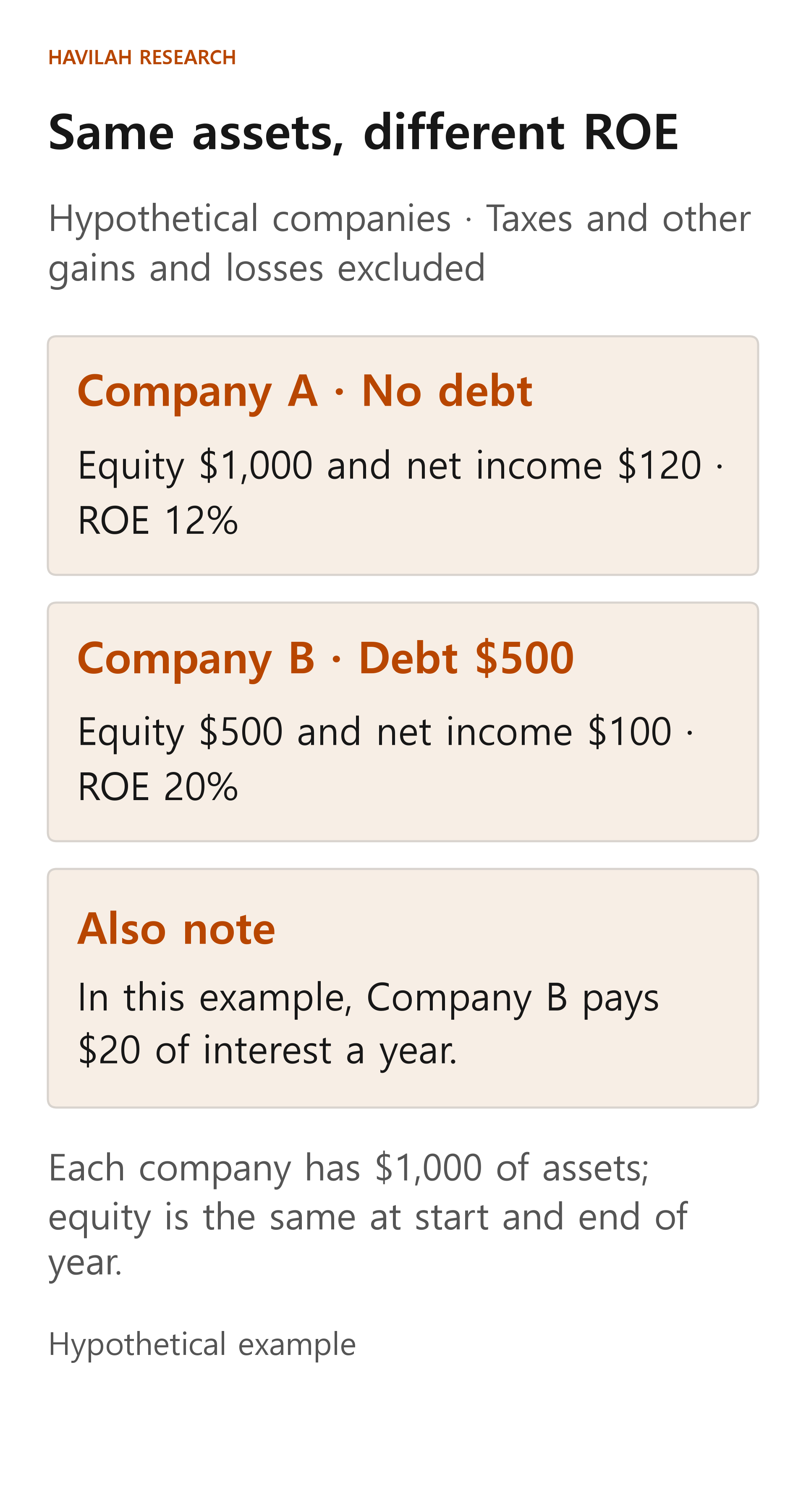
Suppose hypothetical Company A and Company B each use $1,000 of assets to run the same business. Over 1 year, each earns $120 from the business before paying interest, and we assume there are no taxes and no other gains or losses.
Company A has no debt and $1,000 of shareholders' equity. Company B uses $500 of debt and $500 of equity, and over 1 year it pays $20 of interest, which it records as an expense. To keep the explanation simple, assume that each company's equity is the same at the start and the end of the year.
| A hypothetical year | Company A | Company B |
|---|---|---|
| Assets used | $1,000 | $1,000 |
| Debt | $0 | $500 |
| Average shareholders' equity | $1,000 | $500 |
| Business profit before interest | $120 | $120 |
| Interest expense | $0 | $20 |
| Net income | $120 | $100 |
| ROE | 12% | 20% |
Company A's ROE is 120 ÷ 1,000 × 100 = 12%. For Company B, net income of $100, which is what is left after $20 of interest, is divided by $500 of equity, so its ROE is 20%. Under these assumptions, the difference comes from Company B running the same amount of assets with less equity and more debt.
To keep equity the same at the start and the end of the year, this example assumes that each company pays out all of that year's net income as dividends and has no other changes in equity. Real companies may pay different dividends and have other changes in equity.
Debt comes with a duty to repay
A higher ROE at Company B does not mean it is also less risky. When a company borrows, it has to pay interest and principal as the loan agreement requires. Even if the business slows down, the burden of paying interest can remain. And if more of its cash flow goes to repaying debt, it may have less room to spend on the business.
For example, suppose the business profit before interest of both hypothetical companies above falls to $20, with everything else unchanged. Company A pays no interest, so its net income is $20. Company B's net income is $0 after subtracting $20 of interest. Company B's ROE is also 0%.
Even with the same amount of debt, the result changes when the relationship between business profit and the interest burden changes. Borrowing does not always raise ROE. In practice, you should also check when the debt matures, whether its interest rate is variable, and how much cash the company holds.
The ratio can also rise when equity shrinks
ROE depends not only on net income but also on the size of shareholders' equity, the number you divide by. If net income stays the same and equity shrinks, the ratio rises. That is why you should check whether equity has changed because of share buybacks, accumulated losses or other causes.
When a company's equity is close to 0 or negative, a simple ROE comparison is especially hard to interpret. In that case, rather than deciding which company is better from the ratio alone, it is better to find out why equity shrank and what the company's debt and cash flow look like.
What else should you look at when you invest?
First check net income and average shareholders' equity for the same period. Also see whether profit includes items such as a one-time gain from selling an asset, and whether equity changed sharply because of dividends, share buybacks or other causes.
Next, look at how much debt the company has and when it matures, how heavy the interest burden is, and how much cash the business actually generates. Industries differ in the assets they need and the way they raise money, so comparing a company with others that run similar businesses helps you understand it.
A high ROE is a clue that is worth looking into further. That ratio alone is not enough to conclude that a company is a good business or that its share price is a good buying price.