
If a shop sells more goods, is revenue the only thing that goes up? If some costs, such as rent, stay the same for now even when the shop sells more, the profit left over from the extra revenue can be larger.
A margin is the share of revenue that is left as profit. An improving margin means that more profit is left from the same $100 of revenue. To understand why a margin improved, you need to look at how revenue and costs changed together.
First check which profit is being divided
There are several kinds of profit. Gross profit is revenue minus the cost of the goods sold. Operating income goes a step further and also takes off the costs of running the business.
Operating income divided by revenue is the operating margin. For example, if revenue is $100 and operating income is $10, the operating margin is 10%. This does not mean all of that money is left as cash or paid out to shareholders. Interest, taxes and other items still have to be considered separately.
When sales rise, the weight of fixed costs can fall
To keep things simple, suppose a hypothetical shop keeps its prices the same and only sells more units. We will call costs that rise with the number of units sold, such as materials and packaging, variable costs. In this example, variable costs are 60% of revenue.
We will call costs that do not change right away as long as sales stay within a certain range, such as store rent, fixed costs. The shop's fixed costs are $300 in both years, and we assume it has no operating costs other than these.
| Hypothetical shop | First year | Next year |
|---|---|---|
| Revenue | $1,000 | $1,200 |
| Variable costs: 60% of revenue | $600 | $720 |
| Fixed costs | $300 | $300 |
| Operating income | $100 | $180 |
| Operating margin | 10% | 15% |
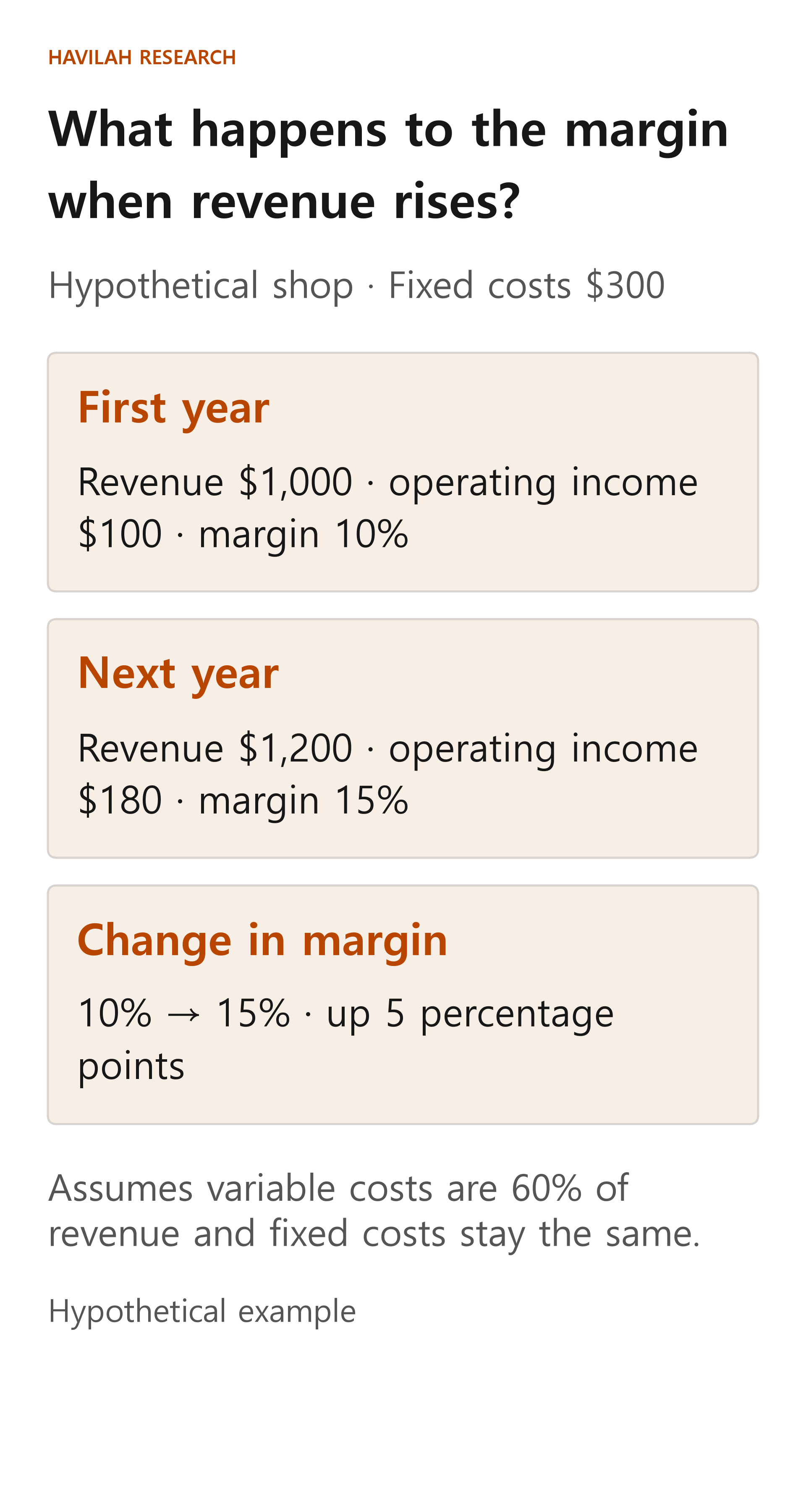
In the first year, operating income is 1,000 − 600 − 300 = $100. In the next year, it is 1,200 − 720 − 300 = $180. Revenue rose 20%, but on the assumption that fixed costs stayed the same, operating income rose 80%.
The operating margin is 100 ÷ 1,000 = 10% in the first year and 180 ÷ 1,200 = 15% in the next year. The difference between the two ratios is 5 percentage points. That is not the same as saying operating income rose 5%.
It can work the other way when revenue falls
Even when the shop sells less, it may still have to pay the same fixed costs for now. If the same shop's revenue falls to $800, with variable costs still at 60% and fixed costs at $300, operating income is 800 − 480 − 300 = $20. The operating margin is 20 ÷ 800 = 2.5%.
When revenue falls, fixed costs can take up a larger share of revenue. The relationship in which profit moves by more than sales do is called operating leverage. This effect can appear both when revenue rises and when it falls.
Other factors besides sales volume also change margins
Raising selling prices or lowering material costs can improve margins. On the other hand, if wages, shipping costs or raw material prices rise, margins can get worse even while sales grow. Whether more high-margin or more low-margin products were sold also makes a difference.
Here is a real example. In its 2025 annual filing, Domino's Pizza gave two reasons why labor costs as a share of revenue fell in its supply chain segment: higher revenue eased the cost burden, and labor became more efficient. The same filing also said that higher insurance costs partly offset this improvement. This is an example from that one segment, and it does not by itself explain the company's overall operating margin.
What should you look at when you invest?
First check whether the figure being compared is the gross margin or the operating margin. Then see how much revenue and profit each changed in dollar terms, and look in the company's explanation of its results for changes in prices, sales volume, product mix and costs.
Fixed costs do not stay fixed forever either. When a company adds stores or factories, rent and labor costs can rise in steps. Even if a company raised its margin by cutting costs, check that it has not cut too deeply into spending that product quality or future growth depends on.
A margin improvement in a single quarter does not tell you that the same ratio will hold in the future. Look at the cost structure over several periods, together with the causes of the change that the company describes.