
A company made a profit, yet its cash went down. Are the numbers wrong? Not necessarily. This can easily happen if some sales have not been paid for yet, or if the company bought equipment and repaid debt.
The income statement, the cash flow statement and the balance sheet show the same company from different angles. Linking the three makes it easier to understand why the numbers changed, and it can also help you spot numbers that were copied incorrectly.
How do the three statements differ?
The income statement compares revenue and costs over a period to show profit. The cash flow statement shows how cash came in and went out during the same period. The balance sheet shows, at a specific point in time, the assets the company has, the liabilities it must pay, and its shareholders' equity.
Assets are things the company owns, such as cash or equipment, and liabilities are obligations, such as money it has to repay. Shareholders' equity is the shareholders' share: assets minus liabilities. On the balance sheet, assets must equal the sum of liabilities and shareholders' equity.
What did the hypothetical company do during the year?
At the start of the year, a hypothetical company had $100 in cash and $100 in equipment. Its total assets of $200 equal the sum of its $80 in liabilities and its $120 in shareholders' equity.
During the year, the company recorded $200 of revenue, but $50 of it has not been collected yet. It spent $100 in cash on business costs, and depreciation on its existing equipment was $20. Depreciation is the expense that records the cost of equipment spread over the period in which it is used.
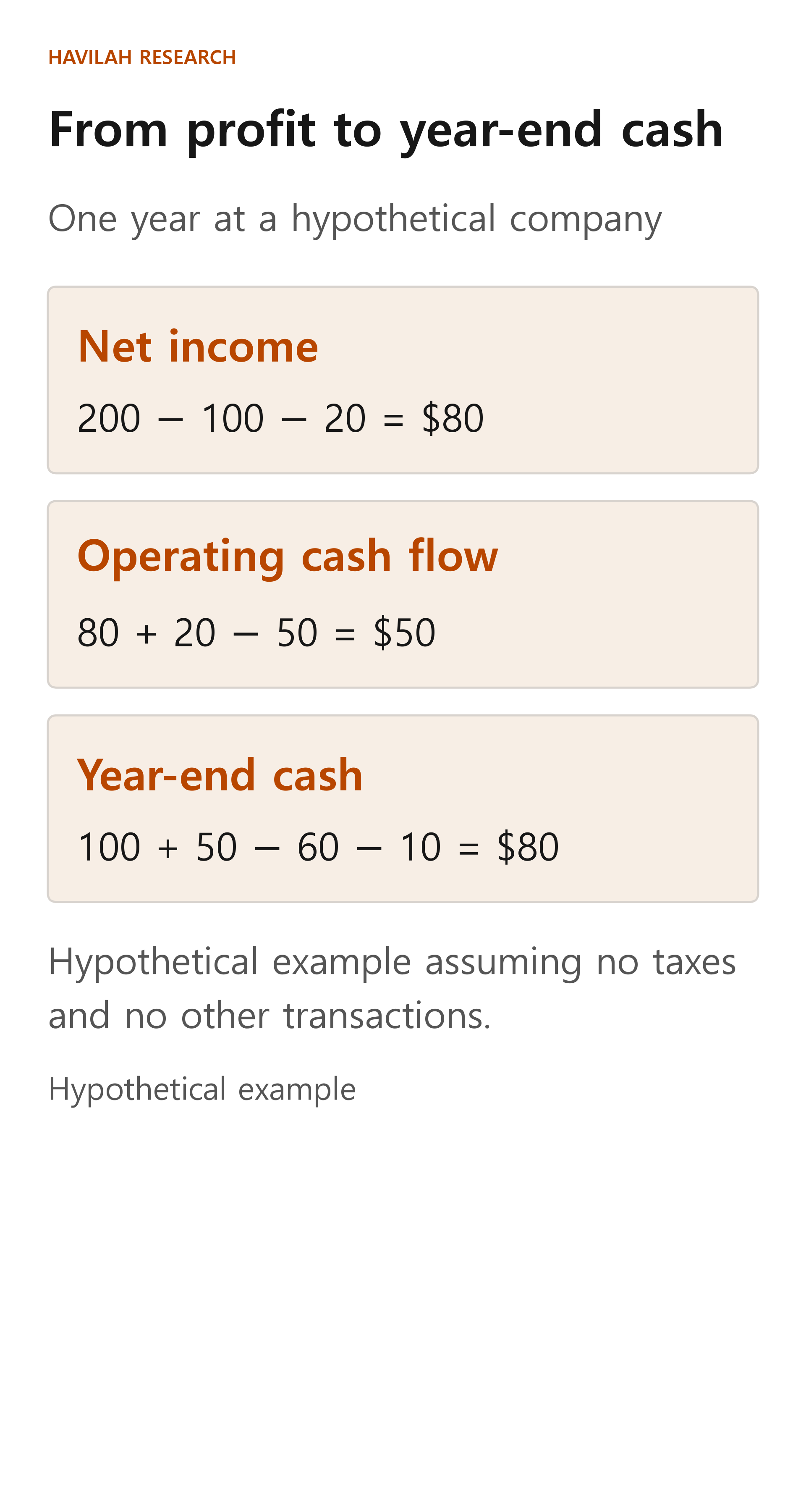
Assuming there is no other income, no other expenses and no tax, net income is 200 − 100 − 20, or $80. Net income is the profit left after costs and other items have been taken into account. In the same year, the company paid $60 in cash for new equipment and repaid $10 of debt principal. Assume there were no dividends, no new shares issued and no other transactions.
Let's link profit and cash
Start with net income of $80. The $20 of depreciation was not a new cash payment that year, so add it back. Then subtract the $50 that was included in revenue but has not been collected yet, and the cash generated by the business, that is, operating cash flow, is $50.
The company paid out $60 to buy equipment and $10 to repay debt principal. Take the $100 of cash at the start of the year, add the $50 from the business, then subtract the $60 and the $10, and cash at the end of the year is $80.
| Hypothetical cash flow | Amount |
|---|---|
| Cash at start of year | $100 |
| Operating cash flow | +$50 |
| Purchase of equipment | −$60 |
| Repayment of debt principal | −$10 |
| Cash at end of year | $80 |
The company recorded net income of $80, yet it ended the year with $20 less cash than it started with. The difference arises because profit and cash are measured on different bases, and because the company also spent cash on equipment and on repaying principal.
Check the year-end balance sheet as well
At the end of the year, the company's assets are $80 in cash, $50 in accounts receivable not yet collected and $140 in equipment. The book value of the equipment was calculated by taking the $100 at the start of the year, subtracting $20 of depreciation and adding the $60 of new equipment. Assume the new equipment was bought at the end of the year, so it was not depreciated that year, and that there were no other adjustments to book value.
Total assets are 80 + 50 + 140, or $270. Liabilities fell from $80 at the start of the year to $70 after $10 of principal was repaid. With no dividends or other changes in equity, shareholders' equity is the $120 at the start of the year plus $80 of net income, or $200. Liabilities of $70 plus equity of $200 also come to $270.
If the numbers don't match, where should you look first?
Suppose someone mistakenly copied year-end cash as $100 instead of $80. If the other numbers stay the same, total assets become $290, which is $20 different from the $270 sum of liabilities and equity. Recalculating the cash flow statement confirms that year-end cash is $80.
But when the two totals match, that does not mean every number is correct. The same error could appear on both sides, or several errors could cancel each other out. In real filings, you also need to look at things such as exchange rate movements, acquisitions, dividends and other changes in equity, and what is counted as cash and cash equivalents.
As an investor, first check that the figures come from the same period and cover the same scope of the company. Then compare, in order, the adjustments from net income to operating cash flow, the beginning and ending cash balances, and total assets against the sum of liabilities and equity. Doing this helps you understand the numbers and spot anything that needs a closer look.