
Not all the money that comes into a company's bank account was earned by running the business well. It may have been borrowed from a bank or raised by selling new shares. Likewise, not all the cash that goes out means the business lost money.
You can see how a company raises money from shareholders and lenders, and how it pays them back, in the financing activities section of the cash flow statement.
Borrowed money and money from selling new shares
When a company receives cash by borrowing from a bank or issuing corporate bonds, there is a cash inflow from financing activities. With borrowing, you need to look at both the principal that must be repaid and the interest the contract requires.
When a company issues new shares and sells them to investors for cash, this is called a share issue (an equity offering). Issuing more shares can lower existing shareholders' ownership percentages, but the company receives cash to use in its business. As an investor, check both how the new money will be used and the terms of the issue.
When investors buy and sell existing shares among themselves on the stock market, the company generally does not receive the money from those trades. Keep this separate from the case where investors buy shares that the company has newly issued.
Dividends and share buybacks send cash out
When a company distributes cash to its shareholders, this is called a cash dividend. When the dividend is actually paid, cash leaves the company. The date a dividend is announced and the date the cash is paid can be different, so check how much was actually paid during the period.
A share buyback is a company buying its own shares. If it pays cash for them, the company's cash falls by that amount. Money paid for cash dividends and share buybacks is generally shown as a cash outflow from financing activities. The actual change in the number of shares issued can vary, depending on how the repurchased shares are treated and on any other share issues.
The mere fact that a company paid dividends or bought back shares does not prove that its business is strong. Look at whether it paid with cash the business generated or relied on new borrowing, and whether it can still afford the investment and debt repayments it will need in the future.
Let's calculate a hypothetical company's financing activities
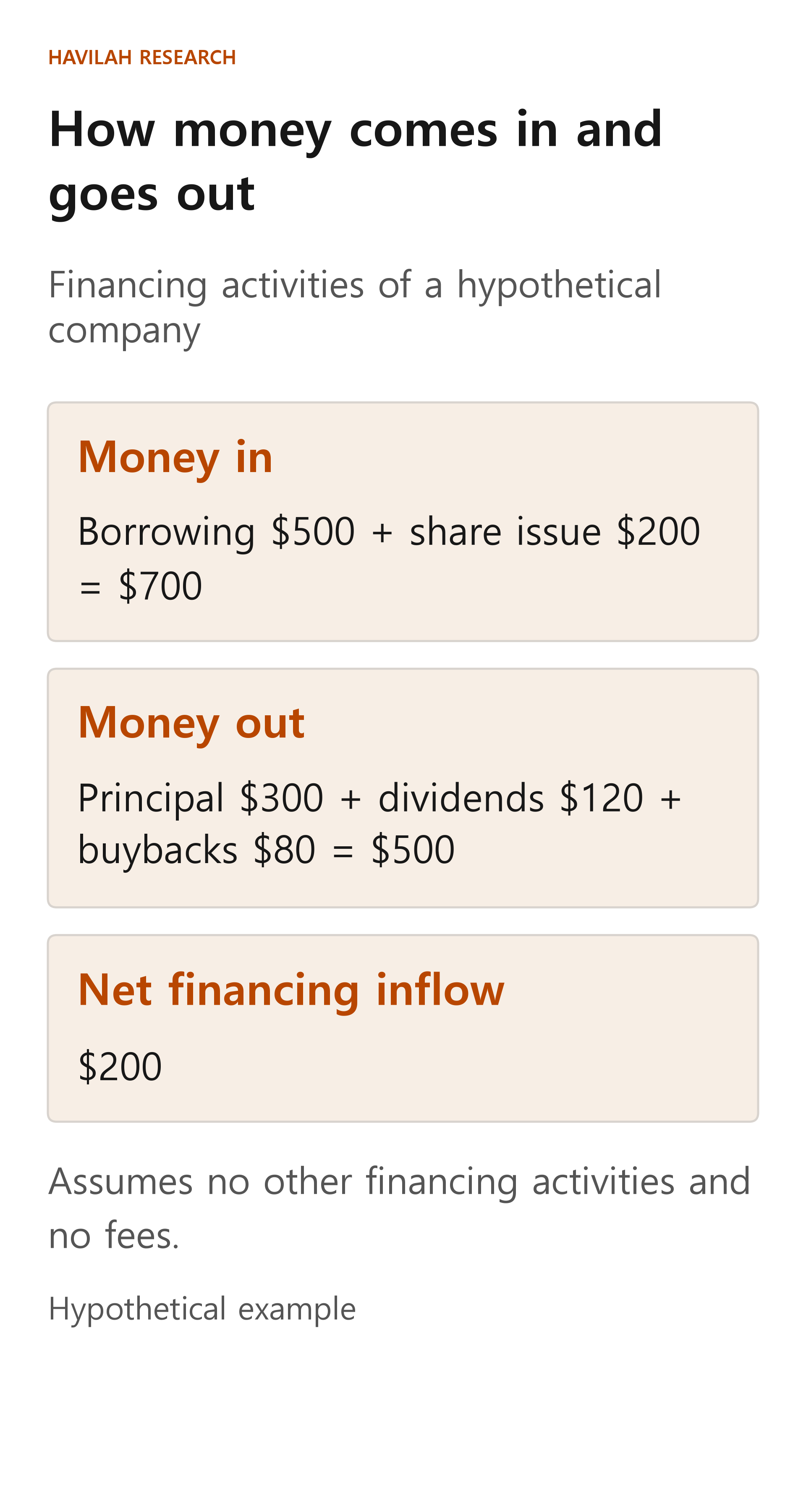
Over one year, a hypothetical company borrowed $500 in new debt and received $200 by issuing shares. During the same period, it repaid $300 of debt principal, paid $120 in cash dividends and spent $80 on share buybacks. Assume there were no fees and no other financing activities.
| Hypothetical financing activity | Cash flow |
|---|---|
| New borrowing | +$500 |
| Issue of new shares | +$200 |
| Repayment of debt principal | −$300 |
| Cash dividends paid | −$120 |
| Share buybacks | −$80 |
| Net cash flow from financing activities | +$200 |
The money that came in is 500 + 200, or $700. The money that went out is 300 + 120 + 80, or $500. So the net cash inflow from financing activities is $200.
A net inflow is not profit
The company above had a net inflow of $200 from financing activities, but this number alone cannot tell you the profit of its business. Much of the money that came in is borrowing that has to be repaid later, and the money from issuing new shares is also different from revenue earned by selling products.
Conversely, negative cash flow from financing activities does not necessarily mean something bad. Cash may have gone out because the company used cash generated by its business to repay debt or pay dividends to shareholders. The reasons behind each inflow and outflow matter more than the sign of the total.
For a real example, in its 2026 annual report the U.S. company NetApp described, for fiscal 2025, the cash it raised by issuing bonds together with its share repurchases, dividend payments and repayments of debt principal. Looking at which transactions took place, rather than at a single net figure, helps you better understand how a company raised and used its cash.
How to check this when you invest
First, look at operating cash flow and cash flow from financing activities for the same period side by side. Check whether cash is coming from the business, whether the company is raising money through new borrowing or share issues, and how much it spends on repaying debt and on shareholder returns.
For borrowing, look at the maturities and interest terms. For share issues, look at the number of shares issued and what the money is for. For dividends and buybacks, it is a good idea to check whether they are sustainable and what was actually paid out and bought back.
The cash flow statement shows how money moved. Rather than judging the share price or future returns from the net financing figure alone, read it together with the cash the business generates and the spending it needs.