
Imagine a company gives an employee, along with a monthly salary, the right to receive shares. At that moment, no cash for that part of the pay may leave the company's bank account. Does that mean there is no cost at all for existing shareholders?
Paying in shares is still a way of rewarding employees for their work. The time when cash goes out and the time when the expense is recorded in the accounts can differ, and if the number of shares actually increases, existing shareholders' ownership percentages can change too.
How does stock-based pay work?
A company can give employees the right to receive shares, or to buy shares at a set price, once certain conditions are met. For example, it may promise shares on condition that the employee keeps working at the company for a certain period. The actual conditions and the way the shares are delivered differ from one company's compensation plan to another.
Stock-based compensation expense is the expense a company records in connection with this kind of pay. Even though it is not a cash salary, it is payment for employees' work, so you need to check it in the financial statements. The amount recorded as an expense and the number of shares actually delivered are not the same figure.
What happens to your stake when the share count rises?
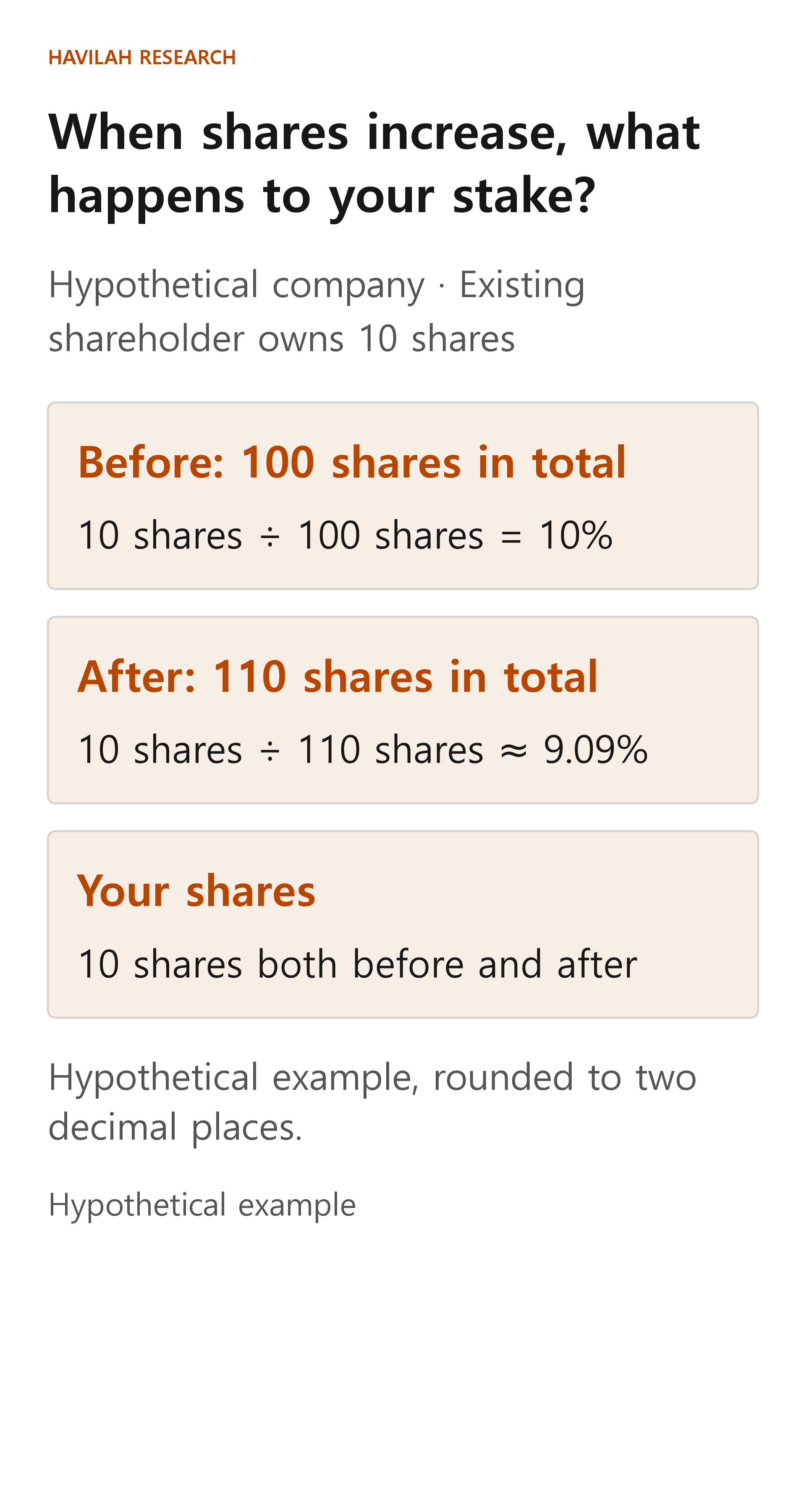
Assume a hypothetical company has 100 shares and you own 10 of them. Your stake is 10 out of 100 shares, or 10%.
Now assume the company issues 10 new shares to employees, so the total number of shares becomes 110. You still own 10 shares, but your percentage of the total becomes 10 ÷ 110 × 100, or about 9.09%. This is rounded to two decimal places.
| Hypothetical share count | Before issuance | After issuance |
|---|---|---|
| Total shares | 100 shares | 110 shares |
| Your shares | 10 shares | 10 shares |
| Your ownership | 10% | About 9.09% |
When your percentage shrinks because the total number of shares rises, even though the number of shares you own stays the same, this is called dilution. Your ownership fell by about 0.91 percentage points. This calculation is a simple example that assumes only an issue of new shares. It does not mean that the company's value or the share price must fall in the same proportion.
Why is it added back on the cash flow statement?
Depending on the company, stock-based compensation expense can be an item for which no cash is paid in the period in which the expense is recorded. When operating cash flow is calculated with the indirect method, non-cash expenses that have already been subtracted from net income are added back so that the figure matches the movement of cash.
Adding the expense back does not mean new cash came in. Nor does adding it back to operating cash flow make the economic cost of stock-based pay disappear. You need to look separately at actual share issuance and at changes in the number of shares.
Stock-based pay does not always lead to new shares being issued right away, either. The employee who received the right may not meet the conditions, or the company may settle it in a different way. The actual outcome can differ depending on the agreement.
Related cash spending can also arise
Some companies hold back part of the shares due to an employee to cover the tax that has to be withheld from the employee's pay, and pay that tax in cash on the employee's behalf. Because cash spending related to stock-based pay can arise in this way, do not look only at the compensation expense itself; check the cash flow statement and the notes as well.
A company may also buy back its own shares to offset the increase in its share count. Share buybacks require cash. But the reasons for buybacks, their timing and the actual change in share count differ from company to company, so do not assume that stock-based pay and buybacks always involve the same amounts.
Where should investors look?
First, check stock-based compensation expense in the income statement and the notes. On the cash flow statement, look for the non-cash expense adjustment and for any related tax payments. Stock-based compensation expense may also be split across several expense lines related to pay.
Next, check the number of shares issued, the conditions of the rights promised to employees, and the number of shares the company actually delivered. A larger share count can also affect earnings per share. But earnings per share is actually calculated with the average number of shares for the period and the related rules, so you should not work it out simply from the year-end share count.
Stock-based pay can be a way to reward employees while managing the company's cash spending. Along with those benefits, investors need to look at changes in the share count, the terms of the pay and the related cash spending.