
Before a shop can serve more customers, it first has to stock up on goods to sell. If it sells to customers on credit, it has to wait until they pay. Even as sales grow, the shop may need more cash along the way.
If you look at inventory, the money customers owe and the money owed to suppliers together, it becomes easier to see how much cash is tied up in running the business.
From stocking goods to getting paid
Inventory is goods that a company will sell, or use to make its products, in the future. If a company pays cash for inventory and keeps it in a warehouse, it is hard to use that cash for anything else until the goods are sold and paid for.
If the company has sold goods but has not been paid yet, the money it is owed is accounts receivable. If it has bought goods from a supplier on credit and has not paid yet, the money it owes is accounts payable.
Buying on credit means the company does not have to spend all the cash right away, but accounts payable still have to be paid later. Paying late does not make the debt go away.
Let's look at the three numbers together
Below is a hypothetical shop to make the idea easier to follow. To keep the comparison simple, we look at inventory plus accounts receivable minus accounts payable. This is one way of looking at the money tied up in business activities.
| Hypothetical item | Start of year | End of year |
|---|---|---|
| Inventory | $100 | $140 |
| Accounts receivable | $120 | $180 |
| Accounts payable | $80 | $100 |
| Inventory + accounts receivable − accounts payable | $140 | $220 |
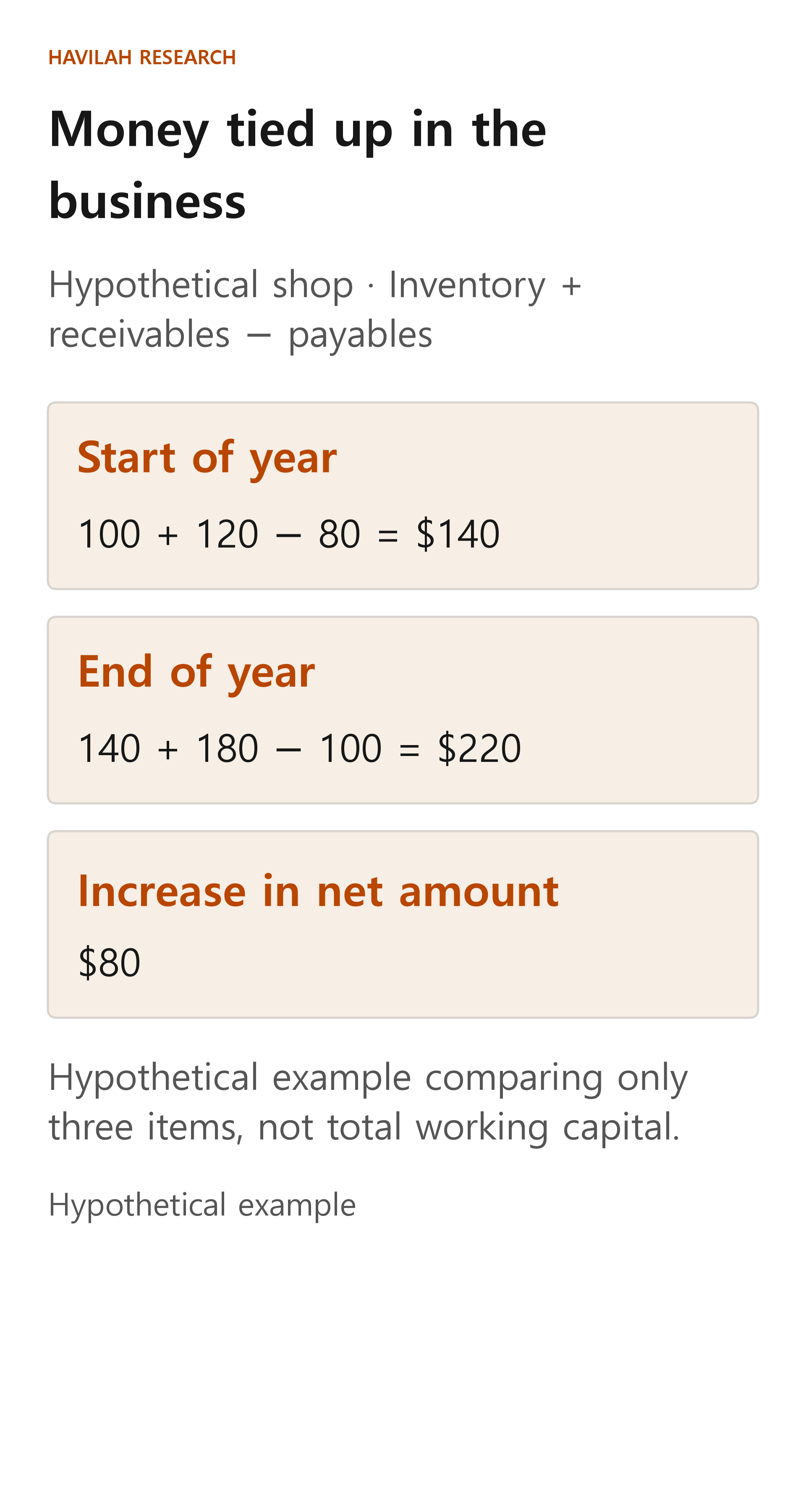
At the start of the year, 100 + 120 − 80 gives $140. At the end of the year, 140 + 180 − 100 gives $220. So the net amount tied up in these three items rose by $80.
This calculation does not cover the same ground as working capital in the broader sense, which is total current assets minus total current liabilities. The items companies report, and how they define them, can differ, so first check which numbers have been included.
How does this affect cash?
In the hypothetical example, inventory rose by $40, accounts receivable by $60 and accounts payable by $20. If you assume all these changes came from the ordinary timing gaps between buying inventory, selling goods and paying for things, the increases in inventory and in accounts receivable each put pressure on cash. The $20 increase in accounts payable has the effect of putting off that much in payments.
Add $40 and $60 and subtract the $20 of postponed payments, and, other things being equal, an extra $80 is tied up in the business. That is the same as the difference between the $220 and the $140 calculated above. It does not necessarily mean that the company's total cash fell by this amount, because other cash flows, such as profit, capital expenditure and borrowing, are also at work.
In real financial statements, balances can also change for reasons that are not cash transactions, such as exchange rate movements or acquisitions. So the ending balance minus the beginning balance does not always equal the adjustment on the cash flow statement. Check the figures against the cash flow statement and the explanations the company discloses.
Is an increase always a bad sign?
When sales grow, the inventory a company needs and the money owed to it can grow as well. This can be a natural change in a growing business. On the other hand, if inventory sits unsold for a long time or customers are slow to pay, the company can have trouble getting its cash back.
Nor is it always good news when accounts payable rise and less cash goes out for now, because the amount that has to be paid later grows. You also need to check whether the company can pay its suppliers reliably.
In its annual filing, the U.S. industrial equipment company IDEX used accounts receivable, inventory and accounts payable together to look at the money its business needs. The same filing also explains that changes in these amounts were affected by exchange rates and acquisitions, among other things. As this shows, it is important to look separately at what caused a balance to change.
Applying this to your investing
Check the changes in inventory, accounts receivable and accounts payable on the balance sheet, then find the related adjustments on the cash flow statement. After that, read them together with revenue for the same period and the company's own explanations.
It helps to ask three questions. Is the inventory something that can be sold in the future? Is the money customers owe being collected on schedule? Does the company have the cash to cover what it owes its suppliers?
The single fact that a balance went up cannot answer these questions. Check whether it is part of the business growing or a sign that collections and sales are slowing, and when the actual cash comes in and goes out.