
A bakery buys a new oven. It pays for the oven today, but it will use it to bake bread for several years. Does the whole price of the oven become this year's expense?
The time when cash goes out and the time when an expense is recorded can be different. When you look at a company's spending on equipment as an investor, you need to think about the two separately.
When a company buys equipment, what stays on its books?
Capital expenditure is money spent to buy or improve assets that a business will use for a long time, such as factories, machines and stores. It is often shortened to CapEx.
If a machine is expected to be used for a long time and meets the conditions for being recognized as an asset in the accounts, the company can record its purchase price as an asset instead of treating the whole amount as an expense right away. This is called capitalization. You can think of an asset as something the company owns and can use in its business in the future.
If the company paid in cash, the purchase price goes out at that moment. But the machine remains on the books as an asset. On the cash flow statement, the money paid for the machine is generally shown as a cash outflow from investing activities.
The cost of a machine becomes an expense over several years
Depreciation spreads the cost of equipment already bought over the period in which it is used.
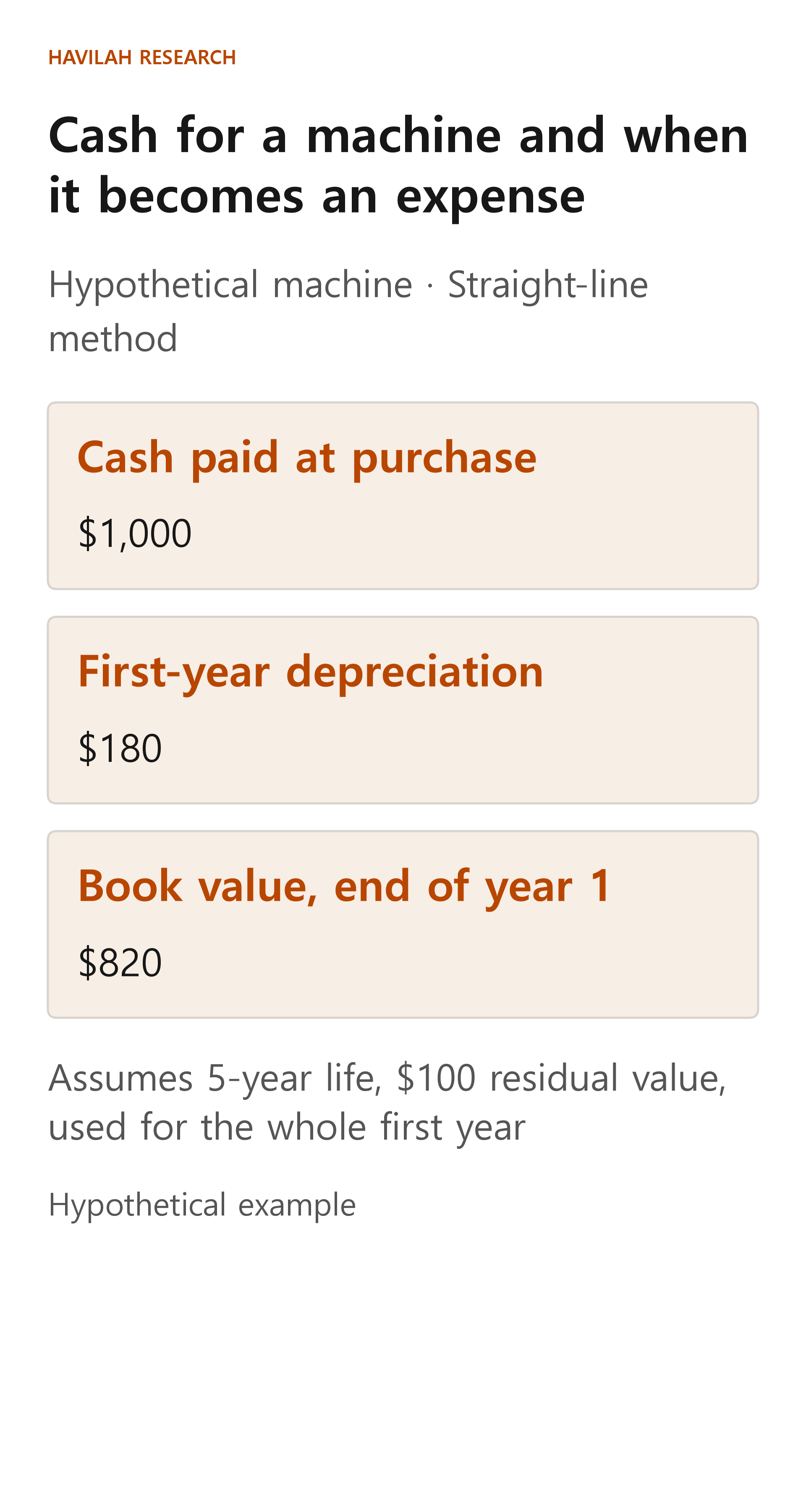
Assume a hypothetical company buys a machine for $1,000 in cash at the start of the year. It starts using the machine right away and expects to use it for 5 years. It estimates that the machine will still be worth $100 after those 5 years. This amount is called the residual value.
Subtract the $100 residual value from the machine's $1,000 price, and the amount to be spread as an expense over its useful life is $900. Using the straight-line method, which divides that amount equally over the 5 years, annual depreciation is $180.
| Hypothetical machine | Calculation |
|---|---|
| Purchase price | $1,000 |
| Expected residual value | $100 |
| Amount to spread as an expense | $900 |
| Expected useful life | 5 years |
| Annual depreciation | $180 |
In this simple example, the cash spent in the first year is the $1,000 purchase price, and the depreciation recorded in the first year is $180. We assumed that the company uses the machine right away, depreciates it for the whole first year, and has no taxes or other spending.
Book value is not the same as a resale price
Subtract the first year's $180 of depreciation from the machine's $1,000 purchase price, and its book value at the end of the first year is $820. Assume there are no other adjustments to the book value, such as an impairment loss. Book value is the amount recorded in the accounts. It does not guarantee the price at which the machine could actually be sold on the second-hand market.
Nor does the same amount of cash go out again when the $180 of depreciation is recorded. In this example, the purchase price was already paid when the machine was bought. Maintaining or replacing the machine may require separate cash spending later.
The 5 years and the $100 are hypothetical estimates. A real company's useful lives, residual values and depreciation methods can differ depending on the nature of the asset and the company's accounting policies. If a machine's value falls much further than expected, the company may also record a separate loss.
Are repair costs the same as the cost of improving a machine?
Routine repairs that keep a machine in normal working order can be an expense in the period in which they occur. On the other hand, spending that substantially improves the machine's performance or extends its useful life can be added to the asset and spread as an expense over several periods.
This distinction has to be judged from what the spending actually is and from the accounting standards that apply. Something called a "repair" is not always an expense, and something called an "improvement" is not always an asset. Check the related accounting policies in the notes to the company's financial statements. The rules used to calculate tax can also differ from the standards used to prepare financial statements.
What should investors look at?
First, check on the cash flow statement how much money was actually spent on buying equipment. Then look at depreciation and the useful lives of the equipment in the income statement and the notes. Depreciation on equipment is not always shown as a separate line on the income statement.
The reason capital spending increased also matters. The effect you can expect differs depending on whether the money goes to keeping old equipment running or to increasing production capacity. But companies do not always disclose these two amounts separately and clearly.
Buying a lot of equipment does not automatically make it a good investment. You need to look at whether the business needs that equipment, whether the investment can lead to profit and cash generation, and whether the company can afford the money it requires.