
A shop has earned cash from its business. But it also needs money to replace an old oven and to refurbish the store. If you look only at the cash that came in from the business, you can miss the money that has to be reinvested like this.
Free cash flow is a measure for looking at the cash a business generates together with the money it spends on equipment. It is also known by its initials, FCF.
Subtract capital spending from the cash from the business
Operating cash flow, which you learned about earlier, is the cash that came in and went out through everyday business activities such as selling goods or providing services. Capital expenditure is spending to buy or improve assets the business will use for a long time, such as factories and machines.
One simple way to calculate free cash flow is to subtract the cash actually paid for capital expenditure from operating cash flow. What this calculation shows is the cash left after the equipment spending included in the calculation. It does not mean money the company can spend however it likes once it has met all its obligations.
Let's work it out with a hypothetical company's numbers
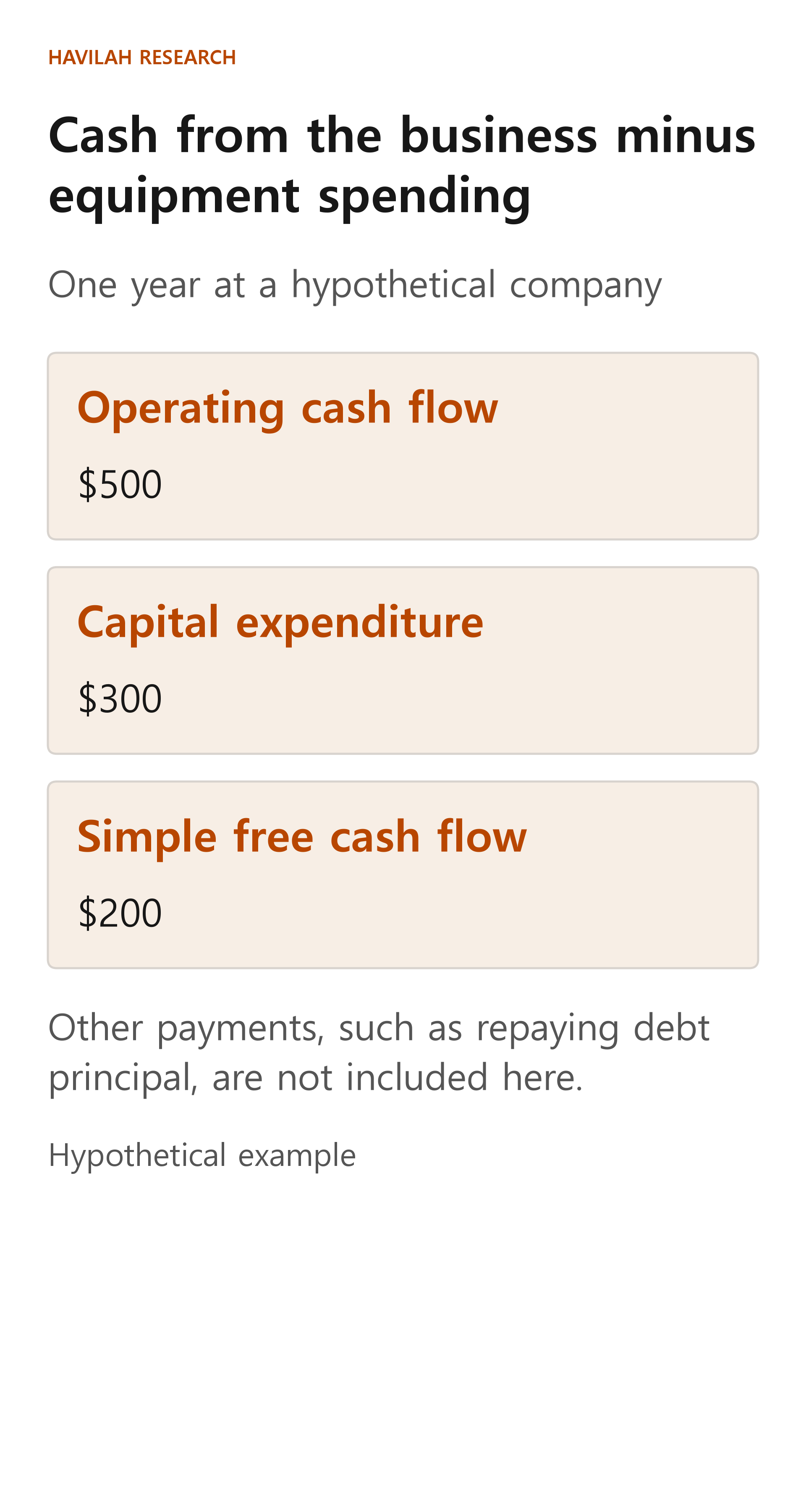
Assume that over one year a hypothetical company generated $500 of cash from its business activities. If it paid $300 in cash for machines and facilities over the same period, free cash flow calculated with this simple method is $200.
| Hypothetical year | Amount |
|---|---|
| Operating cash flow | $500 |
| Cash spent on capital expenditure | −$300 |
| Free cash flow | $200 |
The calculation is simply $500 minus $300. Because you are subtracting the cash spent on buying the machines, you do not subtract the depreciation on those same machines again here. Depreciation is the process of recording the cost of a machine as an expense spread over several periods.
Can all the money left over go to shareholders?
Suppose the same company also has to repay $160 of debt principal in that year. The free cash flow calculation above does not include this repayment, so, assuming no other inflows or spending, $200 minus $160 leaves $40.
Nor is this $40 the company's total cash balance. The example calculates only that year's flows and does not include cash the company already held. If there are other contractual payments or money due for an acquisition, the amount available can change further.
In practice, Walmart presents a measure in its filings that it calls free cash flow: operating cash flow minus payments for property and equipment. The company explains that this figure is not what remains after deducting everything else, such as debt-related payments and other contractual obligations. Check how the filing classifies items, so that you do not subtract interest payments a second time when they are already reflected in operating cash flow.
Is a negative number always bad?
Suppose that in another year the same hypothetical company generated $500 of operating cash flow but paid $600 for capital expenditure. Its free cash flow would then be minus $100. That means the cash the business generated that year was not enough on its own to cover all the equipment spending included in the calculation.
The company can fill the gap by using cash it already has or by borrowing. So a negative number alone does not mean it is about to become unable to pay its bills. But you should look at whether it keeps needing outside money and how it plans to raise money in the future.
Capital spending can mix money spent to maintain old equipment with money spent to grow the business. A company may have a temporary surge of cash going out while it builds a new factory, but the payoff from that investment may also turn out lower than expected. Companies do not always disclose these two kinds of spending separately and clearly.
What to check when you compare companies
The items included in free cash flow can differ from company to company. Some companies also take into account spending other than equipment purchases, or proceeds from selling assets. Rather than just comparing the numbers, first check the calculation method each company discloses and how it adjusts from operating cash flow.
In particular, look at operating cash flow and equipment spending for the same period, and also check for one-off factors and for the investment and debt repayments the company will need in the future. Comparing several years helps you understand whether the business generates cash steadily, or whether the numbers changed because of investment or the timing of collections at a particular point.
Free cash flow is not a substitute for operating cash flow; it is a supplementary measure to look at alongside it. That one number alone cannot determine a company's value or its future earnings.