
Suppose a shop earned a profit of $200 over a year, but the cash that came in from its business, minus the cash that went out, came to $170. What explains the difference? Money from sales that has not been collected yet, inventory bought in advance and bills that have not been paid yet can all create a gap.
Operating cash flow shows how much cash came in and went out through a company's everyday business activities, such as selling goods or providing services. It is easiest to understand if you start from profit and then adjust for the parts that differ from actual cash.
How to get from profit to cash
A cash flow statement can be prepared with the direct method or the indirect method. The direct method shows the money received from customers and the money paid to suppliers and others. The indirect method starts from net income and adjusts for items that involved no movement of cash and for changes in the assets and liabilities the business needs to operate.
Net income is the profit left after costs, taxes and other items have been taken into account. The adjustments in the indirect method turn that profit into a figure closer to the actual cash from the business. An adjustment item does not mean new revenue or new profit.
Working through a hypothetical shop step by step
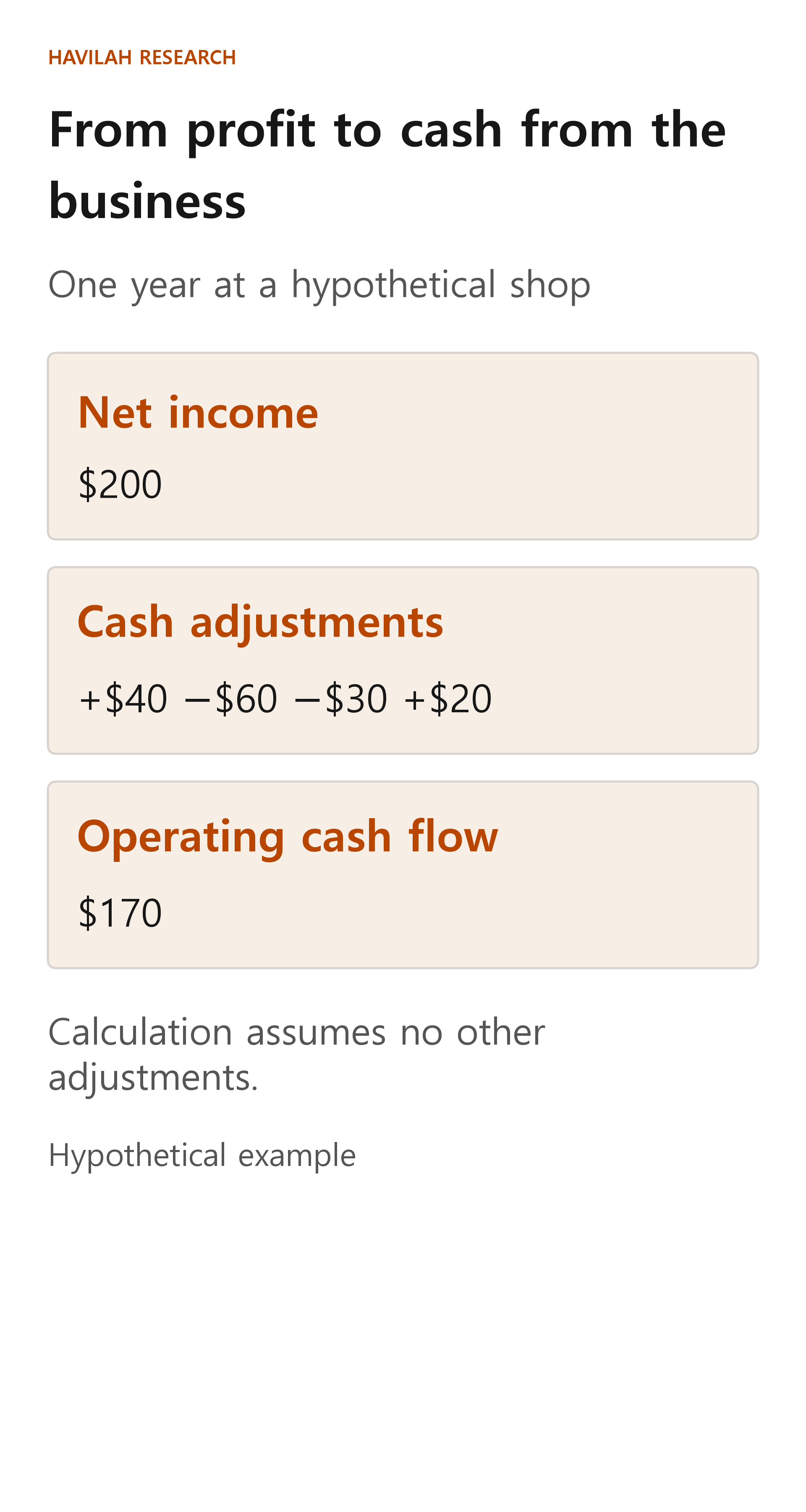
Assume that over one year a hypothetical shop records revenue of $500 and costs of $300, giving net income of $200. The costs include $40 of depreciation. In this example, there are no taxes and no other income or expenses.
Depreciation spreads the cost of equipment already bought over the period in which it is used. The shop did not pay out a new $40 for it this year, so in the cash calculation you add $40 back to net income.
The shop's accounts receivable, the money from sales that it has not collected yet, rose by $60. In this example, assume the whole increase is money from that year's sales that has not been received. It is included in net income but has not arrived as cash, so you subtract $60.
Inventory rose by $30. Here, assume the shop paid cash for extra inventory that year and has not sold it yet. It has not been counted as an expense yet, but the money went out, so you subtract $30.
Meanwhile, accounts payable, the amount the shop owes for purchases made on credit, rose by $20. In this example, this is the unpaid part of the bills for goods and services included in that year's costs. The cost has already been subtracted from profit, but the cash has not gone out yet, so you add $20.
| Hypothetical adjustment | Calculation |
|---|---|
| Start from net income | $200 |
| Depreciation | +$40 |
| Increase in accounts receivable | −$60 |
| Increase in inventory | −$30 |
| Increase in accounts payable | +$20 |
| Operating cash flow | $170 |
Working out 200 + 40 − 60 − 30 + 20 gives operating cash flow of $170. This result holds under the hypothetical assumption that there are no other adjustments.
Can you check it against the money that actually changed hands?
In the same hypothetical example, $60 of the $500 in revenue has not been collected yet, so the cash received from customers is $440.
Of the $300 in costs, the $40 of depreciation is not a cash payment made this year. Of the remaining $260, $20 has not been paid yet, so the cash paid for costs is $240. Add the $30 spent on inventory that has not been sold yet, and the cash paid out for the business comes to $270.
Subtract the $270 paid out from the $440 received from customers, and you get $170. That matches the result of adjusting net income above. The two calculations look at the same hypothetical transactions from different directions.
Points to watch when you look at a real company
A real cash flow statement has many more items besides inventory and accounts receivable. The change in each item can also be affected by other things, such as mergers, exchange rate movements and asset sales. So do not assume that the ending balance minus the beginning balance on the balance sheet always equals the adjustment on the cash flow statement. Check the adjustments the company discloses and the notes to its financial statements first.
When accounts payable rise, less money goes out right now, but those bills still have to be paid at some point. When inventory rises and cash goes out, that can be a normal part of getting ready to sell. On the other hand, if inventory sits unsold for a long time, other problems can follow. Do not decide whether something is good or bad from the direction of a number alone.
Purchases of equipment are generally shown under cash flow from investing activities. Even when operating cash flow is positive, the cash left after investing in equipment or repaying debt can be different. Operating cash flow is also not the same as the total balance in the company's bank accounts.
Applying this to your investing
First, compare net income and operating cash flow for the same period. If the gap is large, look for adjustments such as depreciation, accounts receivable, inventory and accounts payable, and read the reasons the company gives in its filings.
Rather than drawing a conclusion from a single quarter's figures, it is better to check over several periods whether profit is turning into cash. Quarterly cash flow can vary with the seasonality of the business and the timing of payments.