
If a supermarket had nothing on its shelves, customers would go elsewhere. But a company also gets into trouble if goods that do not sell sit in its warehouse for too long. Inventory is needed to make sales, but it can also tie up money and space.
Inventory means the goods a company holds to sell, along with items such as the materials it will use to make those goods. How much there is matters, but you also need to consider when, and at what price, it can be sold.
What goes into inventory?
Finished goods waiting to be sold in a store are inventory. For a manufacturer, raw materials not yet made into products and products still being made can also count as inventory. The cost of the products a company has sold is recorded in the income statement as cost of goods sold.
Inventory can rise for many reasons. The company may have stocked up ahead of the year-end peak season, or customer orders may have been smaller than expected, leaving unsold goods behind. The same increase can mean different things, so look into the reason for the change.
Comparing inventory with revenue
Suppose a hypothetical company sold $1,000 of goods in its first year and its year-end inventory was recorded in its books at $200. The next year, revenue was $1,100 and year-end inventory was $300. Inventory in both years is a balance measured on the same basis.
| Hypothetical item | First year | Next year | Change |
|---|---|---|---|
| Annual revenue | $1,000 | $1,100 | Up 10% |
| Year-end inventory | $200 | $300 | Up 50% |
Revenue rose by $100. Divided by the first year's revenue of $1,000, that is an increase of 10%. Inventory also rose by $100, but divided by the first year's inventory of $200, that is an increase of 50%. Even when the amount added is the same, a different starting amount gives a different growth rate.
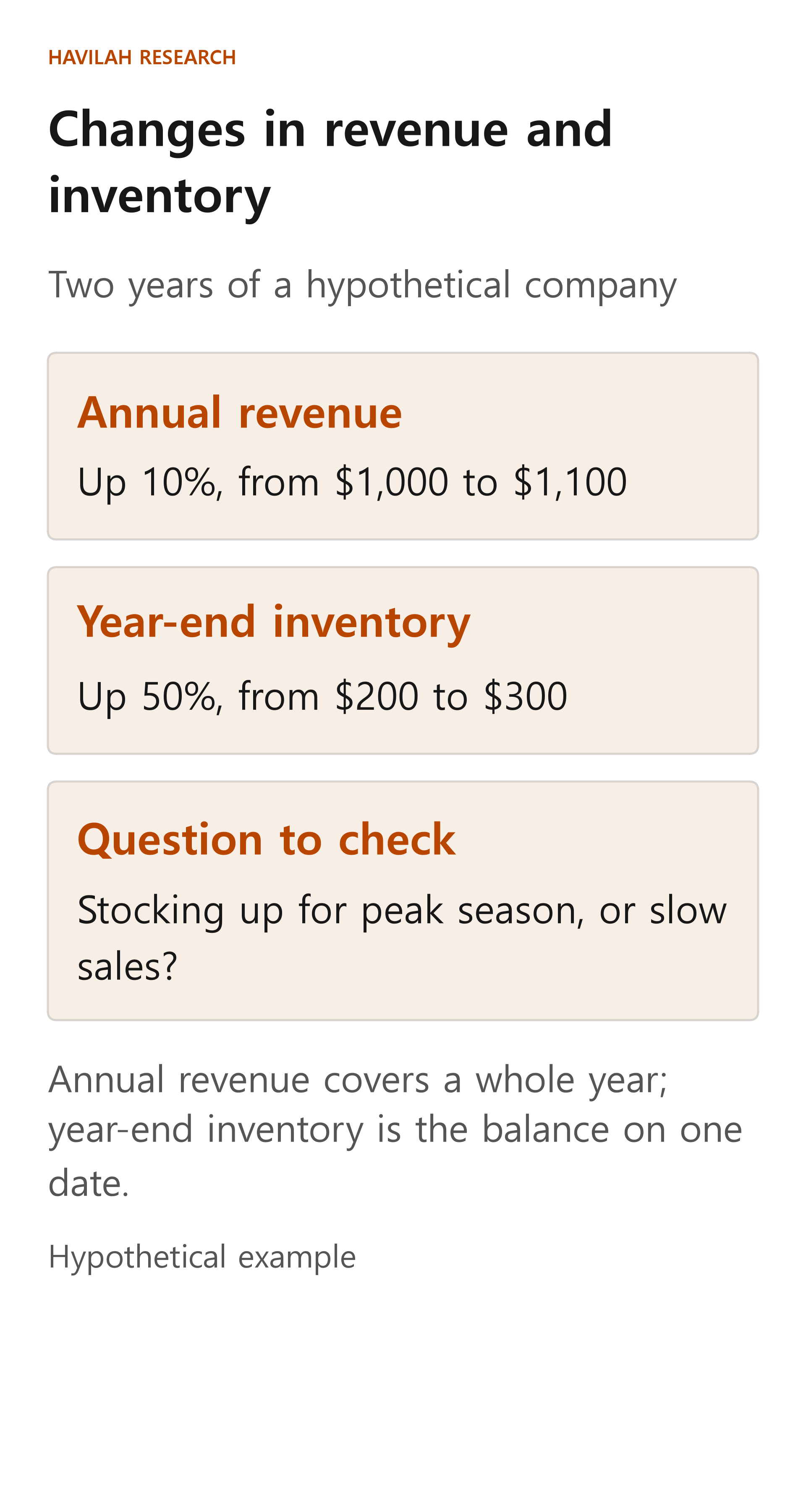
You can ask why inventory grew faster than revenue. But annual revenue is the total for a year, and year-end inventory is the balance on one day. These two numbers alone cannot confirm that the products are not selling or that the company is badly run.
The burden of inventory that sits too long
When goods are stored for a long time, warehouse costs build up, and the goods may become hard to sell at the price originally expected because they go out of fashion or a new product comes out. In industries where products change quickly, it is especially important to check whether old parts can still be used.
Supermicro, a U.S. server company, explained in its annual report that when it values inventory, it considers factors such as how long the inventory has been held, expected use and sales, expected selling prices and product obsolescence. The company explained that, when necessary, it lowers the book value of inventory and records the related inventory reserves in cost of goods sold. This is that company's valuation method; it does not mean that any particular inventory will certainly go unsold.
The book value can also be lowered
Hypothetical inventory is recorded in the books at $100. Suppose the company estimates that if it sells these goods, it can recover $70 after deducting the related selling costs, and that under the accounting standards that apply, it lowers the book value to $70. In this case, the reduction is $30.
Lowering the book value in this way is called an inventory write-down. It can affect profit for that period, but it does not mean that $30 of new cash left the company at that moment. The cash spent to buy or make the goods may have been paid at a different time.
In real companies, inventory valuation is affected by the accounting standards, the type of inventory, expected selling prices, selling costs and other factors. Check each company's notes for the methods and assumptions it uses to value its inventory.
What should investors check?
If inventory has grown, look in the company's explanation for whether it is preparing for a peak season or reacting to a change in orders. Whether raw materials or finished goods grew, and whether there were inventory write-downs or discounted sales, are also useful clues. If public information does not tell you the detailed reason, it is better to note that it has not been confirmed.
Compare cost of goods sold, profit margins and cash flow as well. Inventory is an asset held for future sales, but it takes time to turn into sales and then into cash collected. What matters more than the size of the pile is understanding why it built up and how it will be sold.