
When a company builds a factory or buys machinery, a large sum of money can go out all at once. Yet the full purchase price sometimes does not appear as an expense in that year's income statement. Why is that?
When a machine will be used for several years, the company can, following the accounting standards that apply, record its value as an asset and spread it as an expense over the years it is used. The point when the cash goes out and the point when the expense shows up in profit are different.
Where are factories and machines recorded?
Buildings, equipment, machinery and similar items that a company holds to use in its business for a long time can be shown on the balance sheet as property, plant and equipment. These are tangible assets, meaning assets with a physical form. The amount recorded in the accounts is not necessarily the same as the price they could be sold for now or the price of buying new ones.
The money spent to acquire factories and machinery is often called capital expenditure, or capex. If a machine is bought with cash, you can generally find the payment in the cash flow statement as a cash outflow from investing activities. But check when the payment was actually made and how it is classified in the filing.
Let's buy a hypothetical machine
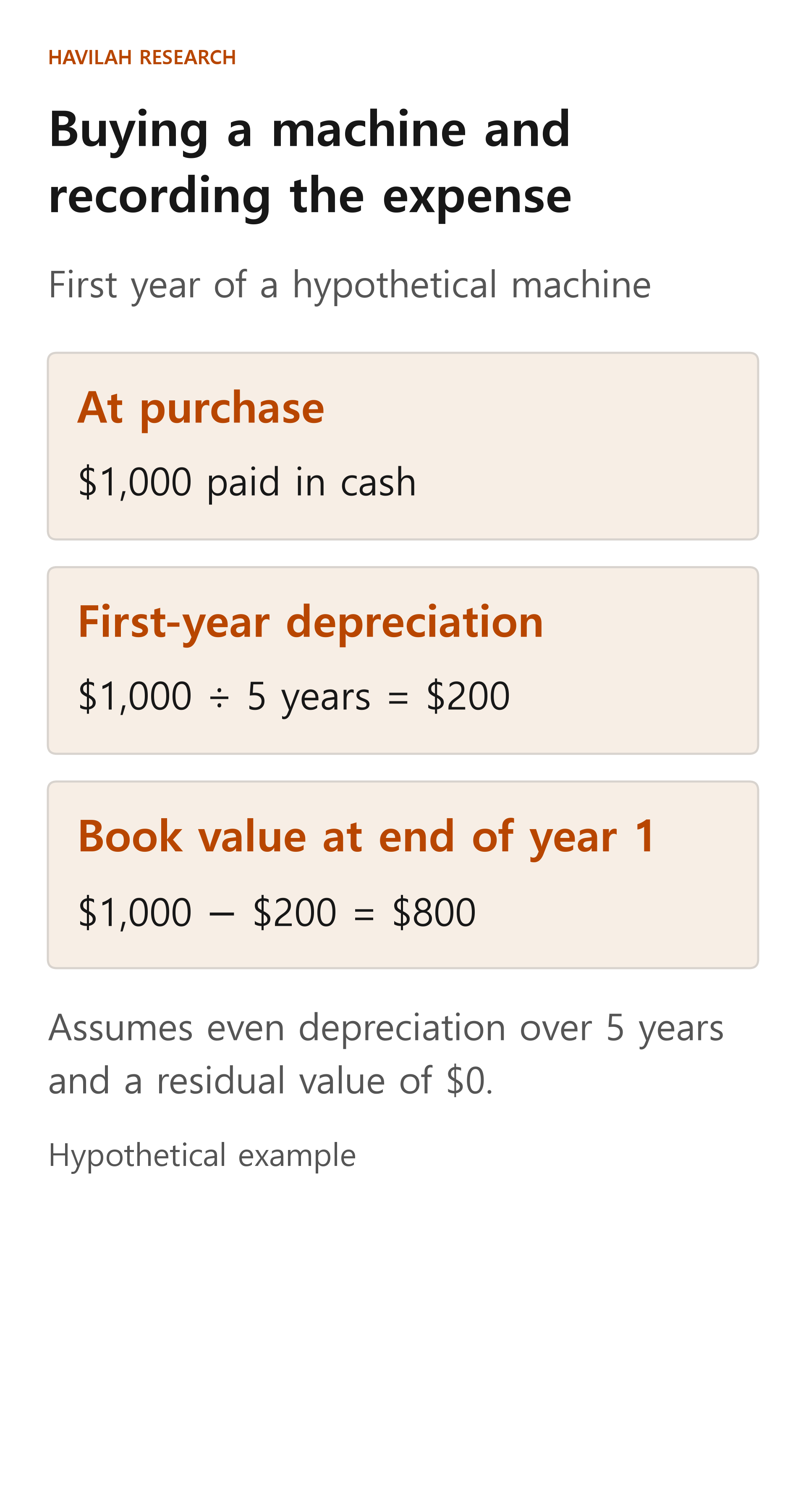
A company buys a machine for $1,000 and pays the full amount in cash. Assume it can be used from the day it is bought, it will be used in the same way for exactly 5 years, and it will be worth $0 once it is no longer used. There are no impairments or extra costs, and the calculation is made exactly 1 year after the purchase.
In this hypothetical example, spreading the machine's $1,000 cost evenly over 5 years gives a depreciation expense of $200 a year. Depreciation expense is the amount recorded as an expense when the cost of a long-lived asset is spread over the years it is used.
Paying $1,000 in cash at purchase does not mean that another $200 of cash goes out on the day the $200 of depreciation is recorded. After 1 year, the machine's book value is shown as $800: $1,000 minus $200 of accumulated depreciation. This $800 is not the price the machine would actually fetch secondhand either.
| Hypothetical item | Amount |
|---|---|
| Cash paid at purchase | $1,000 |
| First-year depreciation expense | $200 |
| Machine's book value at the end of the first year | $800 |
Change the assumptions and the expense changes
The calculation above rests on simple assumptions: the cost is split equally over 5 years and the machine has no value afterward. Real companies review an asset's expected useful life, the value expected to remain after use and a depreciation method that fits the accounting standards. If the asset is expected to be sold for some amount after use, the expense is generally spread on the basis of the cost minus that residual value.
If the machine has to be replaced sooner than expected, or the business outlook worsens so that the amount the company can recover from the asset falls, further review may be needed. A high book value does not mean the equipment will necessarily earn the returns that were expected of it.
Is all software treated the same way?
Software can also be recorded differently depending on its purpose, its stage of development and the accounting standards that apply. For example, part of the cost of developing a program the company will use for its own internal work can be recorded as an asset if certain conditions are met, while other costs are treated as expenses in the period in which they arise.
One U.S.-listed company explained that, for internal-use software, it expenses the costs of the early planning stage and the maintenance costs after the software goes into use as they arise, while it records as an asset the development-stage costs that meet certain conditions. For a company's specific accounting policy, check the conditions and periods stated in its filings. This does not mean that every development cost can be recorded as an asset.
What should investors look at together?
If a company has spent heavily on equipment, look at investing activities in the cash flow statement together with the change in assets on the balance sheet. Then check in the income statement how depreciation and similar expenses are reflected in profit. Depending on the company, depreciation may be split across several expense lines, so you will need the notes too.
An increase in capital expenditure alone does not mean the company has grown successfully. It also matters whether the new production capacity is actually being used, whether product demand and earnings follow, and how much money will be needed to maintain and replace the equipment in the future. The key is to link the book figures for assets with the actual performance of the business.