
A company announces that it has sold a lot of products. Revenue has gone up, but if customers have not paid yet, it will take longer for the money to reach the company's bank account.
Money a company will receive later for goods or services it has already provided is called accounts receivable. You will also often see it called trade receivables, or simply receivables. A rise in receivables does not by itself mean something has gone wrong, but you do need to find out why it happened.
Revenue and money still to be collected are different
A hypothetical company sells a product to a customer for $100 and agrees to be paid next month. Assuming the sale meets the conditions for recording revenue this month, the company can record $100 of revenue and $100 of money to be received. Cash comes in only when the customer actually pays.
When the customer pays, this transaction increases cash and reduces the money to be received. The same sale is not recorded as revenue a second time at that point. It is important to keep the point when revenue is recorded separate from the point when cash is received.
Comparing how fast each one grew
Let's look at another hypothetical company. In the first year, its annual revenue was $1,000, and receivables not yet collected at year-end were $100. The next year, annual revenue was $1,200 and year-end receivables were $180. Assume that the receivables in both years are balances calculated on the same basis.
| Hypothetical item | First year | Next year | Change |
|---|---|---|---|
| Annual revenue | $1,000 | $1,200 | Up 20% |
| Year-end receivables | $100 | $180 | Up 80% |
Revenue rose by $200, an increase of 20% on the first year's $1,000. Receivables rose by $80, an increase of 80% on the $100 at the end of the first year.
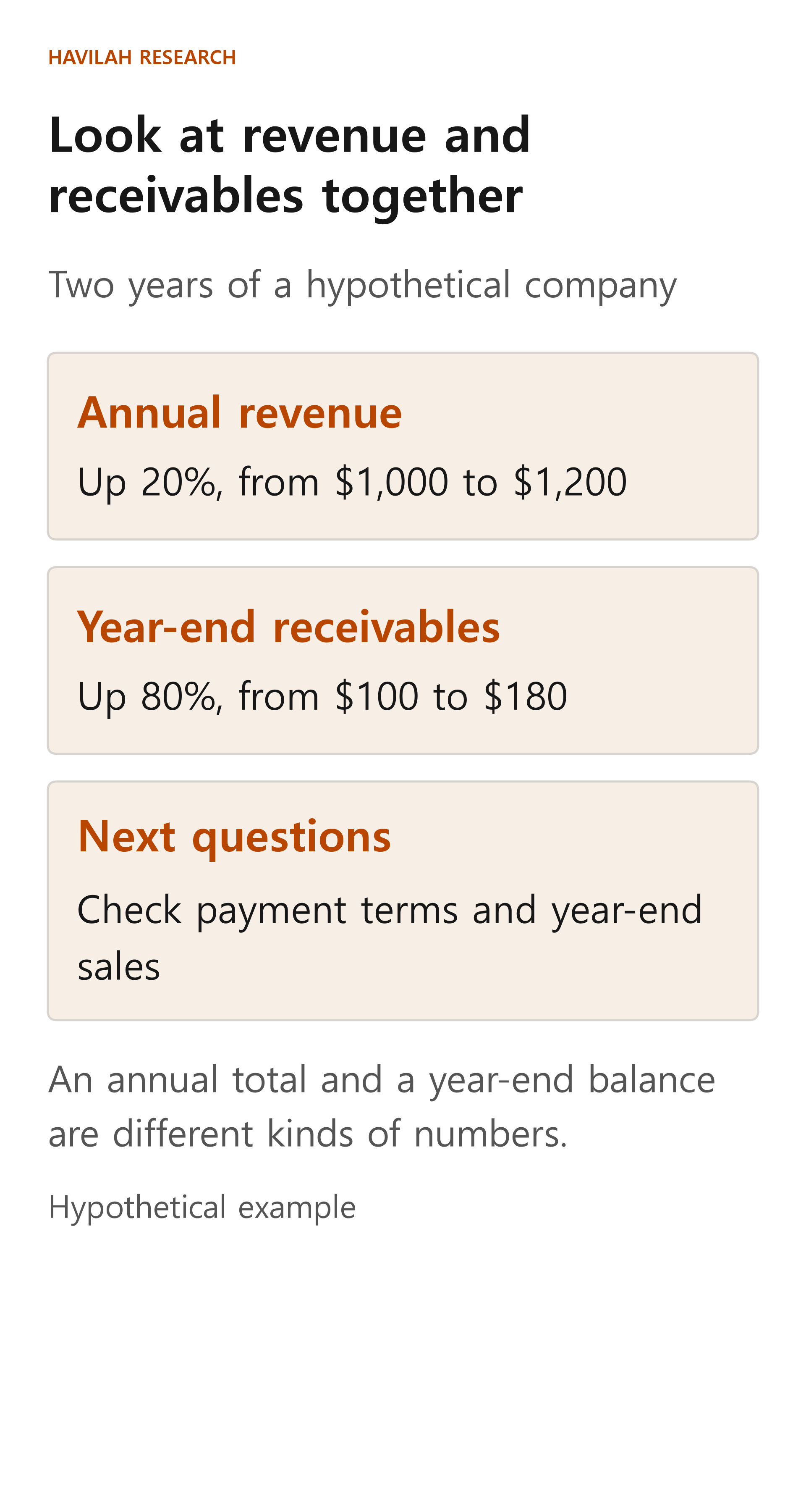
Money to be received growing faster than revenue is a clue worth looking into. But annual revenue is the total for a whole year, while year-end receivables are the balance left on one date. These two numbers alone cannot confirm that customers are paying later than usual.
Looking into why they grew
Large orders may have piled up at year-end, with payment not yet due. The payment period the company gives its customers may have become longer, or the converted value of receivables denominated in a foreign currency may have changed. When a company acquires another company, the acquired company's receivables can also be added.
On the other hand, customers may be failing to pay by the agreed date, or a particular customer's finances may have worsened. So look at the payment terms the company describes, changes in overdue amounts, the situation of its major customers and whether the money was collected afterward.
One U.S. company disclosed that when it estimates expected losses on its receivables, it considers factors such as how long the receivables have been outstanding, its past loss experience, customers' creditworthiness and later collections. The company also disclosed that it shows its receivables net of an allowance and that its receivables are concentrated among a small number of customers. This is that company's own description; it does not mean other companies will show the same results.
Will the company collect everything it is owed?
A company can estimate the chance that some customers will not pay and reflect it in its financial statements. The amount set aside for this is called an allowance for doubtful accounts or an allowance for credit losses. Check whether the receivables shown on the balance sheet are net of this estimate, that is, with the estimate already subtracted.
Expected losses are estimates, so they can differ from the amounts eventually collected. A larger allowance does not mean all the receivables have suddenly become uncollectible, and a small allowance does not mean there is no risk.
What should investors check?
First, look at how revenue and receivables, measured on the same basis, have changed over several periods. Next, look in the notes on receivables and in the company's explanation of its results for information on payment terms, overdue amounts, allowances and customer concentration. Not every company discloses the same level of detail, so keep a separate note of anything you cannot confirm.
Also check, in the cash flow statement, the cash that came into and went out of the business. See whether revenue growth is turning into cash collected, but remember that other items, such as inventory and money owed to suppliers, also affect cash flow. A rapid rise in receivables is a reason to start asking questions, not a number that automatically proves there is a problem.