
Can earnings per share fall even when a company's profit rises? Yes, it can. If the number of shares the profit is divided among has grown as well, the profit for each share can actually get smaller.
Earnings per share is called EPS for short. It shows how much of a period's profit corresponds to each share of common stock. It helps when you want to look not only at a company's total profit but also at the part that belongs to each share you own.
Looking at profit and share count together
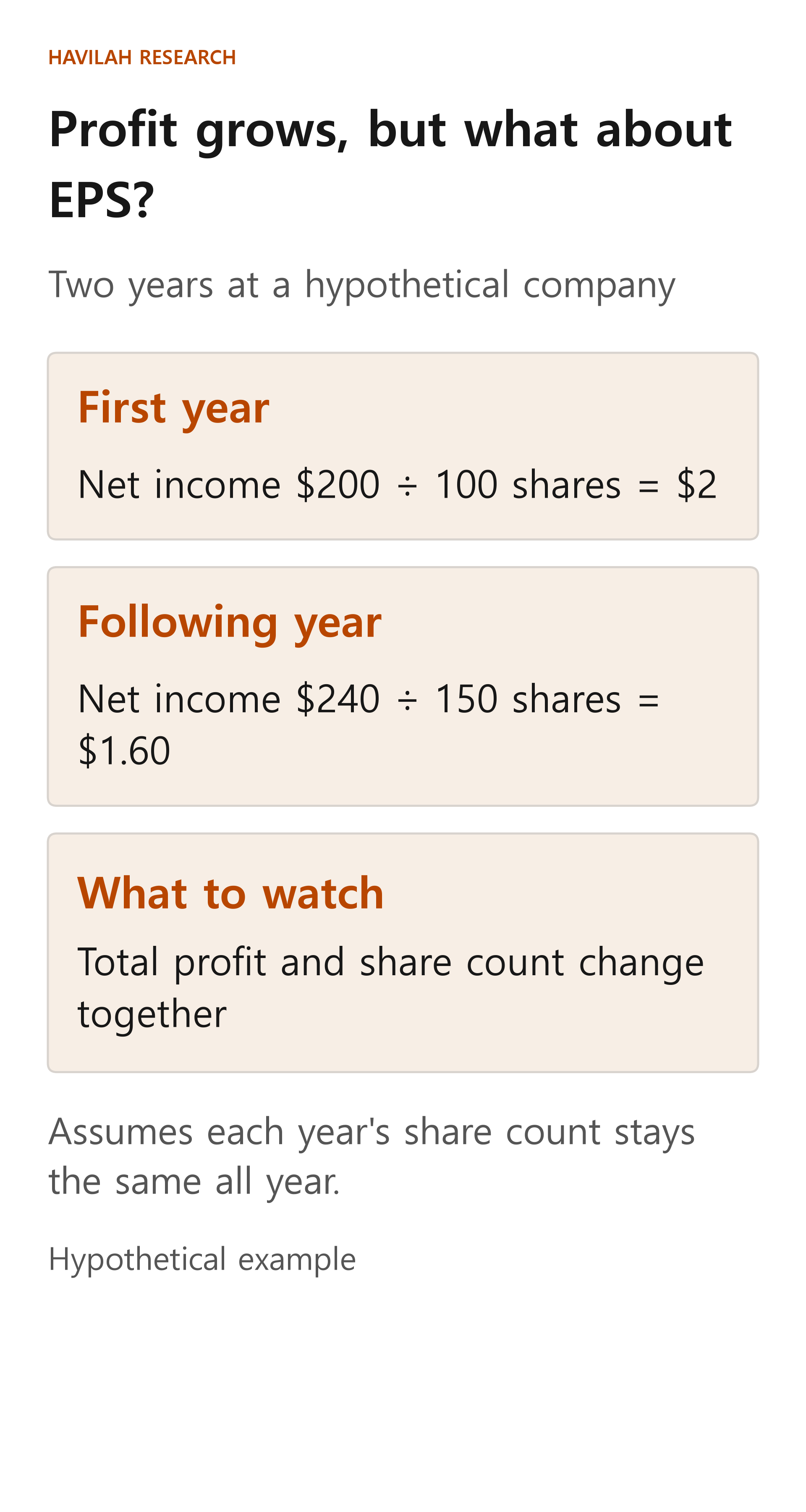
Suppose a hypothetical company recorded net income attributable to common shareholders of $200 in one year, and had 100 shares throughout that year. Assume that in both years no profit belongs separately to preferred shares or similar, so the company's total net income equals the net income attributable to common stock. Dividing net income of $200 by 100 shares gives EPS of $2.
The following year, net income rose to $240, but assume there were 150 shares throughout that year. Dividing $240 by 150 shares gives EPS of $1.60. The company's total net income grew, but the amount per share fell from $2 to $1.60.
This number is not money paid straight to shareholders. Whether the company pays out its profit as dividends or puts it back into the business is a separate decision. And a rise in EPS does not necessarily mean the share price will rise. The level the market already expected and the risks ahead also play a part.
What if the share count changes during the year?
At real companies, the number of shares can change from year to year as they issue new shares or buy back their own. If you then calculate a year's EPS using only the year-end share count, you miss the changes along the way.
For example, suppose 100 shares were outstanding for the first 6 months and 120 shares for the next 6 months. Because the two periods are the same length, the time-weighted average share count in this simple example is 110 shares. Outstanding shares are the shares held by investors. In the real calculation, each share count is weighted by how long it stayed in place.
If net income attributable to common shareholders that year is $220, dividing by 110 shares gives basic EPS of $2. That differs from the roughly $1.83 you get using only the year-end count of 120 shares, because in this example the 120 shares were not outstanding for the whole year. The $1.83 figure is rounded to two decimal places.
Basic EPS and diluted EPS
Companies may show both basic EPS and diluted EPS. Basic EPS uses the weighted average number of common shares over the period. Diluted EPS also takes into account, as the accounting standards require, the possible effect of rights or securities that could turn into shares.
For example, if employees have rights to receive shares under certain conditions, the company works out whether these could lower earnings per share. But not every right is simply added in full to the share count. The actual method, and whether a right is included, can depend on the right's terms and on the accounting standards. Rights that would actually reduce the loss per share, for example in a period with a net loss, may be left out of the diluted calculation.
The notes to one U.S.-listed company's annual report explain that it uses the weighted average share count for the period in basic EPS and takes into account the effect of share rights related to employee compensation in diluted EPS. The notes also show which rights were included in or excluded from the calculation.
Finding out why EPS changed
If EPS rose, look separately at whether net income grew or the share count fell. If a company buys back its own shares and so reduces the share count, EPS can rise even if net income stays the same. That does not automatically mean the business grew. The price paid for the buybacks, the cash used and the debt that remains also matter.
Conversely, if a company raised money by issuing shares, EPS may fall for now, but you should also check what it did with the money. Whether a new factory or an acquisition will lead to future profit has to be looked at separately.
EPS is a useful number that links a company's profit to its share count. Looking at net income, the weighted average share count, possible additional shares and how the money was used, all together, helps you understand why the number changed.