
In company earnings releases, you sometimes see a line such as "we had a net loss, but adjusted net income was positive." It is the same company and the same period, so why are the results different?
It is because the company has taken the profit calculated under the basic accounting standards and created a separate number by subtracting or adding back certain items. Adjusted results can help you look at the business from a different angle, but they do not mean the costs left out are actually unimportant.
Two numbers for the same period
Suppose a hypothetical company recorded a net loss of $20 for a year under accounting standards. The company separately announced adjusted net income that excludes $30 of restructuring costs and $40 of stock-based compensation expense, both of which were included in that result.
Restructuring costs are costs a company incurs when it closes down parts of its business or reorganizes. Stock-based compensation expense is the expense recorded in the accounts when a company pays employees with shares or share-related rights.
In this example, assume the two costs are pre-tax amounts that do not overlap, and that the adjustments have no additional tax effect and there are no other adjustments. Adding the two costs back to the $20 net loss gives adjusted net income of $50. When you read real filings, also check the tax effect of the adjustments, which is shown as a separate line.
| Item | Hypothetical amount |
|---|---|
| Net loss under accounting standards | -$20 |
| Adjustment for restructuring costs | +$30 |
| Adjustment for stock-based compensation | +$40 |
| Additional tax effect of the adjustments | $0 |
| Adjusted net income | $50 |
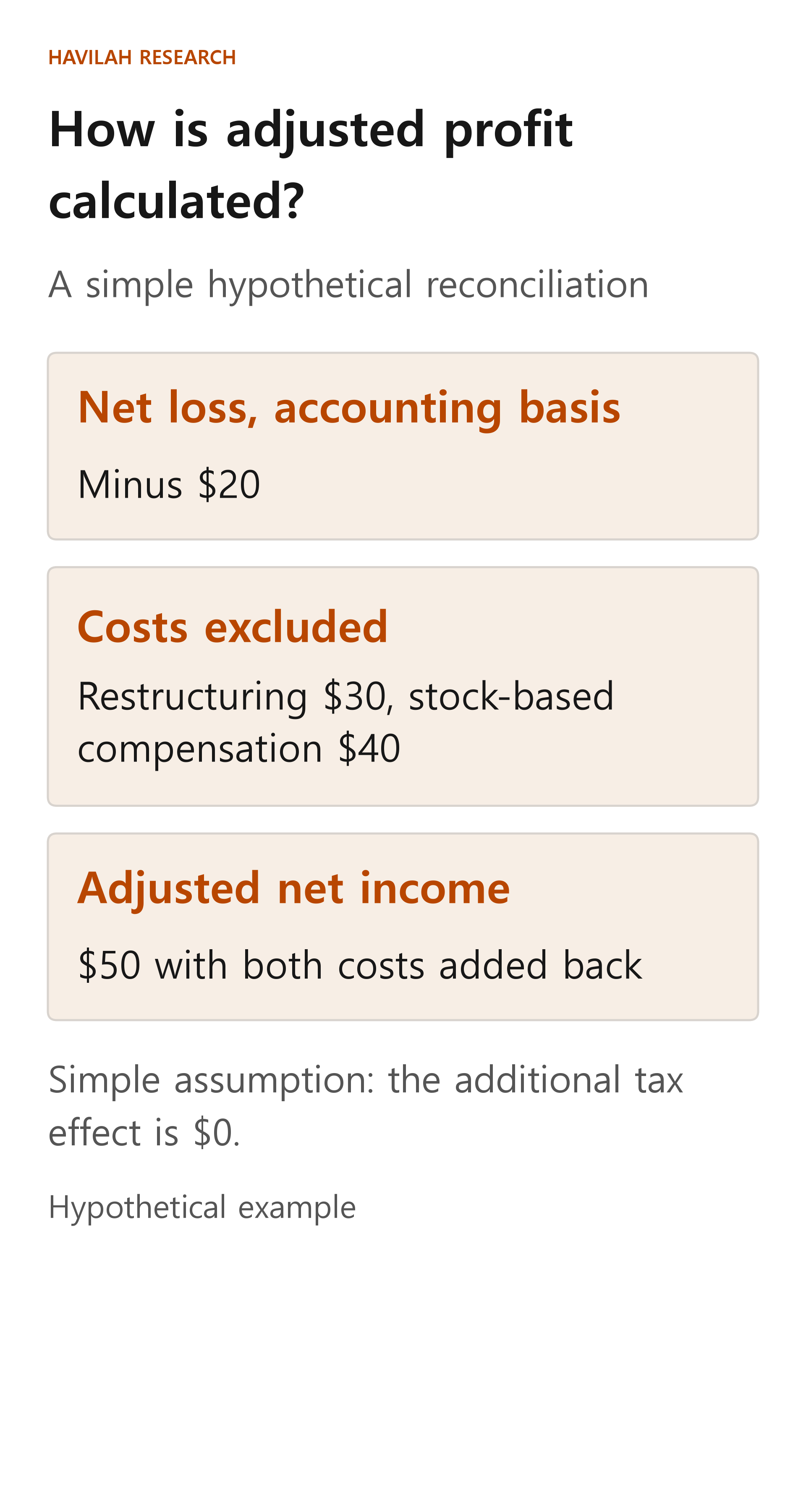
Under accounting standards it is a loss; on the adjusted basis the company presents, it is a profit. What matters more than the fact that the two numbers differ is which items the difference comes from.
Start by reading the reconciliation table
When a company presents adjusted results, first look at the table that links the numbers under accounting standards to the adjusted numbers. It shows which costs or income were added or subtracted, and by how much. Even adjusted results with the same name can exclude different items at different companies.
In the operating income reconciliation table in its annual report, the U.S. company DocuSign showed lines that add back stock-based compensation expense and restructuring-related costs, among other items. The table shows the adjustment method the company chose; it does not prove that the excluded items are economically meaningless.
Will the excluded costs come back?
The cost of closing a single factory may not occur on the same scale every year. Even so, if a company keeps restructuring year after year under different names, you need to check several years of filings. Do not conclude that there will be no such costs in the future just because the name sounds like a one-off.
With stock-based compensation, cash may not go out at the moment the expense is recorded. But it is a way of paying employees, and it can recur. If the company issues new shares, existing shareholders' percentage of ownership may also fall. To see the actual effect, check the terms of the awards together with the record of share issuance and buybacks.
The U.S. Securities and Exchange Commission (SEC) explains that leaving normal, recurring cash operating expenses needed to run the business out of an adjusted measure can be misleading. Whether a cost is recurring and significant has to be judged by looking at the company's business and circumstances.
Numbers to look at together when you invest
If adjusted profit has grown, check whether profit under accounting standards has improved as well. If the gap between them has widened, look at which items grew. Even if profit has improved both before and after adjustments, check actual cash flow and debt separately.
Adjusted results are supplementary information you can use to understand a company. They become more useful when you know what the company excluded and weigh whether those excluded costs could recur or affect shareholders.