
When you look at a company's results, you will see several profit numbers. Operating income is $100, net income is $65, and EBITDA is said to be $140. Which number is right?
The three numbers can all exist at once because each one subtracts or adds back different items. Once you know what each includes, it becomes easier to separate the profit a company earned from its business from the effects of interest and taxes.
Operating income and net income
Operating income is a number that looks at the revenue and expenses that arise from selling the company's products and services and running its operations. As you learned earlier, you can think of it as gross profit minus operating expenses such as selling, general and administrative expenses. For the actual line items in an income statement, you need to check each company.
Net income is the final profit after interest, taxes and other income and expenses below operating income have also been taken into account. For example, two companies with the same operating income can have different net income if they pay different amounts of interest on borrowed money. Net income does not mean the cash the company holds, nor an amount paid straight to shareholders.
What does EBITDA add back?
EBITDA is short for earnings before interest, taxes, depreciation and amortization: profit before interest, taxes, depreciation and the amortization of intangible assets are taken into account. Depreciation is the amount recorded when the purchase cost of an asset used for several years, such as a factory or a machine, is spread out as an expense over the period it is used. If the asset is expected to still have a value it could be sold for once the company has finished using it, that value is usually subtracted from the amount to be spread out as an expense. Amortization of intangible assets is likewise an expense that, under certain conditions, spreads out the cost of assets without physical form, such as patents.
When you look at ordinary EBITDA in U.S. filings, check the breakdown that starts from net income and adjusts for interest, taxes, depreciation and amortization. Companies sometimes also present adjusted EBITDA, which excludes further items. Read the company's reconciliation table to see what was added and what was subtracted.
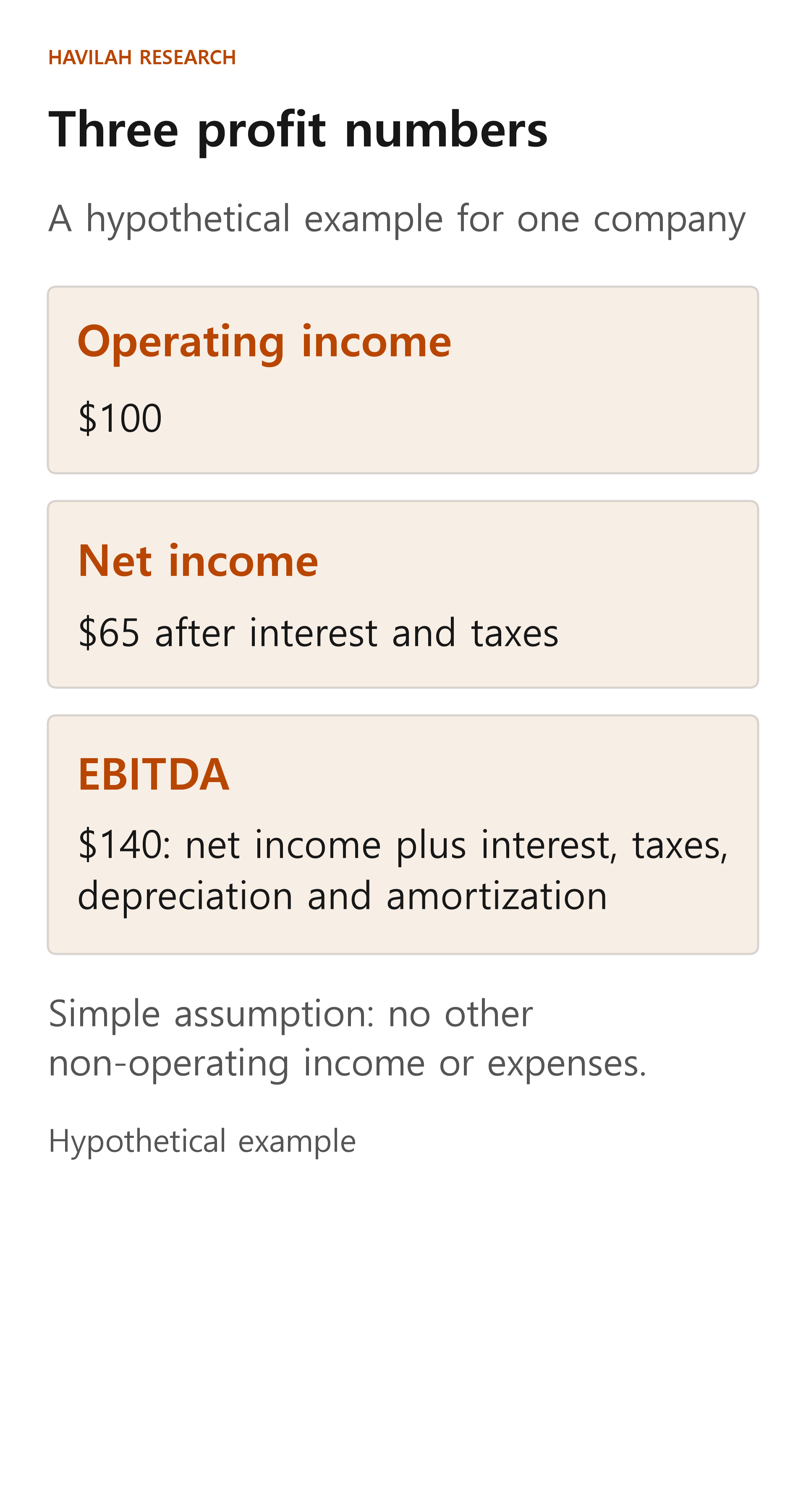
Working it out with hypothetical numbers
Assume a company's operating income for a year is $100. That operating income already includes $40 of depreciation and amortization of intangible assets as expenses. Below operating income there is $20 of interest expense and $15 of income tax expense. Assume there is no other non-operating income or expense.
Net income is $100 of operating income minus $20 of interest and $15 of tax, which is $65. In this hypothetical example, EBITDA is $140: net income of $65 with $20 of interest, $15 of tax and the $40 total of depreciation and amortization added back.
| Item | Hypothetical amount | What it shows |
|---|---|---|
| Operating income | $100 | Profit from business revenue minus operating expenses |
| Net income | $65 | This example's final profit, after interest and taxes as well |
| EBITDA | $140 | Net income adjusted for interest, taxes, depreciation and amortization |
In this example there is no other non-operating income or expense, so adding the $40 of depreciation and amortization to $100 of operating income also gives $140. But real companies can have other non-operating income or expenses, so you should not always call operating income plus depreciation and amortization "EBITDA".
Why EBITDA is not cash
Depreciation and amortization may not be expenses paid in cash during the current period. But buying or replacing machines takes cash. EBITDA does not, on its own, show the money needed to buy equipment again or to repay debt.
Also, if the money still owed for goods sold on credit grows, or inventory piles up, profit and actual cash flow can differ. Do not assume a company has enough cash just because its EBITDA is high; look at the cash flow statement, its spending on equipment (capital expenditure) and its debt as well.
What should you look at in real filings?
When a company announces profit measures, first check the income statement for the same period. Then look at which items the company adjusted, starting from net income, to arrive at the EBITDA or adjusted EBITDA it presents. Even under the same name, the items included in or excluded from adjusted EBITDA can differ from company to company.
Operating income shows the business's revenue and operating expenses, and net income shows the final result after interest, taxes and other items. EBITDA is a supplementary measure that adjusts a set list of items to show the company from another angle. Read the three numbers together, and also check the cash and debt that none of them shows.