
A company's revenue grew, but its operating margin fell. If the cost of making its products did not change much, costs may have risen somewhere else. Costs incurred while developing new products or finding customers are examples.
The fact that costs rose is not enough, on its own, to conclude that management is doing a bad job. First look at what the money was spent on and how large those costs have become compared with the company's revenue.
What are R&D and SG&A expenses?
Research and development (R&D) expenses are the costs of creating new products or technologies and improving existing products. They can include the salaries of development staff and the cost of experiments. Which items are recorded as expenses, and when, depends on the accounting standards that apply and on the nature of the transaction.
Selling expenses and administrative expenses are grouped together as selling, general and administrative expenses, or SG&A for short. They are the costs of promoting and selling products and of running the company. Examples include advertising, the salaries of sales staff and office costs. Companies break these items down differently in their income statements. Some show R&D as a line separate from SG&A.
Subtracting these operating expenses and similar items from gross profit, covered in the previous lesson, gives operating income. The time an expense is recorded and the time cash is actually paid can differ. Dividing operating income by revenue gives the operating margin, the share of revenue that operating income makes up.
Comparing the numbers at a hypothetical company
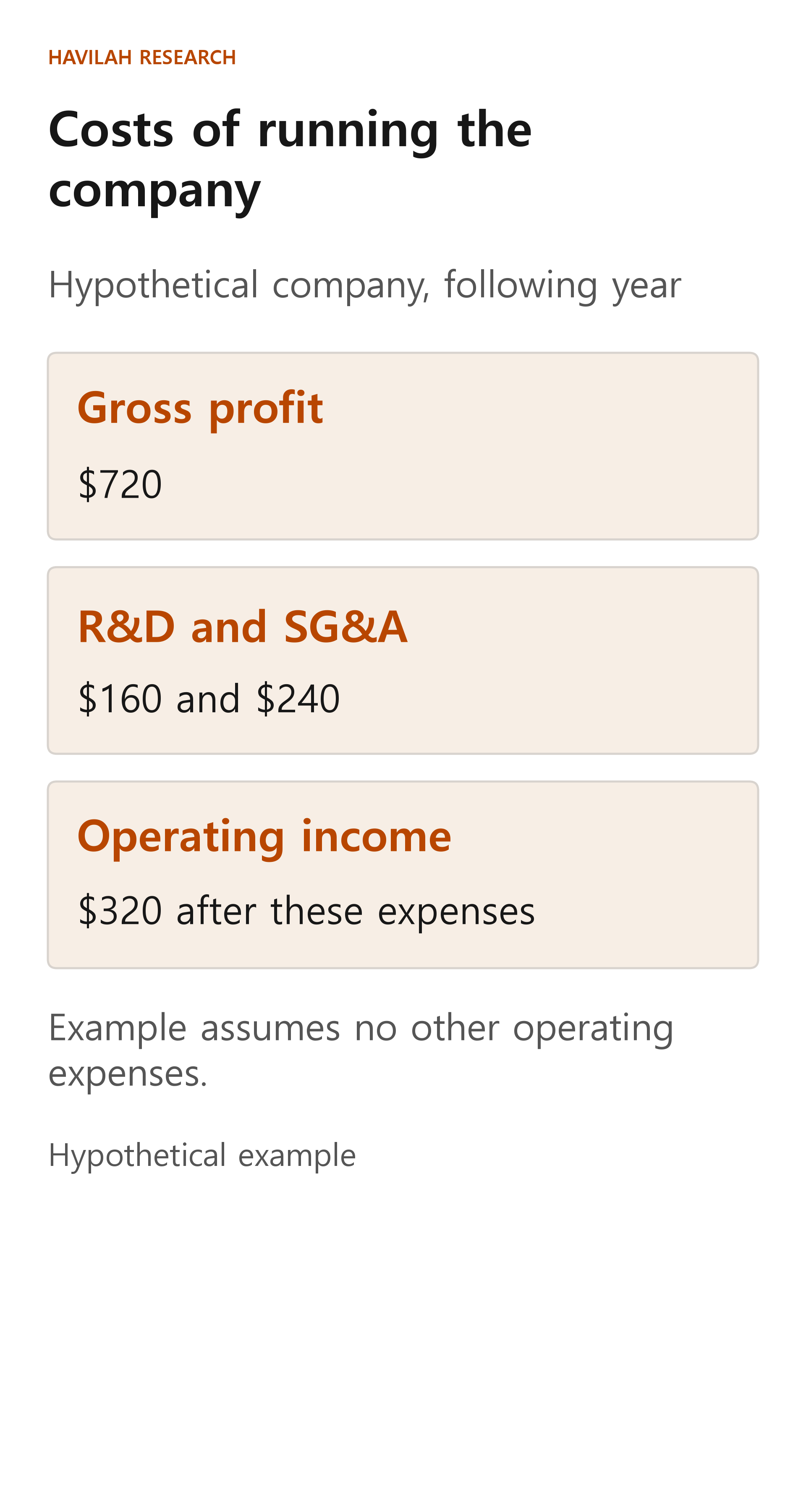
Below is a hypothetical company for illustration. Assume that R&D and SG&A do not overlap, that neither is included in the cost of goods sold already subtracted, and that there are no operating expenses other than these two.
| Item | First year | Following year |
|---|---|---|
| Revenue | $1,000 | $1,200 |
| Gross profit | $600 | $720 |
| R&D expenses | $100 | $160 |
| SG&A expenses | $200 | $240 |
| Operating income | $300 | $320 |
Operating income in the first year is $600 minus $100 of R&D and $200 of SG&A, which is $300. In the following year, $720 minus $160 and $240 gives $320.
Operating income rose by $20. But the operating margin fell from 30% in the first year ($300 divided by $1,000 of revenue) to about 26.7% in the following year ($320 divided by $1,200). Percentages are rounded to one decimal place.
Looking at amounts and ratios together
R&D rose from $100 to $160. Its share of revenue also rose, from 10% to about 13.3%. SG&A rose from $200 to $240, but its share of revenue was 20% in both years.
Even when the amount spent on a cost goes up, its ratio to revenue can stay the same if revenue grows at the same pace. If costs grow faster than revenue, on the other hand, they can weigh on margins. The next step is to find out which costs drove the change.
In its annual report, the U.S. cybersecurity company Fortinet gave an increase in development staff and in compensation-related costs as one of the main reasons its R&D expenses rose in one year. It also named higher personnel-related costs as a major factor in its sales and marketing expenses. These are the causes the company gave for that period, and they do not guarantee future results.
How should you judge rising costs?
The cost of creating a new product comes first, and the revenue may arrive much later. When a company spends more on advertising, you also need to look at whether customers stay for a long time and how much profit is left from them. And if a company lifts its short-term profit by cutting costs, consider whether necessary development or sales work may fall short as a result.
Conversely, even when a company describes rising costs as an investment in the future, the outcome is uncertain. A new product launch may be delayed, or the company may fail to win customers. Check how revenue, profit and the company's explanations have changed over several years.
When you read the reasons for higher costs in a filing, separate them into items such as personnel costs, advertising, development projects and acquisitions. Also check whether each is a one-off factor or a cost that will recur. R&D and SG&A are not simply numbers to be cut; they are clues to where the company is putting its resources.