
Even when companies sell goods at the same price, what it costs to make them differs from company to company. How much is left when you subtract the cost of providing a product or service from the sales amount? The number that answers this question is gross profit.
A large amount left over sounds good, but you cannot conclude from that one number that a stock is a good investment. First, let's look at what has been subtracted and which costs are still left.
How is gross profit calculated?
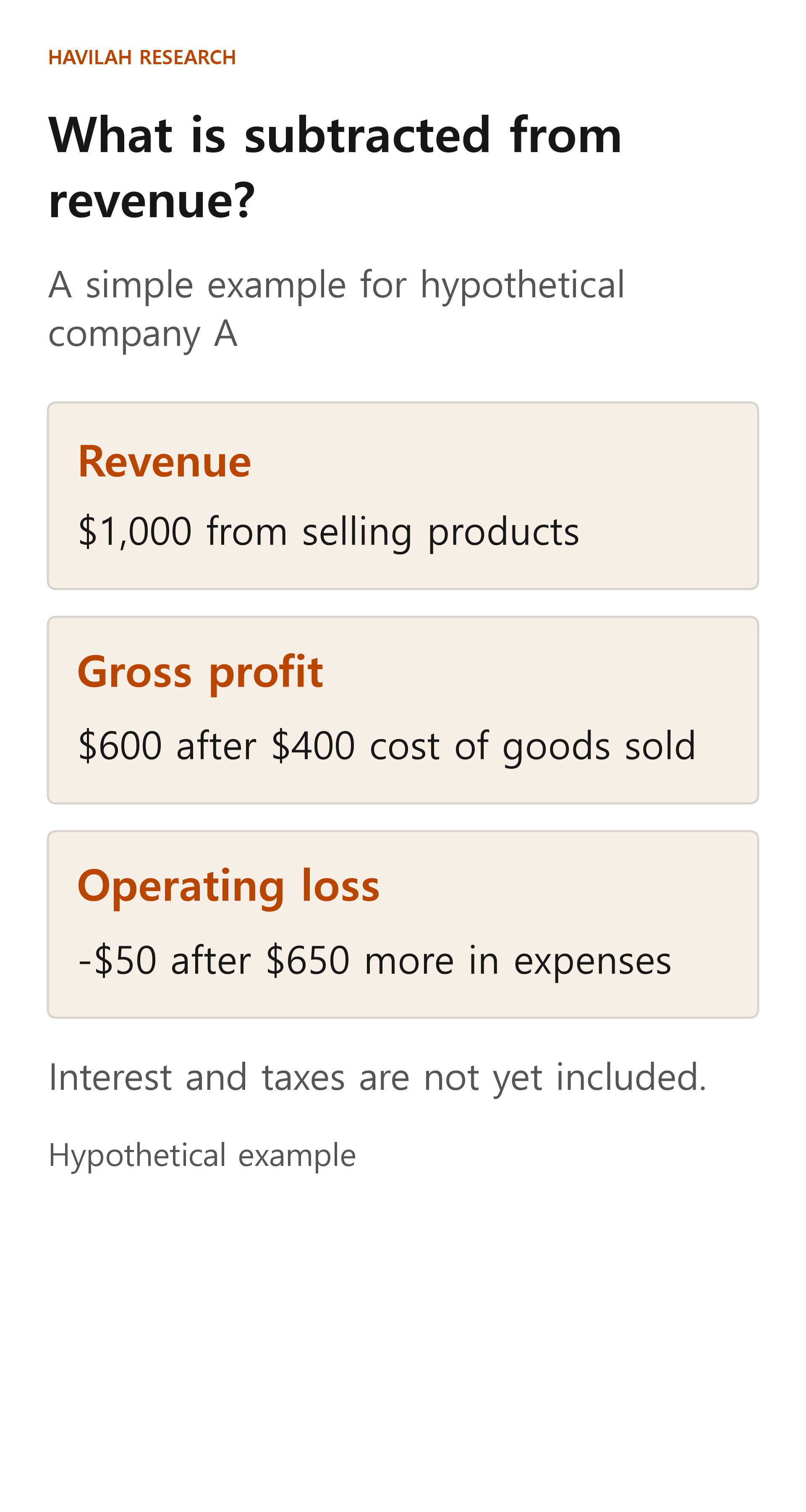
Hypothetical company A sold products and earned $1,000 in revenue. Assume that the costs related to making those products, called the cost of goods sold (or cost of revenue), are $400.
$1,000 of revenue minus $400 of cost of goods sold gives gross profit of $600. Divide this by the $1,000 of revenue and multiply by 100, and the gross margin (gross profit as a percentage of revenue) is 60%. This means that for every $100 of revenue, $60 is left after subtracting the cost of goods sold.
Do not think of the remaining $600 as the company's final profit. Gross profit is not the company's cash balance either. There may be costs not yet subtracted, such as advertising to promote the product or the cost of running offices. Interest and taxes also need to be looked at separately. How costs are classified can differ from company to company, so check the explanations in the company's filings.
Comparing a high-margin company with a low-margin company
Now let's also look at hypothetical company B. Assume both companies sold $1,000 worth of goods over the same period. Company A's cost of goods sold is $400, and company B's is $700.
| Item | Company A | Company B |
|---|---|---|
| Revenue | $1,000 | $1,000 |
| Cost of goods sold | $400 | $700 |
| Gross profit | $600 | $300 |
| Gross margin | 60% | 30% |
| Other operating expenses | $650 | $200 |
| Operating income | -$50 | $100 |
For company B, $1,000 minus $700 leaves gross profit of $300. Dividing $300 by the $1,000 of revenue gives a gross margin of 30%.
In this example, company A's other operating expenses of $650 are larger than its gross profit of $600. The difference is $50, so it has an operating loss of $50. For company B, subtracting $200 of operating expenses from $300 of gross profit leaves operating income of $100.
So a higher gross margin does not necessarily mean higher operating income for that period. Net income, after interest and taxes, can differ again. If company A's spending is an investment in future growth, you need to check the results that follow; for company B, check whether its low expenses can last.
Finding out why the ratio changed
If the gross margin rises, the company may have sold its products at higher prices, raw material prices may have fallen, or manufacturing may have become more efficient. The ratio can also change if higher-margin products make up a larger share of total sales. Conversely, price discounts, rising costs or changes in how fully factories are used (the utilization rate) can lower it.
In its annual report, the U.S. food company BranchOut Food pointed to expanded in-house production, a change in its product mix and more efficient logistics, among other factors, as reasons its gross margin improved. This is the company's own explanation for that period. Whether the same changes will continue in the next period has to be checked separately.
Points to watch when comparing with other companies
The ratio depends on what a company sells and which costs it includes in cost of goods sold. It is hard to put numbers from different industries side by side and say that one is simply better. Even within the same industry, companies can differ in how they classify costs for accounting or in whether they make their products themselves.
First compare several periods for the same company to see whether a change is temporary. Then compare it with companies in similar businesses, and also check what makes up its cost of goods sold and its selling, general and administrative expenses (SG&A). Gross margin is a starting point for looking at a company's competitiveness and cost structure, not an answer that makes the investment decision for you.