
A company announces that it made money this year. Yet the cash left in its bank account has actually gone down. How can cash fall when the company says it made a profit?
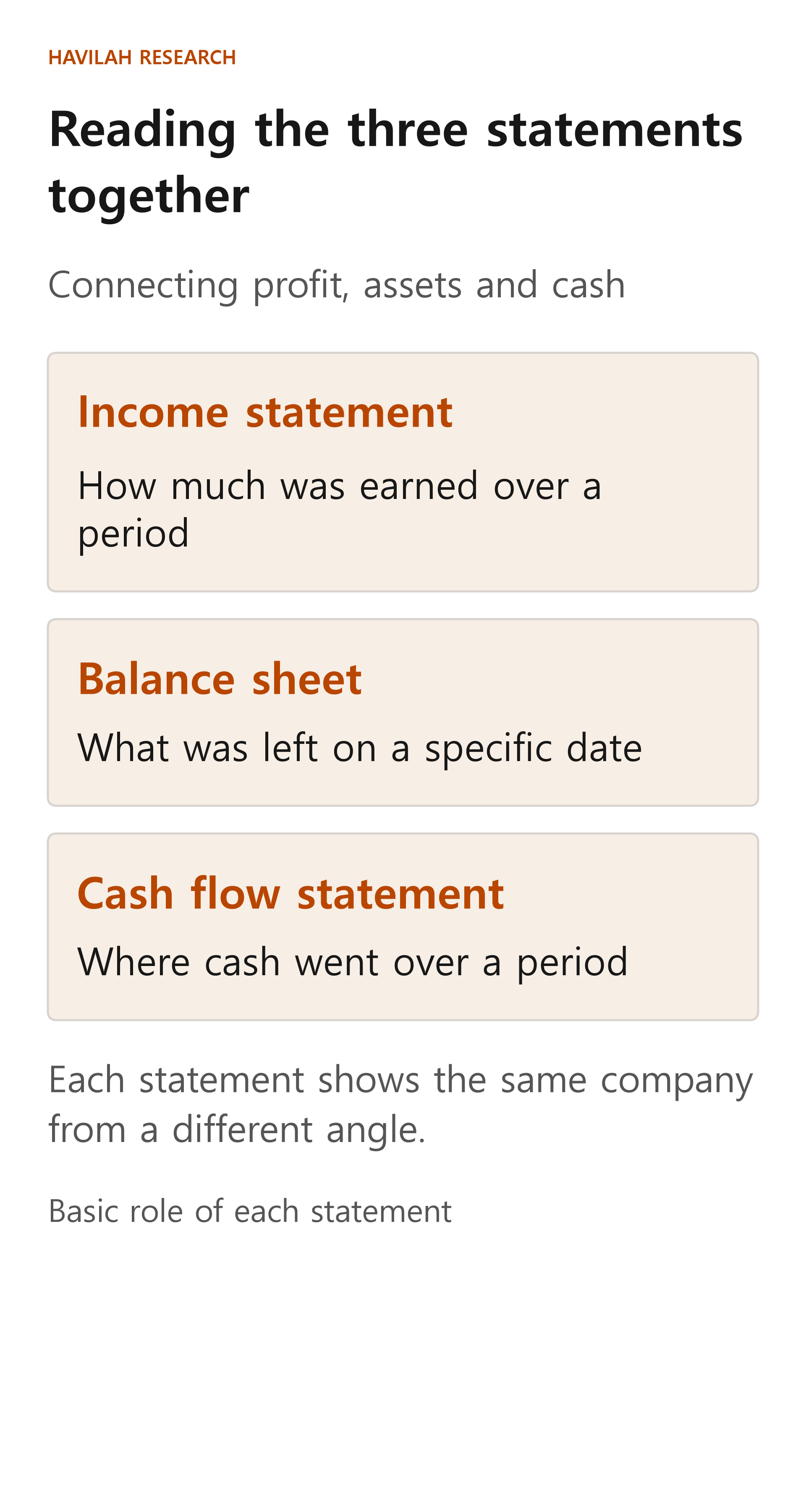
To find the answer, you need to look at the financial statements together. Financial statements are documents that summarize a company's business results and its financial position. In particular, the income statement, the balance sheet and the cash flow statement show the same company from different angles.
One covers a period, the other a single date
The income statement shows how much revenue a company earned and how much in expenses it recorded over a period. The final profit left after subtracting expenses and other items from revenue is called net income. The time money actually changes hands can differ from the time revenue or an expense is recorded, so net income can differ from the increase in cash.
The balance sheet shows, on a specific date, the assets a company has, the liabilities it must pay and its shareholders' equity. Assets are items of value to the company, such as cash or money it is owed. Liabilities are money it has to repay or obligations it has to fulfill. Shareholders' equity is what is left, in accounting terms, after subtracting liabilities from assets. Because it is an accounting amount, it is not the same as the company's value as traded in the stock market.
If the income statement is a video recorded over a year, the balance sheet is closer to a photo taken at year-end. This is only an analogy. The statements do not show everything the way a video or a photo would; they are numbers organized according to accounting standards.
The cash flow statement shows where cash came from and where it went over a period. It splits cash into three groups: cash generated by the business, cash used to buy or received from selling equipment and similar assets, and cash from borrowing or repaying money.
Let's look at a small hypothetical company
This company started the year with only $100 in cash. It had no liabilities, so its shareholders' equity that day was also $100. During the year it sold goods and recorded $100 in revenue, but it received only $60 in cash from customers; the remaining $40 would be paid later. It paid all $70 of its business expenses in cash that same year. Assume there are no taxes and no other transactions.
Connecting the three numbers
On the income statement, $100 of revenue minus $70 of expenses gives net income of $30.
On the cash flow statement, the $60 received minus the $70 paid means cash from the business fell by $10. Starting cash of $100 fell by $10, so year-end cash is $90.
The year-end balance sheet shows two assets: $90 in cash and the $40 not yet received. Money that customers still owe is called accounts receivable. The two assets add up to $130. In this example there are no liabilities, so shareholders' equity is also $130. That is the starting equity of $100 plus net income of $30.
| Statement to check | What it shows for this hypothetical company |
|---|---|
| Income statement | Net income of $30 for the year |
| Cash flow statement | Cash decrease of $10 for the year |
| Year-end balance sheet | $90 in cash and $40 still to be received |
So when profit and cash differ, that does not automatically mean one of them is wrong. In this example, the company gained the right to receive money but has not yet collected all of it. In real companies there are other reasons too, such as inventory, depreciation and expenses not yet paid.
What should you check in real companies?
If net income keeps rising but the cash coming in from operations is weak, you can check whether money owed by customers or inventory has grown. But do not decide there is a problem from a gap in a single quarter. When a company gets paid can vary with its payment terms and the season.
Also, do not jump to the conclusion that the business did well just because cash went up. If cash rose because the company borrowed new money, you also need to look at the debt it has to repay. Cash earned by the business and borrowed cash mean different things.
When you read the three statements, first check that you are comparing the same company, that the income statement and the cash flow statement cover the same period, and which date the balance sheet figures are for. Rather than memorizing each statement on its own, follow how profit, cash and the assets left over connect, and you will understand the company better.