
Imagine you have paid for a year of an online service. The company has received the whole fee today, but it still has to provide the service for the next year. Can it record all the money it received as today's revenue?
The day money is received and the day revenue is recorded may be the same, or they may differ. Deciding in which period the amount a company earns from a transaction is recorded as revenue is called revenue recognition.
Receiving money versus providing the service
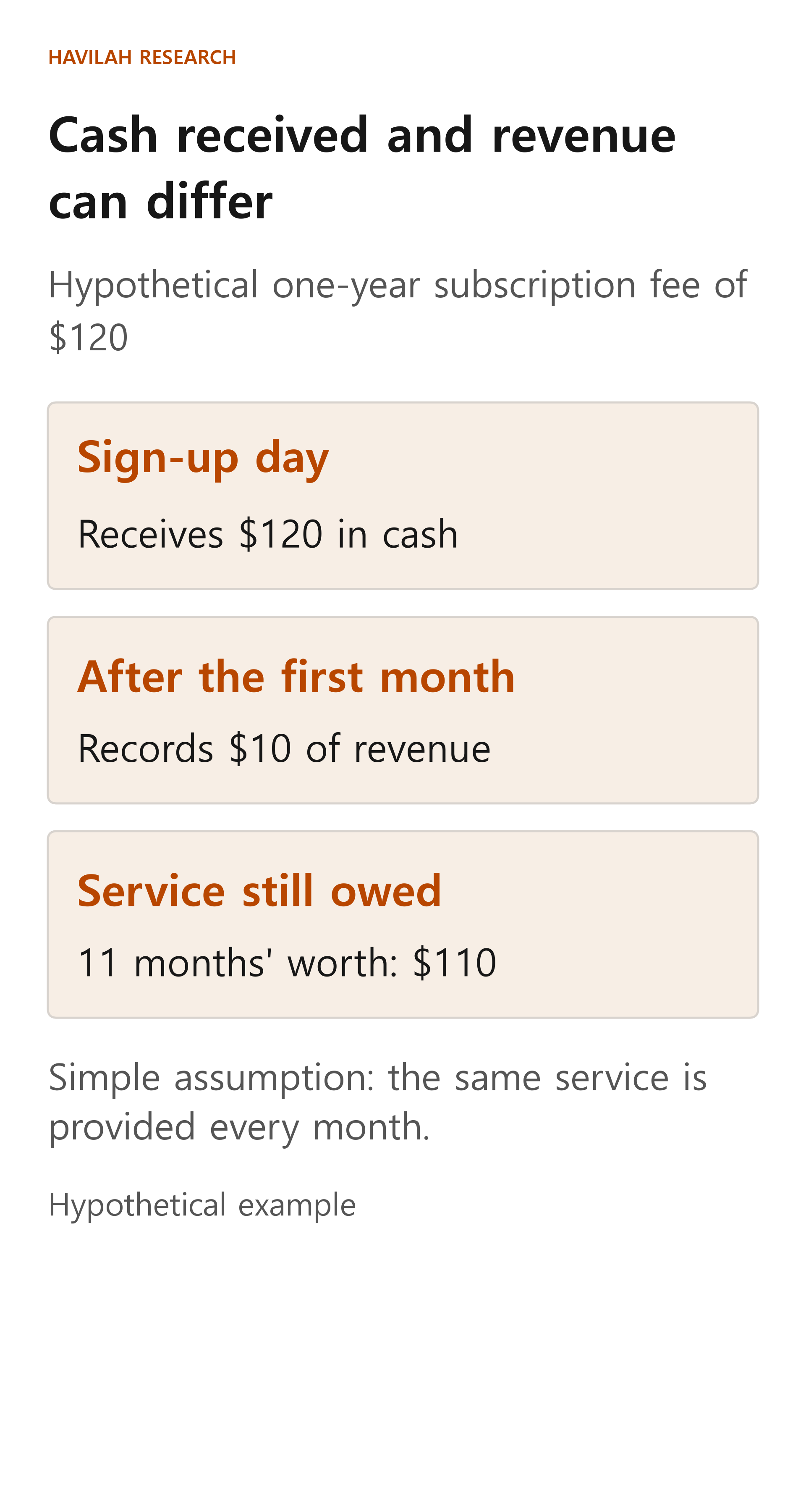
A hypothetical subscription company receives a one-year fee of $120 from a customer in advance. The customer can use the service as soon as they sign up, and the company provides the same level of service every month. Assume there are no refunds or extra charges and that revenue is recorded evenly over the period in which the service is provided.
On the day the customer signs up, $120 arrives in the company's bank account. But the company has not provided a full year of service on that day. It now has an obligation to provide the service in the months ahead.
Divided over 12 months, the amount for one month is $10. In this example, when a month ends the company records $10 as revenue, and the $110 for the 11 months not yet provided remains as an obligation to provide the service in later periods. The part of money received in advance that the company has not yet delivered on is usually called a contract liability or deferred revenue.
What happens as time passes?
If the service is provided as promised, cumulative revenue after 6 months is $60. The $60 for the remaining 6 months corresponds to service still to be provided. Once all 12 months have been provided, the revenue recorded in this example totals $120.
| Point in time | Cumulative revenue | Amount for service still to be provided |
|---|---|---|
| After the first month | $10 | $110 |
| After 6 months | $60 | $60 |
| After 12 months | $120 | $0 |
This calculation holds only under the hypothetical assumption that the service is provided evenly every month. It does not mean you can simply divide every contract by 12. A contract that bundles a separate product, or whose fees vary with usage, may be recorded differently.
Is it different when selling goods?
A company that sells goods may record revenue at a point such as when the customer becomes able to use the goods. For the actual timing, you need to check the contract and the terms of the deal. Receiving an order does not, on its own, always lock in revenue.
Some deals work the other way round: the company provides goods or services first and gets paid later. In that case it may record revenue first and show the money it is owed separately. Accounts receivable, which we looked at in the previous lesson, is one example of such money owed.
One U.S.-listed company explains in its filings that, depending on the contract terms, it records product revenue mainly when goods are shipped or delivered, and records paid subscription revenue spread over the subscription period. Even within one company, the timing can differ with the products and services it sells.
What should you look at as an investor?
Even when revenue grows, the picture behind it can differ: the cash may already be in hand, it may still be owed, or there may be service still to provide for money received in advance. You can find how a company recognizes revenue in the notes to its financial statements. The notes are explanations attached to the statements that describe how the numbers were calculated and any important terms of the company's deals.
If the money a subscription company has received in advance grows, the service it must provide in the future may grow with it. That number alone cannot confirm future profits or customer satisfaction. You also need to look at the cost of providing the service, contract lengths and cancellation terms.
The starting point for reading revenue is simple. Think about three things separately: what the company sold, when it provides it to the customer, and when it gets paid. Then it becomes easier to see why revenue and cash move differently.