
A company's chief executive says the business will grow strongly in the years ahead. The explanation sounds confident and pleasant to hear. But what shareholders need to check is not the tone of the words; it is what results those words led to as time went by.
If you own only a few shares, you can hardly take part directly in the company's day-to-day decisions. So you need to look at what the management team running the company aimed for and how it spent the company's money. Rather than judging people by a single number, it is more useful to compare several records together.
Compare the forecast with the actual result
Take a hypothetical company. Its revenue last year was $1,000, and management forecast revenue of $1,200 for this year. Revenue is the money earned from selling goods or services. It is the amount before costs are subtracted, so it is not the same as profit.
If the company's forecast comes true, revenue grows by $200. Measured against last year's revenue of $1,000, that is growth of 20%.
But actual revenue this year was $1,100. It rose $100 from last year, so actual growth was 10%. That is $100 less than the forecast revenue, and the difference in growth rates is 10 percentage points. A percentage point is the unit used to describe the difference between, say, 20% and 10%.
It would be hard to conclude from this alone that management is incompetent. Exchange rates, the economy or the timing of a large customer's orders may have changed. You also need to check whether revenue from an acquired company was included, and whether the forecast and the actual figures cover the same period. What matters is whether management explains the reasons for the gap in concrete terms and how it changes its outlook and response afterward.
Where did the company's money go?
Rising revenue does not always leave shareholders with a good result. For example, if the company spent too much on advertising and building factories to push up revenue, you should also look at the burden this creates for the future. Advertising costs can affect profit in the period they are spent, while money spent building a factory can be recorded as an asset and then spread out as an expense over several years.
As you learned earlier, when a company borrows to make an acquisition or buy back its shares, you also need to look at why it spent the money and how much debt remains. To know whether a decision was good, check the choice made at the time together with the business results that followed.
What results is pay linked to?
The money and shares given to management are also worth examining. If pay is set on revenue alone, management may focus on growing revenue even while profits shrink. On the other hand, if only profit counts, management may put off investments for long-term growth. Which measures are used, and over what period performance is assessed, both matter.
In the shareholders' meeting documents of U.S. companies, called proxy statements, you can sometimes find the amount of pay, the types of pay and the criteria used to set it. Even when pay is given in shares, the conditions are not the same at every company.
Nvidia described in its shareholders' meeting documents how it aims to link executive pay to company performance. This is the intent behind the pay design the company presents. As an investor, you also need to check the specific performance conditions and what was actually paid out. When pay is given in shares, also consider whether new shares could shrink existing shareholders' portion.
Gather the records on one page
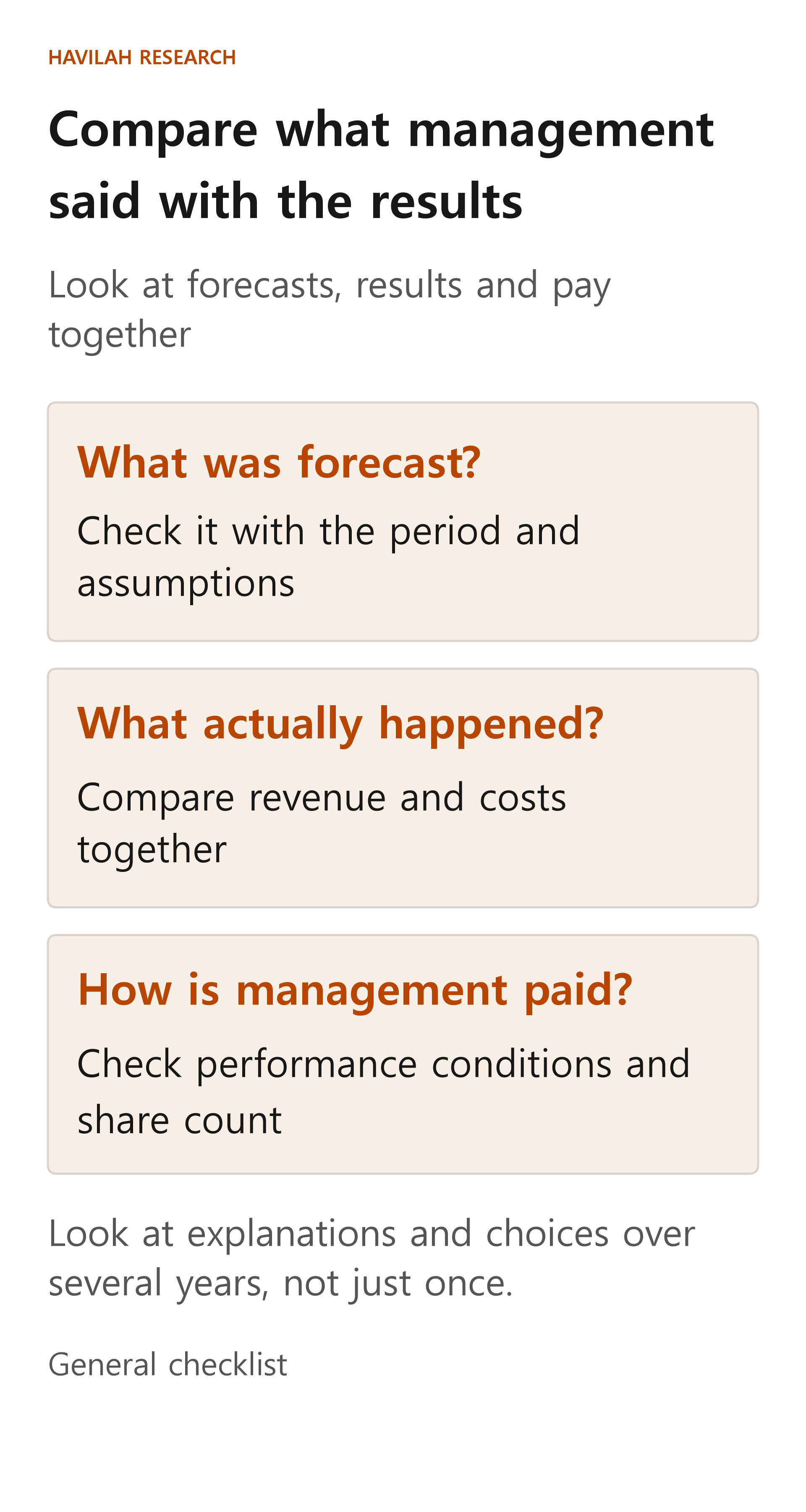
You do not need to give complicated scores from the start. If you write down the following four points in a table or a note, it becomes easier to compare them the next year.
| What to check | Question to write down |
|---|---|
| Goals and results | What was forecast, and what was the actual result? |
| Use of money | How was money spent on investment, acquisitions and debt repayment? |
| Pay | What performance is management's pay based on? |
| Explanations and risks | Does management explain why results differed and what risks remain? |
The annual reports of U.S. companies describe the business risks and contain management's discussion of the results for the last fiscal year. In shareholders' meeting documents, you can sometimes find the proposals to be voted on and information on executive pay. The documents you need can differ by company and by the type of filing, so check for each company.
A good scorecard is not one that automatically gives management high or low marks. It is a record for comparing information with the same questions over time and for checking why the explanations changed. Looking at the numbers and the circumstances together helps you understand the company's next decisions.