
You own 10 shares of a company that earned more this year than last year. Yet the profit for each share actually went down. How can that happen?
It may be that not only the company's total profit changed, but also the number of shares that profit is divided among. To understand how much of the profit belongs to one share, you need to look at profit and the number of shares together.
When the share count grows, your ownership percentage changes
Suppose a hypothetical company has 100 shares in total and you own 10 of them. You own 10% of the company.
Your 10 shares ÷ 100 shares in total × 100 = 10% ownership.
Now assume the company issues 20 new shares to other investors to raise money. There are no other changes in the share count, and you neither buy nor sell any shares. The company now has 120 shares in total, and your ownership falls to about 8.33%.
Your 10 shares ÷ 120 shares in total × 100 = about 8.33%.
When the share count rises and existing shareholders' ownership percentages fall, this is called dilution. The figure 8.33% is rounded to two decimal places. You still own 10 shares, but the portion of the company they represent has changed.
That said, issuing new shares can bring money into the company. The economic effect on existing shareholders depends on where that money is spent and what results it produces. A lower ownership percentage alone does not tell you whether you gain or lose on your investment.
Profit per share can fall even when the company's profit rises
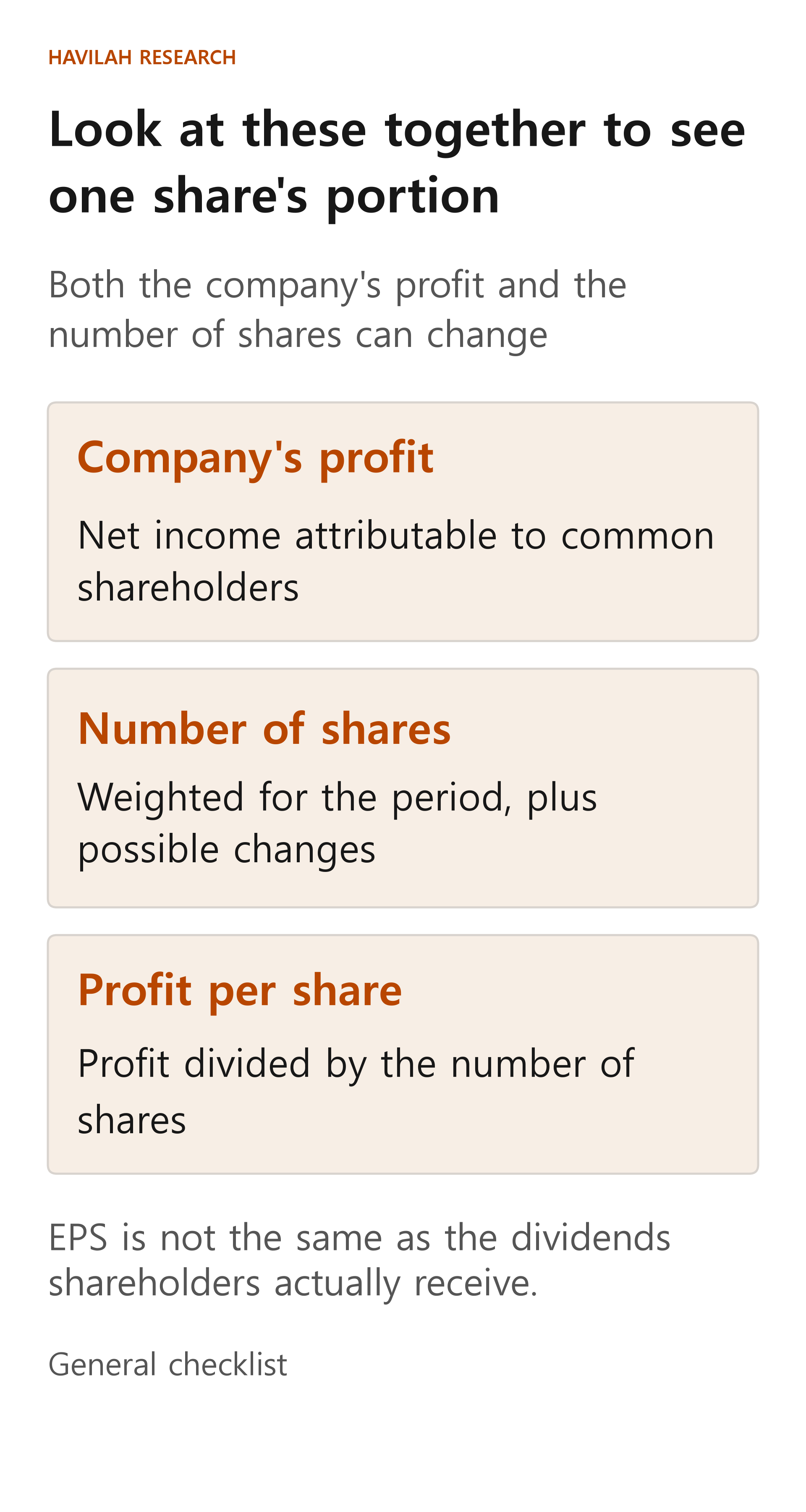
Assume the hypothetical company above earned net income of $100 attributable to common shareholders in its first year, and had 100 shares throughout that year. Earnings per share (EPS) is the net income attributable to one share of common stock.
First-year net income $100 ÷ 100 shares = EPS of $1.
Suppose the company issued 20 new shares before the next year began and had 120 shares throughout the next year. If net income the next year is $108, the company's total profit grew 8%, but EPS is $0.90.
Next year's net income $108 ÷ 120 shares = EPS of $0.90.
EPS fell 10%, from $1 to $0.90. This is a hypothetical result in which the share count grew faster than the company's profit. At real companies, the number of shares can change during a period, so basic EPS is usually calculated using the weighted average number of shares for that period. A weighted average is an average that takes into account how long each share count was in place.
EPS is a measure of the company's profit divided by the number of shares. It does not mean the company paid all of that amount out to shareholders as cash dividends.
Also look at shares that have not been issued yet
A company may have granted rights to receive shares, or to buy shares, for example to employees who meet certain conditions. If these rights turn into actual shares, the share count can rise.
Companies often report EPS in two forms: basic and diluted. Diluted EPS reflects the effect of rights that could increase the share count, among other things, according to set accounting standards. It is not simply a matter of adding every right unconditionally, so you should also check how it is calculated in the notes to the financial statements.
McDonald's explains in its annual report that its diluted EPS calculation reflects the dilutive effect of stock-based compensation. This is how one company does the calculation, and it does not mean every company's share count will grow in the same way.
Sometimes the share count rises without dilution
A stock split divides existing shares into smaller units. For example, if every shareholder's shares are turned into two shares for each one held, each shareholder's holding and the total number of shares grow at the same rate. If nothing else changes, each shareholder's ownership percentage stays the same. Do not confuse this with issuing shares to new investors.
When you invest, check how much net income grew, along with basic and diluted EPS and the change in the share count. Why the company issued shares, and what business the money raised is used for, also matter. Even if there are buybacks, the total share count can move differently from what you expect if new shares are added at the same time.