
A company is making good money. Should it use that money to build a new factory, pay down debt or return it to shareholders?
The choice it makes changes both the money the company can earn in the future and the risks it will have to carry. As an investor, you should look not only at how much a company earned but also at where it spent the money.
Profit and cash are not the same number
A company can report an accounting profit while money owed by customers has not yet come in, or while cash has gone out to buy inventory in advance. It can also go the other way: cash may come in at a different time from when the profit is recorded.
So when you check how the money was used, look at the cash flow statement together with the income statement. The cash flow statement separates the money that came in and went out through operations, the money spent on things like equipment, the money borrowed or repaid, and the money paid to shareholders.
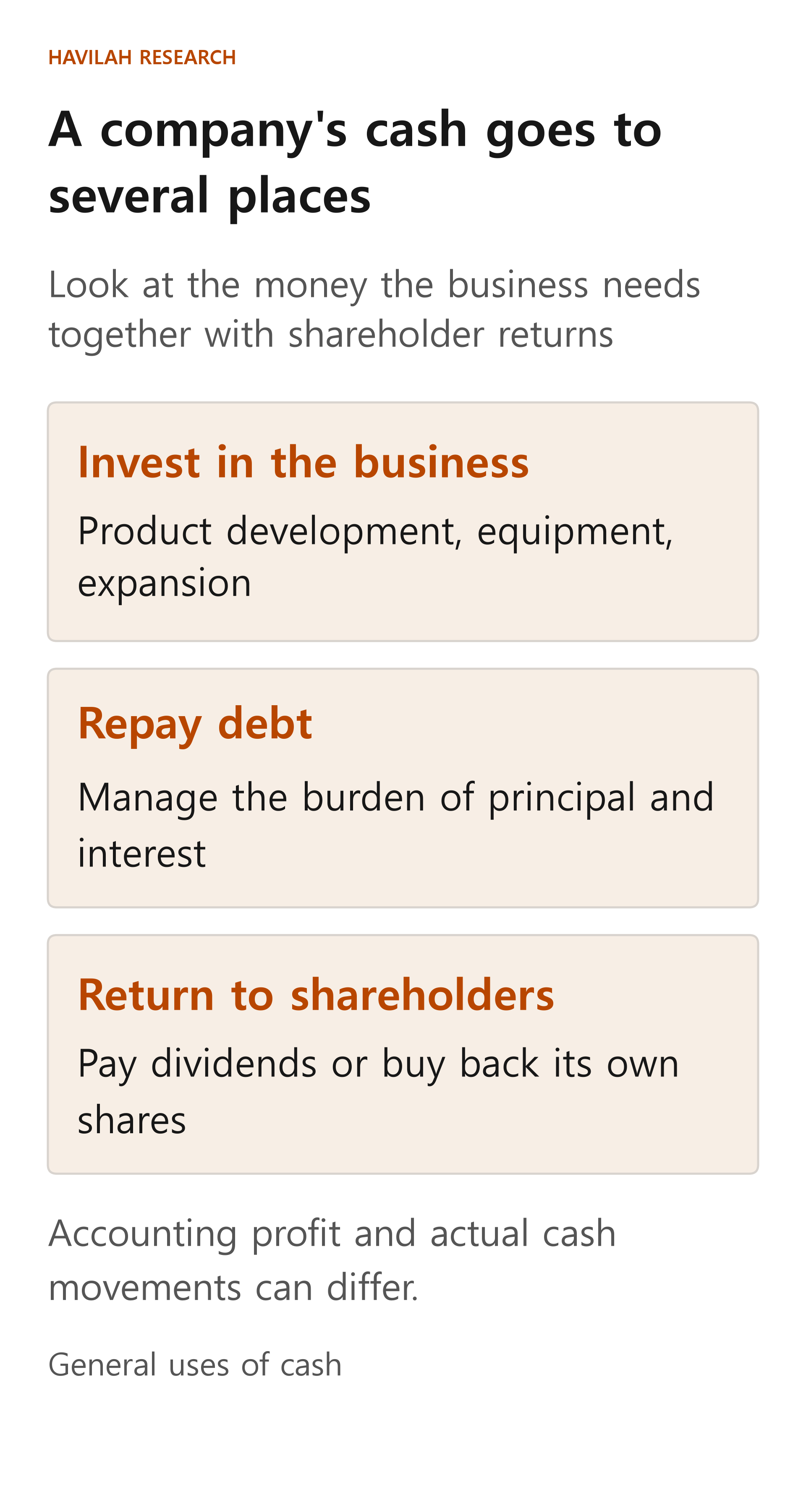
What choices can a company make?
It can spend money on developing products, on equipment or on expanding the business. If these investments succeed, revenue and profits may grow, but there is no guarantee the company will get back all the money it invested. Paying down debt, on the other hand, can help reduce the principal and interest it will owe in the future. The terms of the loans and when they are due need to be checked separately.
A dividend is money a company pays out to its shareholders. A share buyback is when a company buys its own shares. If the number of shares held by shareholders in the market falls after the buyback, the remaining shareholders may each own a larger proportion of the company. But if other changes happen at the same time, such as new shares being given to employees, the actual share count may not fall as much as expected.
PayPal explains in its annual report that buybacks can be used to offset the effect of shares added through stock-based compensation or to reduce the number of shares outstanding. Announcing a plan does not always mean the company will buy back the full amount planned.
Work out how the cash moves
Suppose a hypothetical company starts with $100 in cash and brings in $100 of cash from its operations during the year. Assume that in the same year it spends $50 on equipment, $30 on share buybacks and $10 on dividends. There is no other cash coming in or going out.
Starting cash $100 + $100 from operations − equipment $50 − buybacks $30 − dividends $10 = remaining cash $110.
This example is based on the cash that came in from operations. It does not mean the company's accounting net income was $100. A real company may have many more items, such as interest, taxes, acquisitions and debt repayment.
Buybacks also change the share count
Suppose the company above started with 100 shares and spent a total of $30 buying back 3 shares at $10 each. Assume the repurchased shares are removed from the shares outstanding and that no new shares are issued and the share count does not change in any other way.
Shares repurchased: $30 ÷ $10 per share = 3 shares.
Shares outstanding afterward: 100 shares − 3 shares = 97 shares.
If an investor keeps holding 10 shares, the percentage of all shares they own rises from 10% at the start to about 10.31% after the buyback. That is 10 shares ÷ 97 shares × 100, rounded to two decimal places. This calculation shows only the change in ownership percentage. The company's cash fell by the $30 it spent, and neither a higher share price nor an investment gain is guaranteed.
What should investors look at?
Check whether the company still has enough cash left after covering the investment its business needs and its debts. If it issued new shares while buying back shares, also look at how much the number of shares outstanding actually changed.
Dividends and buybacks are not always the best choice. If a company returns money to shareholders by passing up good investment opportunities or by taking on too much debt, the burden on the company can grow. On the other hand, sensible reinvestment can help the business later on.
When you look at management's choices, check not only "how much did they spend?" but also "why did they make that choice, and how did the company's cash and debt change?"