
Who makes a company's important decisions matters to investors. How much voting power do the shares you bought carry? If the company pays money to a business owned by someone close to management, what terms should you check?
These questions are a starting point for looking at a company's corporate governance. Corporate governance is the way shareholders, the board of directors and management make decisions about the company and oversee it.
The number of shares and the number of votes can differ
At a shareholders' meeting, shareholders can vote on important proposals. How many votes each share carries can depend on the class of share and the company's rules.
Suppose a hypothetical company has 90 Class A shares and 10 Class B shares. Each Class A share carries one vote, and each Class B share carries ten votes. Assume one person holds all 10 Class B shares and no Class A shares.
This person holds 10 of the 100 shares in total, so they own 10% of the shares. But when you count the votes, the result is different.
- Class A votes: 90 shares × 1 vote = 90 votes.
- Class B votes: 10 shares × 10 votes = 100 votes.
- Total votes: 90 votes + 100 votes = 190 votes.
The Class B holder's share of the voting power is 100 votes ÷ 190 votes × 100 = about 52.63%, rounded to two decimal places. Although they hold 10% of the shares, in this hypothetical case they have more than half of all the votes. Whether a given proposal actually passes depends on the rules for that proposal and on how many other shareholders take part, among other things, so you need to check those as well.
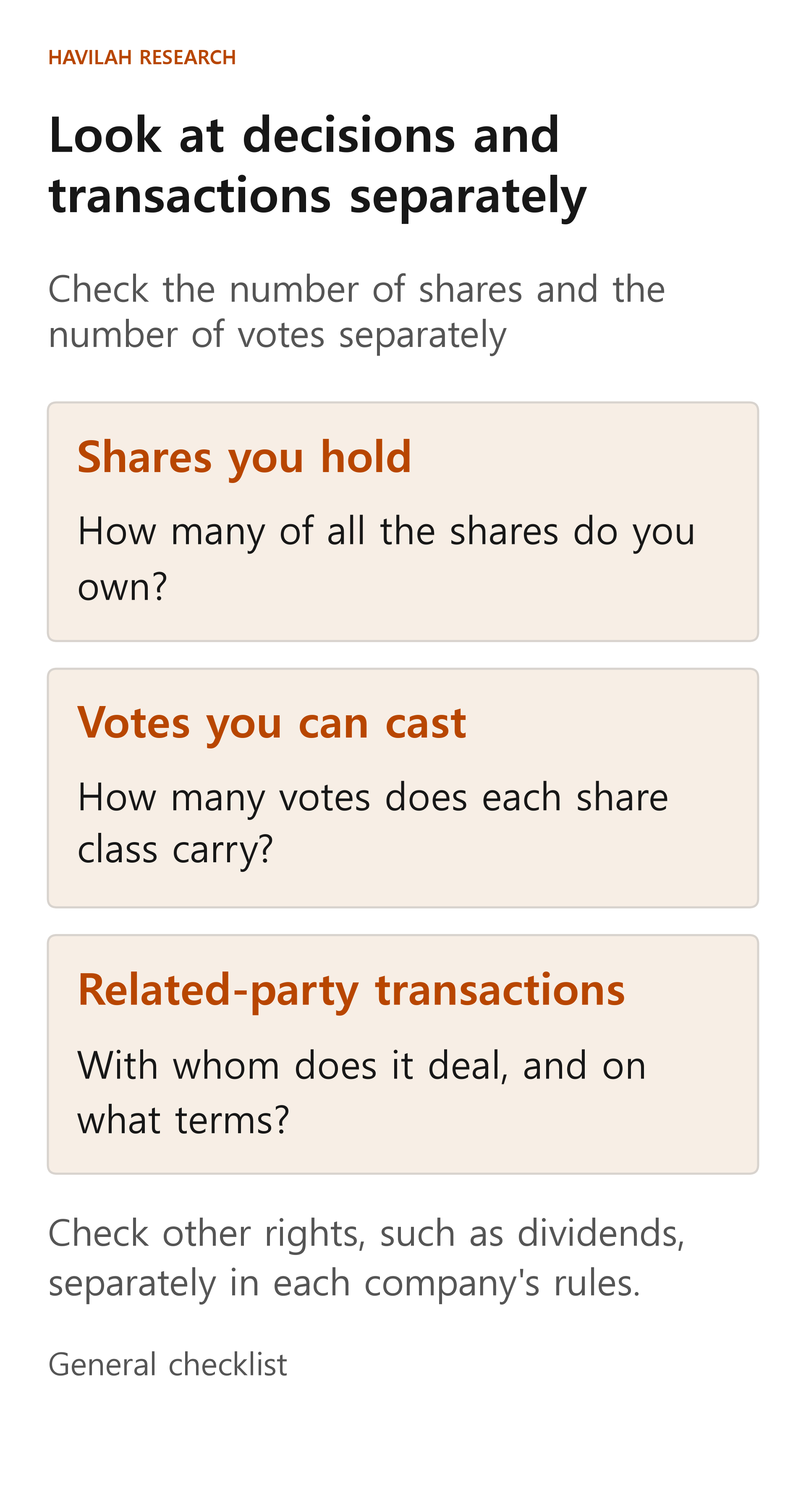
How do you check this at a real company?
Meta explains in its shareholders' meeting documents (its proxy statement) that each Class A share carries one vote and each Class B share carries ten votes. This is a real example of voting rights that differ by share class. The 90 shares and 10 shares in the calculation above are not Meta's figures; they are hypothetical numbers used for illustration.
Different voting rights do not tell you whether the rights to dividends or to the company's assets are the same or different. You need to read the company's articles of incorporation and its filings separately to see which rights come with each class of share.
Some argue that concentrating voting power in a few shareholders lets a company be run with a long-term view. On the other hand, ordinary shareholders' objections may have little effect on decisions. Rather than simply labeling the structure good or bad, first check who can make which decisions.
When a company deals with people close to it
Imagine a company rents a building owned by an executive's family, or buys services from a company connected to a major shareholder. A transaction like this, in which people or businesses closely connected to the company are involved, is called a related-party transaction.
A related-party transaction is not in itself wrongdoing or a loss. It may be a necessary deal. But when the other party is close to management, you need to consider whether that party's interests could come before those of the company and its other shareholders when the price and terms are set.
For example, to see whether the rent is reasonable, you would need to compare the building's location, size and lease term with the terms for similar buildings. A single number is rarely enough to say it is expensive or cheap. Also check the purpose of the transaction, the amount, how the price was set and who approved it.
Where should investors look?
The annual reports and shareholders' meeting documents (proxy statements, filed with the SEC as Form DEF 14A) of U.S. companies can contain information on share classes, the holdings of major shareholders and related-party transactions. Check the related-party transactions section of the report and the notes to the financial statements, and see whether the information you need is referenced in another document.
Do not fill in contract terms you cannot confirm with guesses. The voting structure and the details of transactions are each clues to understanding how the company makes decisions and spends its money. Along with the company's business results, look at how those decisions could affect ordinary shareholders.