
Two companies sell similar products. One can cut its price and still have room to spare, while the other could lose money selling at the same price. Why does this difference arise?
It may be because one company makes what customers want at a lower cost, or has strengths that other companies find hard to copy. A competitive advantage is a strength, compared with competitors, that helps a company win customers and run its business.
The room a cost difference creates
Suppose two hypothetical companies sell a product at the same price of $10. Company A spends $4 to make one unit, and Company B spends $6. If quality and terms of sale are the same, here is what is left from each unit sold after subtracting the production cost from the selling price.
Company A: selling price $10 − production cost $4 = $6.
Company B: selling price $10 − production cost $6 = $4.
Company A keeps $2 more per unit. This difference is not net income. Both companies still have other costs to subtract, such as selling expenses and the cost of running the head office.
If Company A cuts its price to $8, it still has $4 left after the production cost. If Company B cuts to the same price, it has $2 left. Other things being equal, the lower-cost company has more room to compete on price. Whether a price cut actually brings in more sales, though, is a separate question.
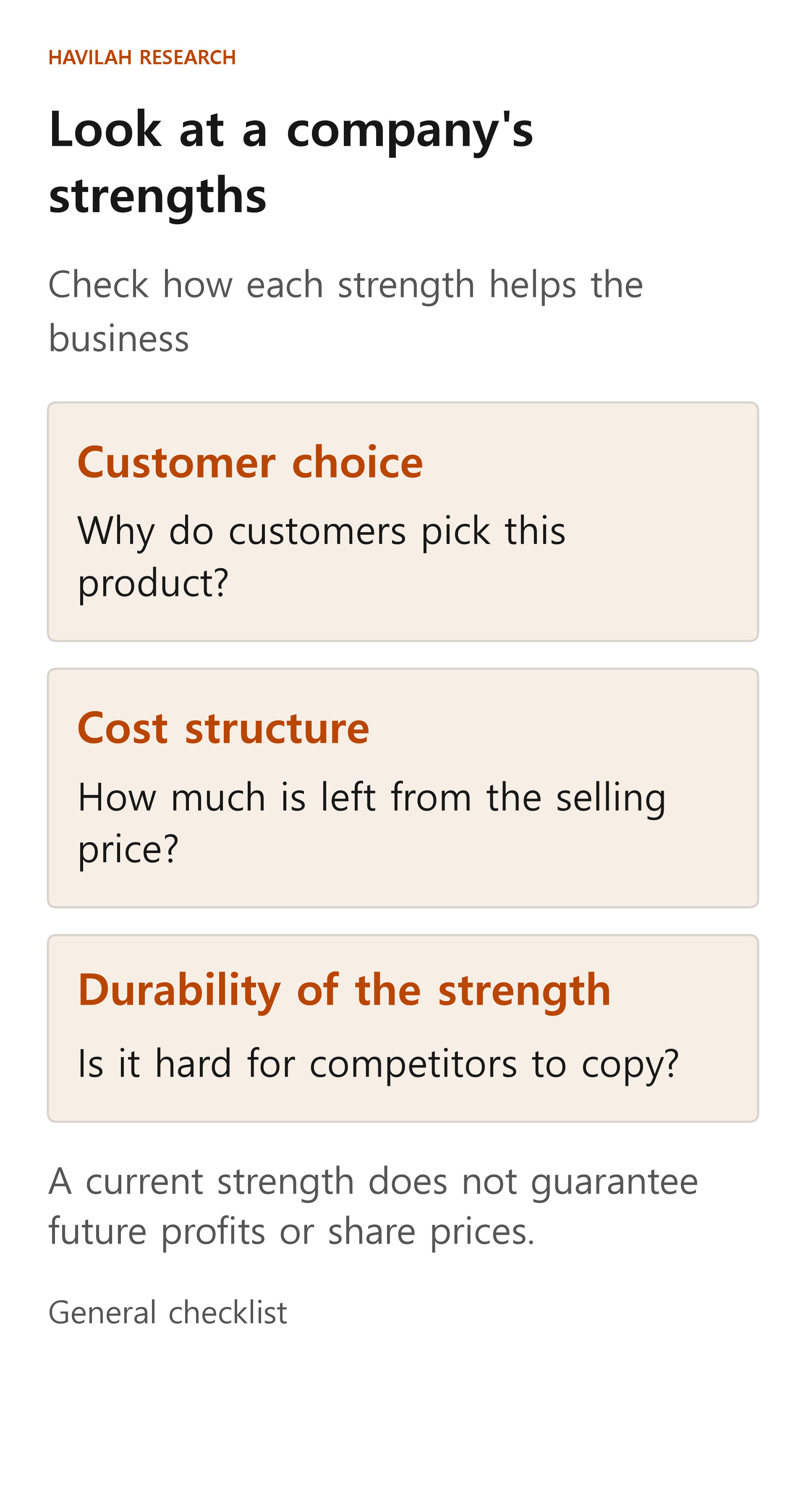
Strengths go beyond cost
Customers may trust a brand and keep coming back to it, or like a product's performance and service better than a competitor's and so be willing to pay a higher price. When a company keeps solving its customers' problems, they also have fewer reasons to switch elsewhere.
Business customers may have to spend time and money on staff training and data transfer when they move to new software. These are the switching costs you learned about earlier. Even when an existing product has this advantage, customers can leave if a competitor's product becomes much better or moving becomes easier.
You can also look at how a company describes itself. In its annual report, the U.S. electronics retailer Best Buy describes the knowledge of its employees, its store and online services and its supply chain, among other things, as competitive strengths. At the same time, it states that some competitors compete on price with lower cost structures. This is the company's own description, and you need to check separately how long the strengths will actually last.
How can you tell whether a strength is real?
Start by looking at why customers choose the product. Whether it is the price, ease of use, or service and trust affects how competitors might catch up.
Next, compare the company's revenue, costs and profit margins with its competitors' over several periods. It is often hard to compare the same products under similar conditions, so you need to work out why any difference arose. Do not conclude that a temporary cost cut or one unusual year of results is a lasting strength.
It also matters whether customers are moving to other products more often and whether competitors are launching similar features. Companies do not disclose how every customer behaves, so record the facts you have confirmed separately from your estimates.
A good business is not the same as a good price to invest
Even an excellent company can lose its edge because competitors catch up, technology changes or costs rise. A company earning high profits today will not necessarily keep earning them forever.
And knowing that a company is good does not tell you whether the price you would pay for its shares today is reasonable. As an investor, you need to look at both how long the company's strengths can last and what expectations the current share price already reflects.