
Even if you think the semiconductor industry will grow, you may have no idea which company to research first. Companies that design the products, companies that sell equipment and companies that handle manufacturing do not all make money in the same way.
When that happens, start by drawing an industry map. Write down the roles needed for a product to be made and sold, then mark where each company you are interested in sits. This helps you check what each business actually does, instead of grouping companies together because their names sound alike.
First, write down what each company does
For example, if you are researching semiconductors, you can separate companies that design the chips, companies that supply production equipment, companies that actually manufacture the chips and customers that use them as components. One company may play several roles or hand part of its work to outside firms, so a simple classification does not tell the whole story.
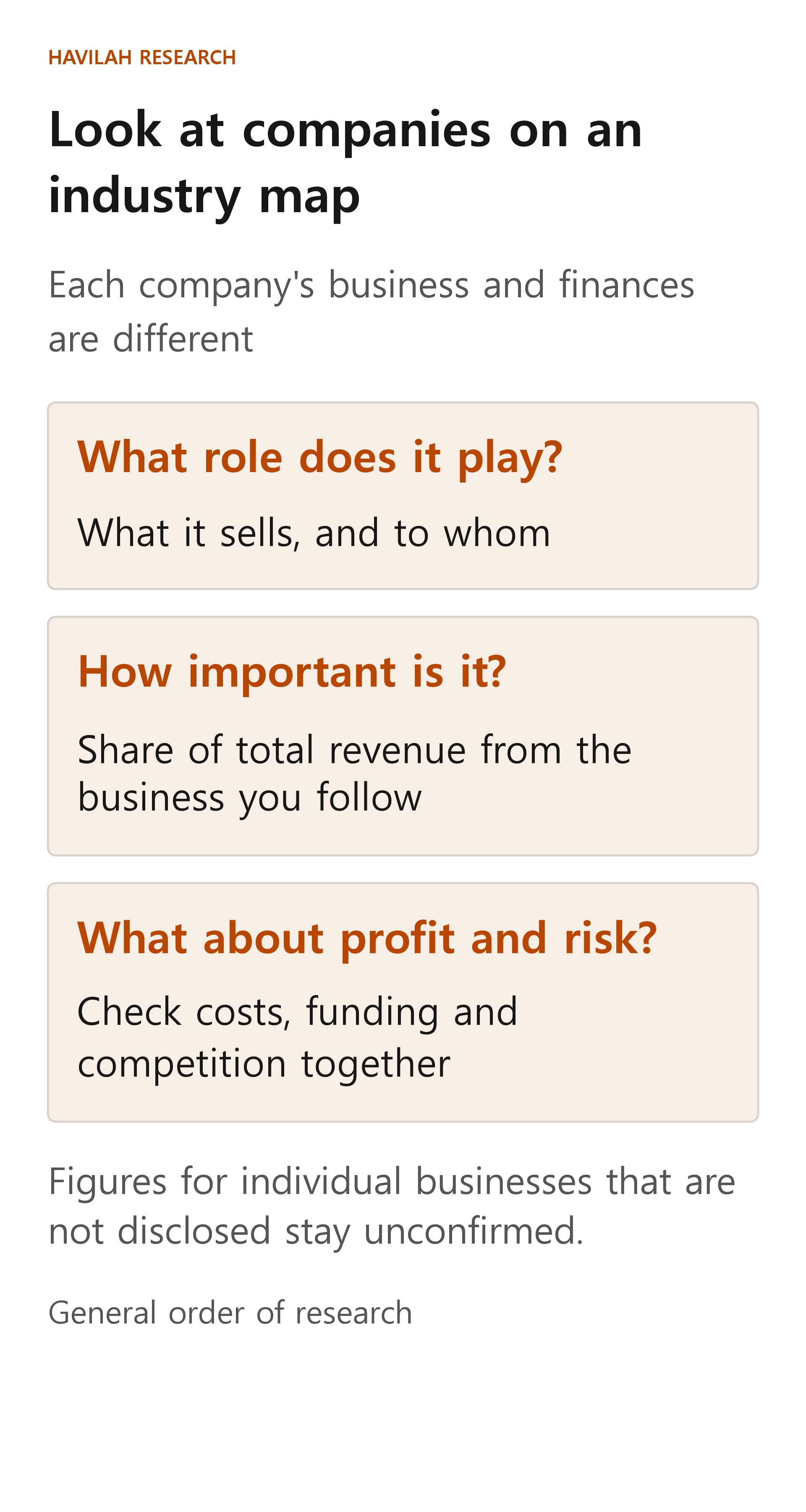
Next to each company, write down three things: what it sells, who buys it, and how much of the company's revenue that business makes up. Supplying products to the industry you are interested in is not the same as the whole company depending heavily on that industry.
Calculate the share of the business you are interested in
Suppose two hypothetical companies, Company A and Company B, both supply products to the same industry. Company A earned $200 from the business you are interested in, out of total revenue of $1,000 for the year. Company B earned $240 from that business, out of total revenue of $400.
Company A: revenue from the business of interest $200 ÷ total revenue $1,000 × 100 = 20%.
Company B: revenue from the business of interest $240 ÷ total revenue $400 × 100 = 60%.
Company B is smaller overall, but the business you are interested in makes up a larger share of its revenue. This share is a clue to how important that business is to the company. It does not mean, however, that if demand in the industry rises by 10%, the company's total revenue will rise by some fixed proportion. Customers, competitors, prices and how much the company is able to supply all play a part.
If the revenue share is high, should you invest right away?
No. In the hypothetical example above, assume Company A's annual operating income is $100 and Company B's is $20. Operating income is the amount left from a company's operating activities after its costs are subtracted.
Company A's operating margin is $100 ÷ $1,000 × 100 = 10%.
Company B's operating margin is $20 ÷ $400 × 100 = 5%.
What we calculated here is the operating margin of each company as a whole, not the margin of the business you are interested in on its own. B has a higher share of revenue from that business, but its overall operating margin is lower than A's. These numbers alone cannot decide which company is the better investment. You also need to look at the share price, future results, debt and risks.
If the data is missing, leave it blank
The annual report of a U.S.-listed company contains a description of its business, its financial statements and its main risks. Some companies disclose revenue or profit by business segment, but others do not report the products you are interested in separately. For example, the semiconductor company Diodes Incorporated explains that it operates as a single segment for financial reporting purposes. Reporting as a single segment does not, on its own, mean that there is no other information by product at all. If the numbers are not there, do not invent a share to fill the gap. Record it as unconfirmed.
The way segment profit is calculated can also differ from company to company. Some companies use their own measures that leave out certain costs. Do not compare different measures as if they were the same operating income. Check what each one includes.
Finally, narrow down your candidates
After you pick a few companies of interest from the industry map, move on to the next questions. Check who the customers of that business are, whether the company has strengths that are hard for competitors to take away, and whether it has enough facilities and money to grow.
Then look at how much expectation is already built into the current share price. Deciding that an industry and a company are good does not automatically tell you what price to pay. Narrowing down candidates sets the order of your research. It does not mean you have made the decision to buy.