
If there is only one bakery in your neighborhood, is it easy for that shop to raise its prices? If there are ten bakeries nearby, is it easy for customers to switch to another one?
Questions like these matter when you look at stocks, too. Even if a company makes good products, it may struggle to raise prices if customers can easily choose a similar product. On the other hand, even a company with few competitors cannot set prices however it likes if customers can put off buying or solve their problem some other way.
Counting competitors is not enough
Picture a hypothetical market where four companies sell the same product. In the first market, each of the four companies has 25% of total sales.
The second market also has four companies. But assume that one company sells 70% and the other three sell 10% each. The number of companies is the same, but the way sales are divided is different.
Market share is the portion of a defined market that one company holds. For example, if total sales are 100 units and one company sold 70 of them, its market share by units sold is 70%.
In the first market, the shares of the top two companies add up to 50%. In the second market, the largest company's 70% plus the next company's 10% comes to 80%. How heavily a market's sales are concentrated in a few companies, as measured this way, is called market concentration.
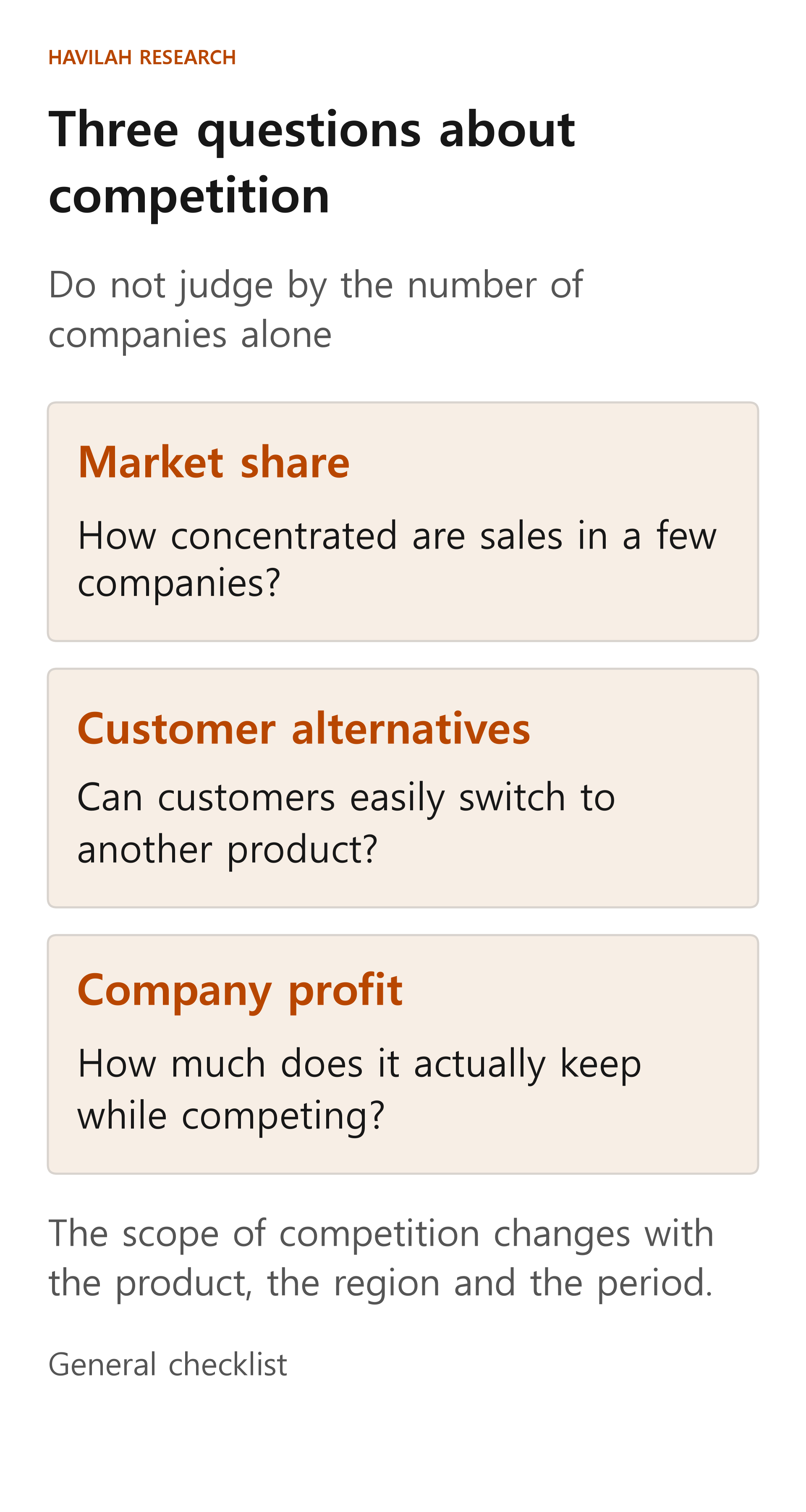
A high market share does not guarantee that a company will keep earning large profits or that its share price will rise. If a small competitor launches a new product, or customers change what they look for when they buy, market share can shift as well.
Is it easy for customers to move elsewhere?
If there are many similar products and switching costs little money and time, customers can compare price or quality and move easily. A company then has to consider the risk of losing customers whenever it raises prices.
In other cases, a customer who wants to switch to another product may have to retrain staff or move existing data. These costs and inconveniences are called switching costs. When switching is hard, that can help the existing company keep its customers. But if its prices or service get worse, customers may eventually look for an alternative.
Competition is not only about price. The U.S. discount retailer Dollar General explains in its annual report that it competes on a number of factors besides price, such as store location, product range, quality and service. First find out what the important points of competition are in the industry you are looking at.
Define the market before you compare
When you see a figure such as "this company's market share is 70%," check what it was calculated on. The percentage changes depending on whether it covers the global market or one particular country, and whether it combines all products or looks at just one kind of product.
Market share calculated on units sold can also differ from market share calculated on revenue. For example, a company that sells a lot of low-priced products may lead in the number of units sold but trail other companies in sales value. Make sure the companies you want to compare are measured on the same products, regions and period.
When you invest, look beyond the numbers
First, look at what the company offers that is different from its competitors. Check how product performance, price, service and customer relationships affect buying decisions.
Next, look at how easily customers can switch to a different product, and whether new companies can enter the market. The fact that a company has few competitors is not enough, on its own, to conclude that it can raise prices at will or keep earning high profits.
Finally, check how the competitive situation shows up in actual revenue and costs. If a company cut its prices or greatly increased its advertising spending to sell more, its profit may be smaller than expected even if its market share rises. Reading the shape of the market together with the company's numbers is the place to start.